For years, CUSMA compliance was the cornerstone of cross-border ecommerce between Canada and the United States. Qualifying goods moved duty-free. The paperwork was manageable. The model worked.
That assumption has now changed for a significant category of Canadian-origin products.
On July 20, 2026, President Trump signed three proclamations under Section 338 of the Tariff Act of 1930, imposing an additional 50% duty on specified Canadian-origin goods. As Reuters reported, the move came amid broader USMCA renegotiation pressure and covers approximately US$20 billion worth of Canadian imports. The tariffs are scheduled to take effect at 12:01 a.m. Eastern Time on August 19, 2026.
Critically, the Section 338 tariffs apply regardless of whether a product qualifies for preferential treatment under CUSMA. CUSMA compliance may continue to eliminate the normal customs duty, but it will not protect covered products from this separate additional charge.
For Canadian brands selling into the United States, and for U.S. businesses importing from Canadian suppliers, the question is no longer whether this affects you. It is whether your specific products are covered, and what you do before August 19.
In case you are still navigating the broader context of cross-border trade after earlier tariff developments, the Ecom Logistics guide to cross-border ecommerce after the Supreme Court tariff ruling covers the structural background behind where Canada-U.S. trade now stands.
What the Section 338 Tariff Actually Covers
Section 338 of the Tariff Act of 1930 allows the President to impose additional duties of up to 50% on goods from any country found to discriminate against U.S. commerce. It has not previously been used in the modern trade era to impose broad tariffs on a major trading partner like Canada. The three proclamations each target a different dispute with Canada, covering motor vehicles, alcoholic beverages, and dairy, but the actual product lists extend well beyond those three headline categories.
Scroll down to Annex II of each proclamation and the list broadens fast beyond the headline sectors. Clothing, furniture, wigs, cement, plywood, wine, hockey sticks, fishing rods, seeds, and swimming pools all appear. If your products fall into any of these categories, the tariff may apply to you even if your business has nothing to do with motor vehicles, alcohol, or dairy. The U.S. Trade Representative puts total exposure at nearly US$20 billion, covering approximately 5% of all goods the U.S. imported from Canada in 2025.
Products excluded from the Section 338 tariffs include energy products, potash, fish, certain critical minerals, and goods already subject to Section 232 tariffs on steel, aluminum, and copper. Civil aircraft and parts under specific provisions are also excluded. Everything else is determined by the product’s precise HTSUS tariff code, not its general description.
If your compliance review stopped at motor vehicles, alcohol, and dairy, there is a good chance you have not found your actual exposure yet.
| Proclamation | Trade Dispute Cited | Example Products Covered |
| Motor Vehicles | Canada’s 2025 surtax on U.S.-origin vehicles and tariff-rate quotas | Motor vehicles, cement, plywood, furniture, hockey sticks, swimming pools, seeds, fishing rods |
| Alcoholic Beverages | Provincial liquor board restrictions on U.S. alcohol purchases | Wine, beer, spirits, and related beverage products |
| Dairy | Canada’s administration of dairy tariff-rate quotas under CUSMA, which the U.S. argues disadvantages American dairy suppliers. | Dairy products including milk, cream, cheese, and related goods; also clothing, wigs, cosmetics |
All three proclamations impose a uniform 50% additional duty. Coverage is determined by the specific HTSUS code in each proclamation’s Annex II, not the headline category.
Why CUSMA No Longer Protects Covered Products
This is the part that catches most businesses off guard.
Under CUSMA’s standard framework, goods that meet the rules of origin and are properly documented can enter the United States duty-free. That framework remains in place for products not covered by the new Section 338 proclamations. However, products otherwise eligible for preferential treatment under CUSMA remain fully subject to the additional 50% Section 338 duty. There is no CUSMA carve-out in any of the three proclamations.
In practical terms: a Canadian product that previously entered the United States at zero duty under CUSMA could now face an additional 50% charge on its customs value, on top of any other applicable duties, taxes, and fees. A valid certification of origin is still required where a business is claiming CUSMA treatment, but it will not eliminate the Section 338 duty for covered goods.
Unlike Section 122 of the Trade Act of 1974, Section 338 carries no fixed expiration date, leaving these tariffs in effect indefinitely unless the president acts to modify or terminate them. This is not a temporary surcharge with a scheduled end date.
Why the August 19 Customs Entry Date Is the Critical Detail
The tariff does not trigger on the date an order is placed, the date an invoice is issued, or the date a parcel leaves Canada. The tariffs apply to goods entered for consumption, or withdrawn from warehouse for consumption, on or after 12:01 a.m. Eastern Time on August 19, 2026.
That means:
A shipment sent from Canada before August 19 but cleared through U.S. customs after August 19 may still face the new duty.
Goods already sitting in a U.S. foreign trade zone are not automatically protected. Covered goods admitted to a U.S. foreign trade zone on or after August 19 must enter under privileged foreign status and will be subject to the Section 338 tariff upon consumption entry.
The relevant date is the customs entry date, not the shipping date. Businesses with inventory in transit or arriving close to the deadline should confirm the entry timing with their customs broker immediately.
What This Means for Ecommerce Businesses
For Canadian brands selling into the United States:
The most immediate impact is a potential reset in landed cost for covered products. A product with a customs value of US$100 that previously entered duty-free under CUSMA could now carry an additional US$50 duty before brokerage fees, processing charges, and taxes are added. For ecommerce brands operating on standard retail margins, that is not an adjustable rounding error. It is a structural change to the economics of cross-border selling.
Brands need to recalculate landed costs across their full catalogue, not just the three headline sectors. If direct cross-border shipping remains part of the model for affected products, the question of who absorbs the duty, the brand or the customer, needs to be resolved before August 19. Delivered Duty Paid shipping will prevent customs surprises at the door but requires the cost to be factored into pricing. Delivered Duty Unpaid arrangements risk refused deliveries, chargebacks, and customer experience damage.
For U.S. businesses importing from Canadian suppliers:
The same cost reset applies from the importer side. Purchase orders placed before the effective date, inventory arriving near the deadline, and customer pricing agreements that predate the proclamations may all be affected. Importers should confirm with their customs broker how entries will be declared on or after August 19, review contracts to determine who absorbs new duties, and recheck pricing arrangements with Canadian suppliers.
What to Do Before August 19
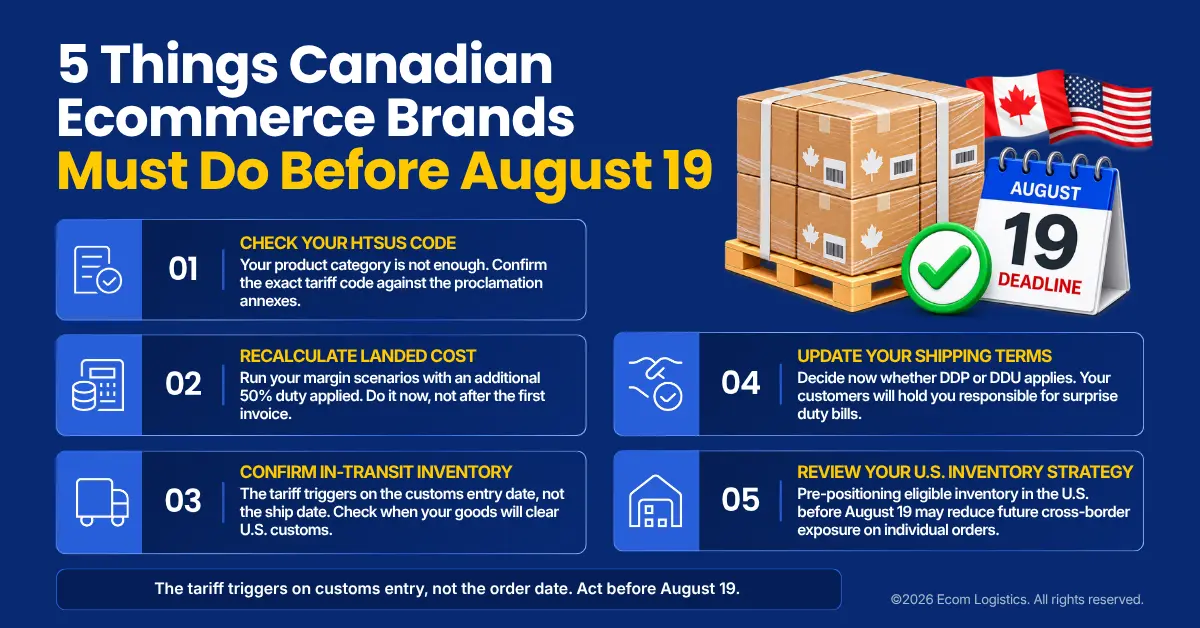
Review Every Product at the HTSUS Code Level, Not the Category Level
A general product description is not sufficient to determine whether the new duty applies. The correct HTSUS classification for each affected SKU must be confirmed against the proclamation annexes. A product that sounds unrelated to motor vehicles, alcohol, or dairy may still appear in one of the broader annex lists.
Recalculate Landed Cost With the 50% Duty Included
Run pricing and margin scenarios for every product that may be covered. Understand the full impact before the effective date, not after the first invoice arrives.
Confirm the Customs Entry Timing for Inventory in Transit
Speak with your customs broker about any shipments currently in transit or arriving near August 19. Understand exactly when those goods will be entered for consumption and whether any action is available to accelerate or adjust entry timing.
Review Your Customer-Facing Shipping Terms
Decide whether DDP or DDU applies to affected products and update checkout pricing and terms before the effective date. Customers receiving unexpected duty bills after August 19 will hold the brand responsible regardless of the legal structure.
Consider U.S. Inventory Positioning for High-Volume Products
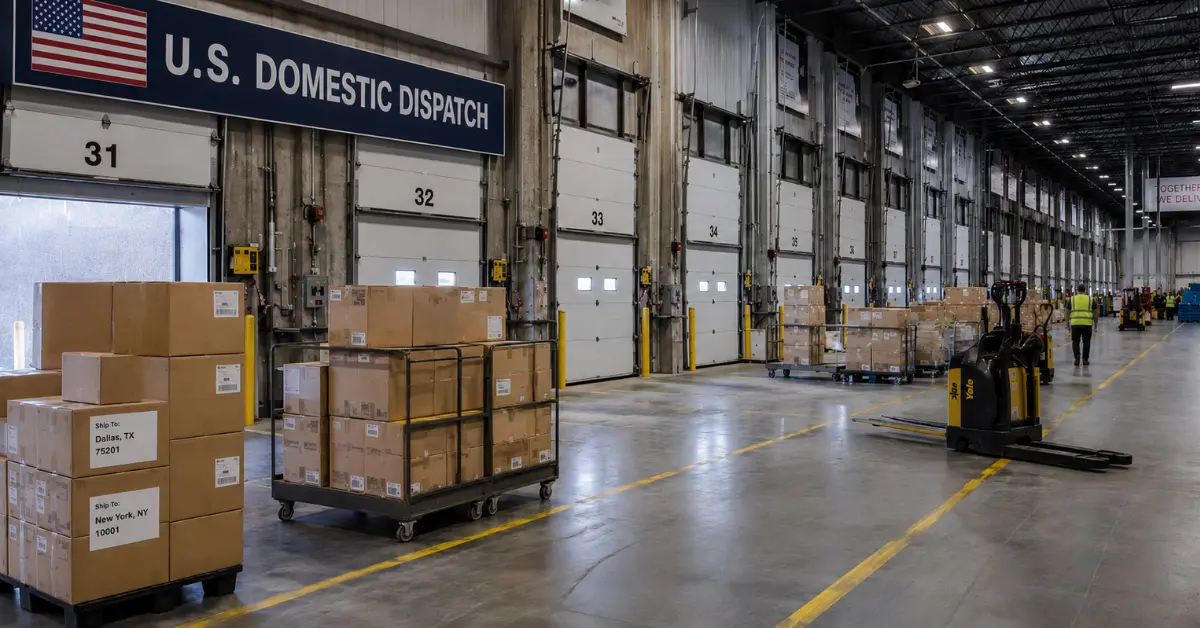
For brands with consistent U.S. demand on covered products, pre-positioning eligible inventory in the United States before August 19 may reduce future exposure to repeated cross-border duties on individual shipments. Once inventory has been properly imported and is available for domestic fulfilment, U.S. customer orders can ship within the United States rather than crossing the border each time.
This is not a guaranteed tariff exemption. The duty treatment of the initial import still depends on the product’s classification, origin, entry timing, and customs arrangements. Businesses should confirm this with a licensed customs broker or trade adviser before making inventory decisions.
How U.S. Fulfilment Can Support Your Cross-Border Strategy
For ecommerce brands with consistent U.S. demand, holding inventory in a U.S. fulfilment centre provides several operational advantages that become more significant as cross-border costs increase.
Once Canadian-origin inventory has been properly imported into the United States, individual customer orders ship domestically. There is no border crossing, no per-order brokerage fee, no customs processing charge, and no risk of a customer receiving a duty bill at their door. Delivery is faster, more predictable, and more cost-efficient at scale.
“The brands that are thinking ahead on this are the ones reviewing their U.S. inventory strategy now, not in September,” says Tammy Huynh, Commercial Director Fulfilment at Ecom Logistics. “Whether a product is ultimately covered by the new tariffs or not, having U.S.-based inventory for your highest-demand SKUs is a more resilient model for cross-border ecommerce. It removes a layer of cost and uncertainty from every single order.”
Ecom Logistics operates warehouses across Canada and the United States, including facilities in Virginia and Pennsylvania, supporting brands operating across both markets. Our U.S. expansion positions us to support Canadian brands and U.S. importers who need domestic American fulfilment as cross-border costs rise. Services include B2B and B2C fulfilment, inventory management, order processing, pick-and-pack, domestic shipping, returns handling, and real-time inventory visibility through an integrated WMS. For brands evaluating their fulfilment strategy before August 19, Ecom Logistics can support inventory positioning, domestic U.S. fulfilment, and multi-location inventory management across the Canada-U.S. network.
The right approach will vary by product, demand profile, customs classification, and inventory volumes. Businesses should review their specific products and import plan with their customs broker and fulfilment partner together.
The Tariff Could Still Change: How to Stay Flexible
These tariffs arrive against a backdrop of broader Canada-U.S. trade uncertainty. Canada and the U.S. are engaged in USMCA/CUSMA joint review talks, but have not yet reached agreement to renew the deal or adjust these tariffs.
The tariffs could be amended, suspended, or withdrawn through government action or a negotiated agreement before or after August 19. Legal challenges in the U.S. Court of International Trade are anticipated. Canada has stated it remains open to negotiation while reserving the right to take protective measures. AP News has reported on the ongoing negotiations between the two countries as both sides weigh their next steps before the effective date.
These tariffs remain in effect indefinitely unless and until the president issues a new proclamation modifying, suspending, or terminating them. Until an official change is announced, businesses should plan for the scheduled effective date while building flexibility into their inventory and fulfilment decisions.
Watching for updates from the White House, U.S. Customs and Border Protection, and the Canadian government in the days before August 19 is essential. Any change to the proclamations will come through official channels.
Conclusion: CUSMA Was the Foundation. Now You Need a New Layer.
The cross-border ecommerce model between Canada and the United States has been built, for many brands, on the assumption that CUSMA compliance equals duty-free entry. For covered products after August 19, that assumption no longer holds.
The right response is not panic. It is preparation. Review your product classifications, recalculate your landed costs, confirm your in-transit inventory, and assess whether U.S. inventory positioning makes sense for your highest-volume SKUs. None of these actions require certainty about whether the tariffs will ultimately proceed as scheduled. They are the right operational steps regardless.
Ecom Logistics offers ecommerce fulfilment across Canada and the United States. If you are reassessing your cross-border fulfilment strategy before August 19, now is the time to act. Ecom Logistics offers U.S. warehousing, domestic fulfilment, and an inventory approach built for a changing trade environment.
Frequently Asked Questions
Section 338 of the Tariff Act of 1930 authorises the U.S. President to impose additional duties on goods from countries found to discriminate against U.S. commerce. On July 20, 2026, President Trump signed three proclamations under this authority imposing a 50% additional duty on specified Canadian-origin products, effective August 19, 2026. It is the first time Section 338 has been used in the modern trade era to impose broad tariffs on a major trading partner like Canada.
No, for covered products. CUSMA preferential treatment may still eliminate the standard customs duty on qualifying goods, but it does not remove the additional 50% Section 338 duty for products listed in the proclamation annexes. A valid certification of origin is still required where CUSMA treatment is claimed, but it will not protect covered goods from the new charge.
The proclamations focus on three headline sectors: motor vehicles, alcoholic beverages, and dairy. However, the Annex II lists in each proclamation extend to a much broader range of products including cement, furniture, plywood, clothing, wine, hockey equipment, fishing rods, seeds, cosmetics, and chemicals. The precise HTSUS tariff code, not the product name, determines whether a specific product is covered.
The tariff applies to goods entered for U.S. consumption, or withdrawn from a U.S. warehouse for consumption, on or after 12:01 a.m. Eastern Time on August 19, 2026. The relevant date is the customs entry date, not the order date or the shipping date.
Not automatically. If goods are shipped from Canada before August 19 but are not entered for U.S. consumption until after that date, the Section 338 duty may still apply. Businesses should confirm the expected customs entry timing with their broker for any shipments arriving close to the deadline.
U.S.-based inventory can help reduce future cross-border shipment exposure by enabling domestic fulfilment for U.S. customer orders. However, it is not a guaranteed tariff exemption. The duty treatment of the initial import into the United States still depends on the product’s classification, origin, entry date, and customs arrangements. Confirm your specific situation with a licensed customs broker before making inventory decisions.
Unlike Section 122 tariffs, which had a fixed 150-day limit, Section 338 carries no expiration date. The tariffs remain in effect indefinitely unless the president issues a new proclamation modifying, suspending, or terminating them. They could be changed through government action or a Canada-U.S. trade agreement, but no automatic expiry applies.
Confirm the correct HTSUS classification for every potentially affected product. Check those codes against the Section 338 proclamation annexes. Recalculate landed costs with the additional 50% duty included. Review in-transit inventory and confirm customs entry timing with your broker. Assess whether U.S. inventory positioning makes operational sense for your highest-demand products. Update customer-facing shipping terms to reflect the new cost structure.
- About the Author
- Latest Posts