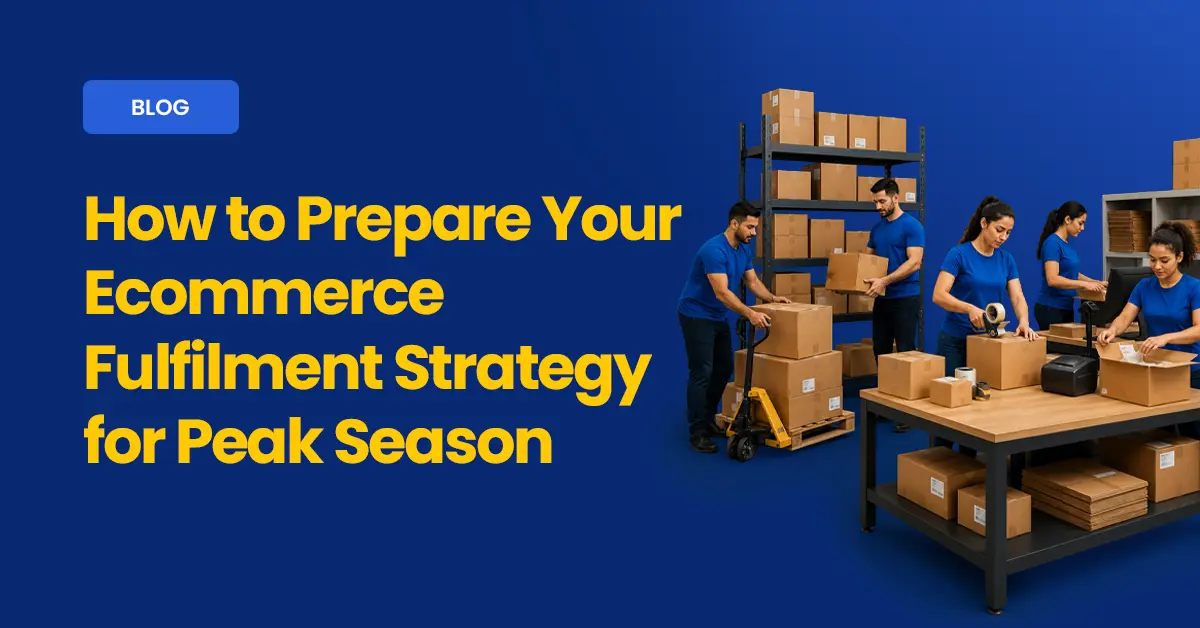
Peak season does not arrive without warning. The dates are known months in advance. The volume spike is predictable. The carrier pressures are documented every year. And yet, a significant share of ecommerce brands still find themselves reacting to Q4 rather than performing in it. The difference is not marketing spend or product selection. It is fulfilment preparation.
Ecommerce peak season fulfilment is where the gap between a prepared operation and an unprepared one becomes visible to customers. A brand whose warehouse, carrier network, inventory positioning, and delivery infrastructure were stress-tested before peak arrives will outperform one that tried to figure it out in November. Understanding the most common ecommerce fulfilment mistakes is the right starting point before building a peak season strategy that avoids repeating them.
This blog walks through the five areas that determine peak season fulfilment performance and what to have in place in each one before volume arrives.
Why Peak Season Breaks Ecommerce Fulfilment Operations
The stakes are not abstract. For many retailers, the holiday season accounts for up to 32% of their annual revenue, according to Capital One Shopping’s holiday shopping statistics. That concentration means a fulfilment operation that degrades under volume does not just create a bad customer experience. It undermines the most important revenue window of the year.
What causes peak season fulfilment to break is rarely a single failure. It is the compounding of existing gaps under pressure. Inventory systems that are slightly inaccurate at normal volume become critically inaccurate when order velocity triples. Carrier arrangements that are adequate at baseline buckle when every brand is competing for the same capacity simultaneously. Warehouse processes that work with ten staff members do not automatically scale with thirty.
Peak season exposes what already exists. The brands that prepare in Q2 and Q3 are the ones whose operations hold in Q4.
Prepared vs. Unprepared: A Peak Season Fulfilment Comparison
| Area | Unprepared Operation | Prepared Operation |
| Inventory | Reacting to stockouts mid-peak | Safety stock positioned before Q4 |
| Warehouse capacity | Throughput degrades as volume spikes | Capacity stress-tested and confirmed pre-peak |
| Staffing | Hiring and training during peak | Fully trained team in place before October |
| Carrier strategy | Single carrier, no contingency | Multi-carrier routing, surcharges confirmed |
| Last mile delivery | Partner buckles under peak volume | Surge capacity confirmed, no peak load charges |
| Returns | Reactive, January backlog builds | Process designed and in place before peak |
| Technology | Systems slow or fail under order velocity | WMS and OMS tested at peak volume |
Start Earlier Than You Think You Should
The single most consistent mistake ecommerce brands make with peak season fulfilment preparation is starting too late. August is not early. By September, carrier contracts are being finalised, warehouse space is being allocated, and inventory needs to already be on its way to fulfilment centres.
The preparation timeline that works looks like this: demand forecasting and inventory decisions in Q2, carrier and delivery partner conversations in early Q3, warehouse capacity and staffing confirmed by mid-Q3, systems testing completed before October. What follows from October is execution, not planning.
If you are reading this in Q3 and have not started, the most urgent actions are inventory positioning and carrier confirmation. Everything else can be compressed. Those two cannot.
Step 1: Get Your Inventory Right Before Everything Else
Inventory is the foundation of peak season fulfilment. Every other part of the operation depends on having the right stock, in the right location, at the right time. An accurate demand forecast that does not translate into positioned inventory is not a plan: it is a spreadsheet.
The questions to answer before peak season: which SKUs drove the highest volume last Q4, and are they stocked at sufficient depth? Where is inventory positioned relative to where your customers are concentrated? What is your safety stock level for your top 20 SKUs, and is it calibrated to peak velocity rather than average velocity?
Overstocking and understocking both cost money during peak, just in different ways. Overstocking ties up capital and creates returns problems in January. Understocking means lost sales and customer acquisition cost that generated no revenue. The goal is not maximum stock: it is accurate stock positioning. What role inventory management plays in ecommerce fulfilment success covers the operational detail behind getting this right at volume.
Step 2: Prepare Your Fulfilment Operation for Multi-Channel Demand
Peak season does not spike one channel. It spikes all of them simultaneously. Your own site, your marketplace listings, any wholesale or B2B commitments you have, all of them accelerate at the same time. A fulfilment operation built around single-channel volume will show that limitation quickly when multi-channel orders arrive together.
Whether you manage fulfilment in-house or through a 3PL partner, warehouse capacity needs to be assessed against peak volume, not average volume. That means knowing your maximum daily order output, pick and pack throughput at full staffing, and whether the WMS can handle peak order velocity without creating processing delays. If you are working with a 3PL, this is the conversation to have in Q3: ask specifically what their capacity ceiling is at your projected peak volume, and whether your account will receive the same service level when every brand on their network is surging simultaneously. Why ecommerce fulfilment breaks as you scale identifies the specific pressure points that surface when volume increases rapidly: they are predictable, and most of them are preventable with the right preparation.
For brands managing fulfilment in-house, staffing is the variable most commonly underestimated. Temporary peak season labour needs to be recruited, onboarded, and process-trained before peak begins, not during it. A new hire on the warehouse floor in the first week of December is a liability, not an asset. For brands on a 3PL, the equivalent question is whether your partner has the staff headcount and contingency planning already built into their peak season operation, and how you would know if they did not.
Step 3: Sort Your Carrier Strategy Before Rates Spike
Carrier surcharges, peak load fees, and rate increases during Q4 are predictable. They happen every year. The brands that protect their margins are the ones that have carrier diversification and delivery partner agreements locked in before the season starts, not after they have already absorbed the cost.
Single-carrier dependency is a particular risk during peak season. When every brand is competing for the same carrier capacity simultaneously, a provider that cannot accommodate your volume will deprioritise your orders without telling you. The result is shipping delays your customers experience before you do.
The fix is carrier diversification: working with multiple carriers so that no single network disruption, capacity constraint, or rate spike can hold your entire fulfilment operation hostage. Well-prepared ecommerce brands typically work with anywhere from four to six carriers across their peak season operation, spreading volume across networks based on destination, speed requirement, and cost. If your current setup relies on one or two carriers, expanding that mix before Q4 is one of the highest-return preparations you can make. A 3PL partner with an established multi-carrier network removes the complexity of building those relationships independently, giving you access to carrier diversification that would take months to negotiate on your own.
Step 4: Make Sure Your Last Mile Delivery Can Handle the Volume
Fulfilment hands off to delivery at the carrier dispatch point, and this is where most brands lose visibility. 98% of consumers say the delivery experience impacts their brand loyalty, according to Clickpost’s last mile delivery statistics. During peak season, when your order volume is at its highest and your customers’ expectations are at their most acute, the delivery partner you have chosen is representing your brand on every doorstep.
Ask your delivery partner the same questions you would ask at any other time of year, but with peak season specificity: what is your surge capacity? How do you handle volume spikes across your network? What happens to your first attempt delivery success rate during Q4? Do you have additional fleet or carrier capacity reserved for peak period demand?
A delivery partner without clear answers to these questions is a risk that will show up in your customer experience during the worst possible window. Ecom Logistics offers same-day and next-day delivery across major Canadian cities with a fleet of over 500 vehicles, no peak surcharge, no fuel surcharge, and dedicated account management that scales with your volume rather than deprioritising it.
Step 5: Plan Your Returns Before the Rush Arrives
January is the busiest returns month of the year. The volume arrives predictably, as a direct consequence of peak season sales, and yet most brands plan their peak season fulfilment strategy entirely around outbound flow and absorb the reverse logistics consequences reactively in Q1.
A returns process that is not built before peak will create inventory inaccuracies in January, delayed refunds that generate customer service pressure, and warehouse floor congestion that affects outbound operations. The time to design the inbound receiving workflow, the condition assessment process, and the system updates that keep returned inventory visible is before peak, not after.
The question to answer now: when a return arrives at your warehouse dock in January, what happens to it? If the answer is not specific and documented, the returns process is not ready for peak season volume.
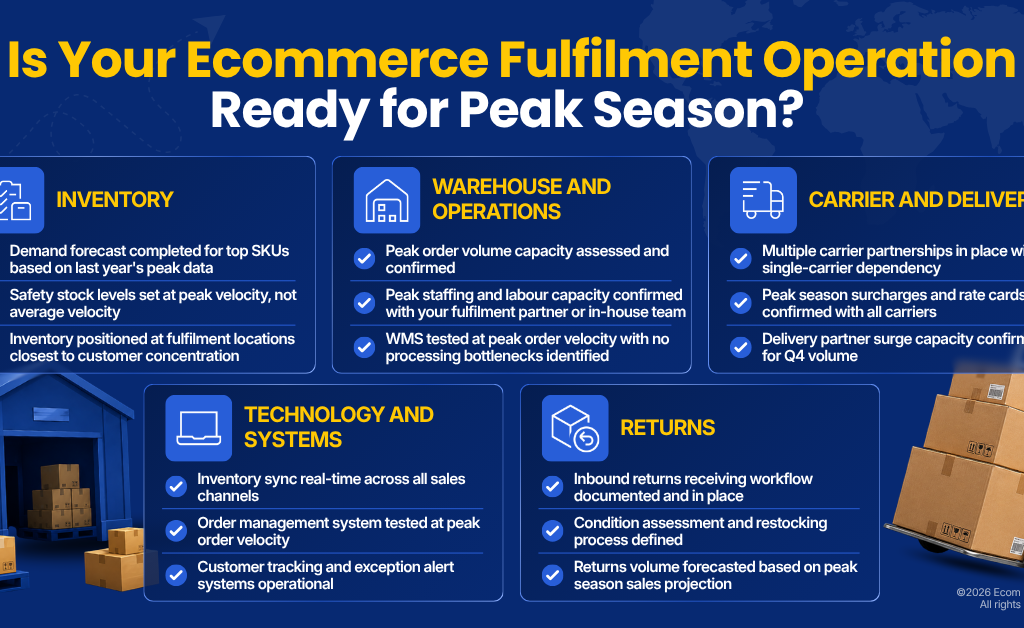
Peak Season Fulfilment Readiness Checklist
Conclusion: Peak Season Fulfilment Performance Is Decided Before Q4 Arrives
“The brands that call us in October asking for peak season capacity are the ones we have to have a difficult conversation with,” says Tammy Huynh, Commercial Director at Ecom Logistics. “The brands that are ready in Q4 are the ones that had that conversation in Q2. Peak season fulfilment preparation is not something you can compress into the last six weeks. The infrastructure has to be in place before the volume arrives.”
Ecom Logistics offers ecommerce fulfilment and same-day and next-day last mile delivery with real-time inventory management, multi-carrier routing, no peak load charges, and dedicated account management built around consistent performance at volume.
If your ecommerce peak season fulfilment strategy has gaps that need closing before Q4 arrives, talk to our team.
Frequently Asked Questions
Q2 is the right starting point for demand forecasting and inventory decisions. Carrier and delivery partner conversations should happen in early Q3. Warehouse capacity, staffing, and systems testing should all be confirmed before October. By the time peak season arrives, preparation should be complete and execution should be the only task remaining.
Ecommerce peak season fulfilment refers to the operational processes that get orders picked, packed, and dispatched during the highest-volume periods of the retail calendar, primarily Q4 from October through December. It covers inventory positioning, warehouse capacity, carrier management, last mile delivery, and returns handling, all of which need to be designed for peak volume, not average volume.
Start with last year’s peak season data: which SKUs sold at what volume, across which channels, over which weeks. Layer in any growth trajectory from the current year and any new product launches or channel expansions. Set safety stock levels based on peak velocity rather than average velocity, and confirm inventory is positioned at fulfilment locations closest to where your customer base is concentrated.
The most common are starting preparation too late, relying on a single carrier without contingency, understaffing the warehouse for peak throughput, failing to plan for returns volume, and not stress-testing WMS and order management systems at peak order velocity before the season begins.
Carriers apply peak load surcharges, fuel surcharges, and residential delivery fees during Q4, and these can add meaningfully to the per-order cost. The brands that protect margins are the ones that have multi-carrier routing and confirmed rate cards in place before the season starts, so they are not absorbing unexpected cost increases mid-peak.
Returns from peak season sales arrive primarily in January. A returns process that is not designed before peak will create inventory inaccuracies, delayed refunds, and warehouse congestion. The inbound receiving workflow, condition assessment process, and system updates that keep returned inventory visible should all be in place before peak season begins, not after.
Ask specifically about surge capacity: how does the partner manage volume spikes across their network, and what happens to their first attempt delivery success rate during Q4? Ask whether they apply peak load charges or additional surcharges during the season. Ask about carrier diversification and whether they have reserved fleet or carrier capacity for peak period demand.
Significantly. 98% of consumers say delivery experience impacts their brand loyalty, and during peak season, when order volumes are highest and customer expectations are most acute, delivery performance is directly visible to customers on every order. A delivery partner whose performance degrades under peak volume produces customer experience failures during the window when retention matters most.
- About the Author
- Latest Posts