A missed delivery window, a wrong item in the box, or a return request that disappears into silence are the moments that end relationships quietly, without the customer ever filing a complaint. They just do not come back.
Most ecommerce brands do not lose customers at checkout. They lose them after it.
Ecommerce fulfillment mistakes are far more common than the industry tends to acknowledge, and their cost is rarely captured in a single line item. It spreads across customer acquisition costs, refund processing, carrier re-deliveries, and the softer but very real erosion of repeat purchase rates. Research on fulfillment performance suggests a single picking mistake can cut into an order’s margin by up to 13% once you factor in returns handling, reshipment, and customer service time, and that is before accounting for the customer you may not see again.
This blog breaks down the most common fulfillment mistakes, what actually causes them operationally, and what a better approach looks like in practice.
The Most Common Ecommerce Fulfillment Mistakes
Fulfillment errors rarely announce themselves dramatically. They accumulate quietly across hundreds of orders until the pattern becomes visible in your return rate, your support volume, or your repeat purchase data. Most of them share a common thread: they are process failures, not people failures. And that means they are fixable. Here are the six that come up most consistently, and what really drives each one.
1. Inaccurate Inventory Management
Overselling a product that is not in stock is one of the most damaging ecommerce order errors a brand can make. The customer has already paid, their expectations are set, and the conversation that follows is almost always a negative one.
The root cause is usually a gap between what the warehouse management system says is on the shelf and what is physically there. This happens when inventory counts are not updated in real time, when SKU mapping is inconsistent across sales channels, or when returns are processed back into available stock before they have been inspected.
The fix is not simply counting more often. It is building a system where inventory levels update automatically at the point of pick, sale, and return receipt. For a detailed breakdown of how to structure this, this guide to inventory management in ecommerce fulfillment covers reorder points, safety stock, and demand forecasting in practical terms.
2. Poor Pick and Pack Accuracy
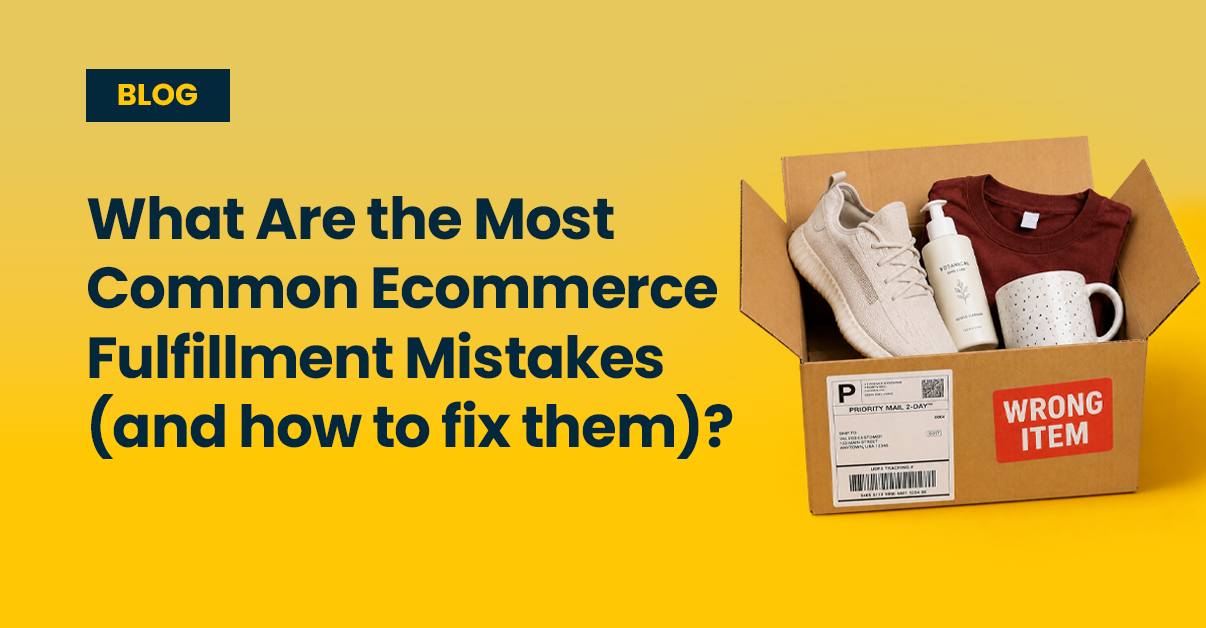
Wrong items, wrong quantities, or missing products in an order are the fulfillment mistakes customers experience most directly. And they generate the most vocal fallout: support tickets, social complaints, and returns that cost more to process than the original margin on the order.
Poor pick and pack accuracy is usually a process and environment problem, not a people problem (again). Warehouses with unclear bin labelling, high SKU density, similar-looking products stored adjacently, or no scanning verification at the packing station will produce errors at volume regardless of how careful individual pickers are.
Barcode scanning at the point of pick and a secondary verification step before sealing the box are the two most reliable interventions. Well-run 3PL operations typically hold order accuracy rates above 99.5%, and that figure is not achieved through supervision alone.
3. Over-Reliance on a Single Carrier

Shipping delays are one of the most visible fulfillment failures from a customer’s perspective, and a significant share of them trace back to a structural decision made well before any single shipment leaves the warehouse: using only one carrier.
When a brand ships exclusively through one carrier network, any disruption to that network becomes the brand’s problem. Weather events, carrier strikes, peak season capacity constraints, and price increases all land without a contingency. There is no backup routing, no rate comparison, and no leverage in negotiations.
Carrier diversification does not mean complexity. It means having the infrastructure to route orders through the most appropriate carrier for each shipment based on destination, speed requirement, and cost. A good 3PL provider handles this by default, which is one of the underappreciated operational advantages of outsourcing fulfillment rather than managing it in-house.
4. Treating Returns as an Afterthought
Returns are a fulfillment problem, not just a customer service one. When a return arrives at the warehouse without a clear process for inspection, restocking, or disposal, it creates inventory inaccuracies, delays refunds, and ties up capital in product that is sitting unprocessed.
Brands that treat returns as an edge case tend to build their fulfillment operations around outbound flow only. The result is a reverse logistics process that is reactive, manual, and slow. Processing a single return can cost anywhere from 20% to 65% of the item’s original value, according to Shopify’s analysis of NRF data, once you account for return shipping, inspection, and restocking. For high-volume ecommerce brands, that is not a rounding error on the P&L.
A robust returns process includes a clear inbound receiving workflow, condition-based routing for returned items (restock, refurbish, or discard), and system updates that reflect returned inventory in real time. This is not complicated to design, but it requires deliberate attention that many brands do not give it until returns volume forces it.
5. Choosing the Wrong 3PL Provider, or Outgrowing One Silently
One of the most consequential fulfillment mistakes to avoid is staying with a 3PL provider that is no longer a fit. The signs are gradual: error rates creep up, response times slow, your account stops receiving proactive communication when something goes wrong. Because the deterioration is incremental, many brands adapt around it rather than addressing it.
The wrong 3PL is not always a bad operation. It is sometimes simply one that was right for your brand at 500 orders a month but does not have the technology, capacity, or geographic coverage you need at 5,000. Fulfillment infrastructure needs to scale with the business, instead of lagging behind it.
When evaluating a fulfillment partner, the questions that matter most are: what is their order accuracy rate at your volume? And do they offer real-time inventory visibility? Our complete guide to ecommerce fulfillment covers what a well-structured operation looks like at each stage of growth.
6. Lack of Real-Time Visibility Across the Order Lifecycle
Customers who cannot see where their order is will contact support. That is not a theory; it is a predictable operational cost that scales linearly with order volume. But real-time visibility is not just a customer experience feature. It is an operational tool.
When a brand has genuine visibility into order status at every stage, from pick confirmation to carrier handover to last-mile progress, they can catch exceptions before they become failures. A stalled shipment can be re-routed. A delayed delivery can be communicated proactively. An inventory discrepancy can be flagged before it causes a mispick.
Brands that lack this visibility are not just inconveniencing customers. They are operating blind on one of the most consequential parts of their business.
Fulfillment Mistakes to Avoid During Peak Season
Peak season does not create new fulfillment problems. It exposes the ones that already exist.
Inventory inaccuracies that are manageable at normal volume become critical when orders double. Carrier over-reliance becomes a genuine crisis when network capacity tightens across every provider simultaneously. A returns backlog that was handled manually at baseline becomes a warehouse floor problem when November and December returns arrive in January.
The brands that perform consistently through peak periods are not the ones that hustle harder in Q4. They are the ones that have already built the systems, carrier relationships, and fulfillment infrastructure to absorb volume without the error rate climbing with it. Peak season is a stress test, and the results reflect decisions made months earlier.
If your fulfillment operation requires significant manual intervention to handle a volume spike, that is itself the signal that something structural needs attention. There is more on how to maintain fulfillment speed and visibility during peak that is worth reading before the next busy season arrives.
What Good Fulfillment Looks Like: A Benchmark Comparison
There is a version of fulfillment that most brands do not realise they are missing because they have never experienced it at close range. It does not look dramatic. Orders go out right, on time, every day. Returns come back in and get processed before they create a stockpile. Inventory numbers reflect reality. When something does go wrong, the brand finds out before the customer does.
That level of operational consistency is not reserved for enterprise businesses with in-house logistics teams. It is what a well-run fulfillment operation looks like at any scale, and the gap between that and a struggling one almost always comes down to a handful of the same structural decisions: whether inventory syncs in real time or relies on manual counts, whether carriers are selected dynamically or by default, whether returns have a defined workflow or get handled as they come.
The table below puts the contrast in concrete terms. If your current operation sits closer to the left column than the right on more than one of these, the issues are unlikely to resolve on their own.
| Metric | Underperforming Operation | Well-Run Operation |
| Order accuracy rate | 96-97% (roughly 1 in 25-30 orders has an error) | 99.5%+ consistently |
| Inventory sync | Manual updates, periodic counts | Real-time across all sales channels |
| Carrier mix | Single carrier, no contingency | Multi-carrier with dynamic routing |
| Returns processing | Reactive, manual, slow to restock | Structured inbound workflow, real-time updates |
| Customer tracking visibility | Basic carrier tracking link only | Real-time status from pick to delivery |
| Peak season performance | Error rates climb with volume | Consistent accuracy regardless of volume |
Conclusion: How the Right 3PL Partner Eliminates Most of These Mistakes
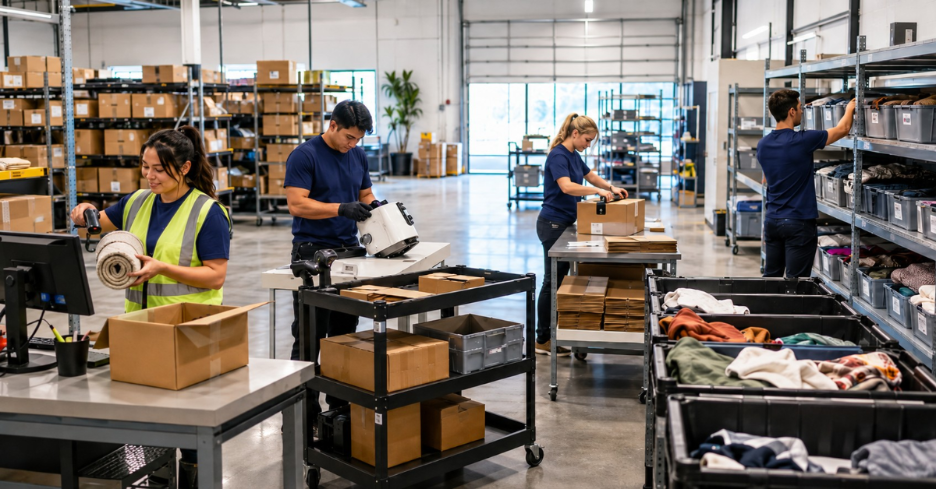
Most of the ecommerce fulfillment mistakes covered in this blog are not solved by working harder. They are solved by having the right infrastructure in place: warehouse technology that eliminates manual counting errors, a carrier network broad enough to absorb disruptions, and a returns process that handles volume without breaking down.
Building that infrastructure in-house is possible, but it is capital-intensive, time-consuming, and requires operational expertise that most ecommerce brands do not have as a core competency. For most scaling brands, partnering with a 3PL that has already built it is a significantly faster and more cost-effective path.
“The brands that come to us after fulfillment problems have usually been absorbing the cost for longer than they realise,” says Omar Laz, Senior Director Fulfillment at Ecom Logistics. “Order errors, carrier delays, and returns backlogs are not just operational inconveniences. They show up directly in customer retention numbers. Once we get them onto a properly integrated fulfillment system, the improvement in accuracy and throughput is usually visible within the first few weeks.”
Ecom Logistics operates fulfillment centres across North America with real-time inventory management, multi-carrier routing, and a structured returns workflow built in from day one. If your fulfillment operation is creating customer experience problems or costs you cannot get ahead of, get in touch with our team to talk through where the gaps are and what a better setup would look like for your business. Contact our experts today.
Frequently Asked Questions
The most common are inaccurate inventory management, poor pick and pack accuracy, over-reliance on a single carrier, a weak returns process, and lack of real-time order visibility. Each of these is addressable with better systems and the right fulfillment partner.
Fulfillment errors directly impact repeat purchase behaviour. A customer who receives the wrong item, experiences a significant shipping delay, or struggles with a return is unlikely to order again. The cost of a single fulfillment error is not just the re-shipment; it is the loss of that customer’s lifetime value.
The most common causes are inventory systems that do not update in real time, inconsistent SKU mapping across sales channels, and returns being credited back to available stock before they have been inspected. All of these are addressable with the right warehouse management technology.
Carrier diversification is the most effective structural fix. Relying on a single carrier creates a single point of failure. Working with a fulfillment partner that routes orders across multiple carriers based on destination, speed, and cost significantly reduces delay risk, particularly during peak periods or carrier disruptions.
The clearest signals are a rising error rate, slow response times when issues occur, lack of real-time inventory visibility, and an account that is being managed reactively rather than proactively. If your 3PL is consistently reacting to problems rather than preventing them, it is time to evaluate alternatives.
A good returns process has a structured inbound receiving workflow, condition-based routing for returned items (restock, refurbish, or discard), and real-time system updates that reflect returned inventory immediately. It is designed to handle returns as a normal operational volume, not as an exception.
Real-time visibility allows brands to catch exceptions before they become failures. A stalled shipment can be re-routed. An inventory discrepancy can be flagged before it causes a mispick. A delayed delivery can be communicated proactively. Without it, most problems are discovered by customers rather than prevented internally.
For most brands processing more than a few hundred orders a month, a specialist fulfillment partner typically offers better accuracy, lower per-order cost, and more carrier flexibility than managing fulfillment in-house. The clearest sign it is time to consider outsourcing is when fulfillment errors are recurring and in-house fixes are not holding.
- About the Author
- Latest Posts