Most ecommerce brands believe they understand fulfillment. Orders come in, products go out, customers receive their packages. It feels straightforward, until scale exposes the cracks.
As order volumes grow, fulfillment stops behaving like a background operation and starts influencing everything from conversion rates to customer lifetime value. Delivery speed affects purchase decisions. Inventory accuracy shapes marketing confidence. Returns impact margins far more than most teams expect. Fulfillment quietly becomes one of the most powerful forces inside the business, even when it is not treated like one.
In Canada, the challenge is amplified. Geographic spread, regional delivery expectations, rising last mile costs, and customer demand for fast shipping across provinces make fulfillment decisions harder and more expensive to get wrong. What worked at five thousand orders a month often fails at fifty thousand, not because teams are underperforming, but because the underlying fulfillment model was never designed to scale.
This is why ecommerce fulfillment can no longer be approached as a tactical or purely operational function. It is a strategic system that directly affects revenue, margins, customer experience, and long term growth. Brands that recognise this early tend to move with more confidence. Brands that do not often spend years reacting to fulfillment problems instead of preventing them.
This guide is written for established ecommerce brands that are either operating or want to operate in Canada. It breaks down how ecommerce fulfillment actually works today, what it truly costs, and the most common challenges brands face as they scale. The goal is not to simplify fulfillment, but to make it easier to understand, evaluate, and improve with intention.
What Ecommerce Fulfillment Actually Involves Today
Ecommerce fulfillment is often reduced to a simple phrase: pick, pack, and ship. In reality, that description only captures a fraction of what modern fulfillment looks like, especially for mid market and enterprise brands operating at scale.
Fulfillment begins long before an order is placed. It starts with inbound inventory planning, supplier coordination, and receiving processes that determine how accurately products enter the system. Missed counts, delayed receipts, or poor quality checks at this stage tend to create problems that surface much later, often when orders cannot be fulfilled on time.
Once inventory is received, storage and inventory management become ongoing disciplines rather than static tasks. Slotting decisions, stock rotation, and real time inventory updates directly affect pick speed and order accuracy. As order volumes increase and SKU counts expand, these decisions grow more complex. Small inefficiencies at this stage compound quickly when multiplied across thousands of orders.
Order processing is where fulfillment becomes visible to customers. This includes how quickly orders are released to the warehouse, how efficiently items are picked and packed, and how consistently accuracy is maintained. Delivery promises made at checkout are only as reliable as the systems and processes supporting them behind the scenes.
Shipping and last mile delivery add another layer of complexity. Carrier selection, zone coverage, transit times, and cost optimisation all influence both customer experience and margins. In Canada, balancing speed with cost often requires careful coordination across regions rather than relying on a single delivery solution.
Finally, returns and reverse logistics complete the fulfillment lifecycle. Returned products must be received, inspected, restocked, or removed from circulation with speed and accuracy. When this process breaks down, inventory visibility suffers and cash flow slows, even if outbound fulfillment appears to be working well.
Taken together, ecommerce fulfillment is a connected system, not a sequence of isolated tasks. Each stage affects the next, and weaknesses in one area tend to ripple across the entire operation. Understanding this broader picture is the first step toward building fulfillment that supports scale rather than restricting it.
How the Ecommerce Fulfillment Process Works Step by Step
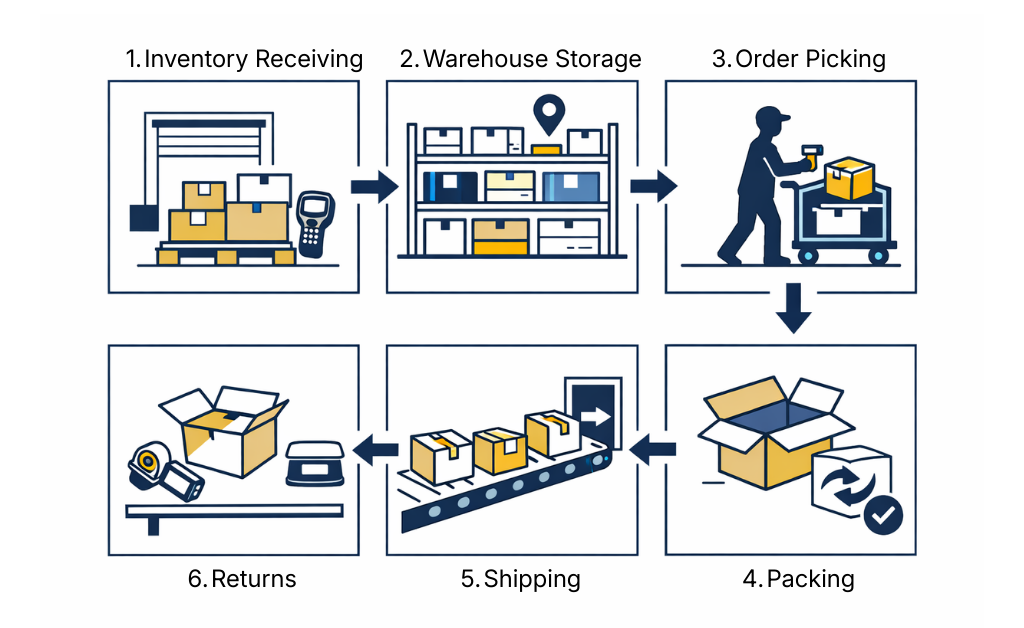
Understanding fulfillment at scale requires looking at each stage as part of a continuous flow rather than a set of handoffs. When one stage slows down or loses accuracy, the impact is rarely contained. It shows up in delayed shipments, missed delivery promises, and frustrated customers.
Below is how the ecommerce fulfillment process typically works for established brands, with the operational realities that often get overlooked.
Inventory Receiving and Quality Checks
Fulfillment starts when inventory arrives at the warehouse, not when an order is placed. This stage sets the foundation for everything that follows.
Inbound shipments must be received, counted, and inspected against purchase orders. Accuracy here is critical. Even small discrepancies between expected and actual quantities can lead to overselling or stockouts weeks later. Quality checks also matter, particularly for apparel, electronics, or fragile products, where defects discovered late create expensive downstream issues.
For growing brands, inconsistent receiving processes are one of the most common causes of inventory inaccuracy. Without clear procedures and accountability at this stage, fulfillment teams end up compensating for errors they did not create.
Warehousing and Inventory Management
Once inventory is received, storage is not simply about putting products on shelves. How and where items are stored affects picking speed, labour efficiency, and order accuracy.
High velocity SKUs need to be placed for easy access. Slower moving items require different handling. As SKU counts grow, poor slotting decisions increase pick times and error rates. Inventory management systems must reflect real time movements, including transfers, cycle counts, and adjustments.
At scale, inventory accuracy becomes a strategic advantage. Brands that can trust their inventory data can sell more confidently, plan promotions accurately, and reduce costly safety stock.
Order Processing and Pick Pack Operations
Order processing is where fulfillment shifts from planning to execution. Orders flow from the ecommerce platform into the warehouse management system, triggering picking and packing activities.
Efficiency at this stage depends on batching logic, pick paths, packaging standards, and labour planning. Poorly designed workflows slow teams down and increase mistakes, especially during high volume periods. Consistency matters just as much as speed. Accurate orders reduce returns, reshipments, and customer support load.
This stage often reveals whether fulfillment operations were designed intentionally or grew reactively over time.
Shipping, Last Mile Delivery, and Carrier Coordination
Shipping is where fulfillment meets customer expectation. Delivery speed, reliability, and cost all come into play at once.
For Canadian brands, last mile delivery requires balancing regional coverage with transit times and pricing. A single carrier approach rarely delivers optimal results nationwide. Coordinating multiple carriers, selecting the right service levels, and managing cut off times are ongoing operational challenges.
Decisions made here directly affect checkout promises, shipping costs, and brand perception. Late or inconsistent deliveries erode trust faster than almost any other fulfillment issue.
Returns Processing and Restocking
Returns complete the fulfillment loop. When handled poorly, they quietly disrupt inventory accuracy and cash flow.
Returned items must be received, inspected, and categorised quickly. Restockable inventory should re enter available stock as soon as possible. Damaged or unsellable goods need clear disposition rules. Delays at this stage create blind spots that affect future fulfillment decisions.
Efficient reverse logistics protect margins and improve customer experience at the same time. It is one of the clearest indicators of fulfillment maturity.
This step by step view makes it clear why fulfillment problems rarely have a single cause. Each stage depends on the ones before it. When brands understand this flow, they are better equipped to design fulfillment systems that scale with the business.
Fulfillment Models Used by Scaling Ecommerce Brands
As ecommerce brands grow, fulfillment almost always needs to evolve. The model that works in early growth stages often becomes a constraint once order volumes increase, SKU counts expand, and delivery expectations rise. There is no universal best model, but there are clear trade offs that experienced brands learn to evaluate carefully.
In House Fulfillment and Where It Starts to Break Down
Many mid market brands begin with in house fulfillment because it offers control and familiarity. Orders are packed close to the team, inventory is visible, and processes feel manageable.
Over time, cracks begin to show. Warehouse space becomes limited. Labour planning turns unpredictable. Delivery speed across provinces becomes harder to maintain. Capital investment in racking, technology, and staffing increases, often without a proportional return.
In house fulfillment can still make sense for certain product categories or volume profiles, but it requires constant investment and operational expertise to remain competitive at scale.
Third Party Logistics and Outsourced Fulfillment
Outsourcing fulfillment to a third party logistics provider allows brands to shift operational complexity to a specialist. This model is often adopted when internal operations begin to limit growth or flexibility.
The right partner brings established warehouse infrastructure, trained labour, carrier relationships, and technology. The challenge lies in alignment. Not all 3PLs are designed for ecommerce at scale, and not all offer the visibility or flexibility that modern brands require.
Successful outsourcing depends on choosing a partner that understands ecommerce dynamics rather than treating fulfillment as a generic warehousing service.
Hybrid Fulfillment Models
Some brands adopt hybrid models that combine in house operations with outsourced fulfillment. This approach is common during periods of transition or rapid growth.
Hybrid models can offer flexibility, but they also introduce complexity. Inventory allocation, system integration, and service consistency require careful coordination. Without clear ownership and data visibility, hybrid setups can create confusion rather than resilience.
For brands considering this model, clarity of purpose matters more than structure.
Centralised Versus Distributed Fulfillment in Canada
Geography plays a defining role in fulfillment strategy for Canadian ecommerce brands. Centralised fulfillment simplifies inventory management but often results in longer delivery times and higher shipping costs to distant regions.
Distributed fulfillment places inventory closer to customers, reducing transit times and improving delivery reliability. It also introduces challenges related to stock balancing and forecasting. When executed well, distributed fulfillment supports faster delivery without compromising cost control.
The right choice depends on order distribution, product mix, and customer expectations. For many scaling brands, a thoughtfully designed distributed model becomes a competitive advantage.
Choosing the right fulfillment model is less about following industry trends and more about aligning operations with growth goals. When this decision is made intentionally, it sets the foundation for cost control and customer satisfaction.
The True Cost of Ecommerce Fulfillment
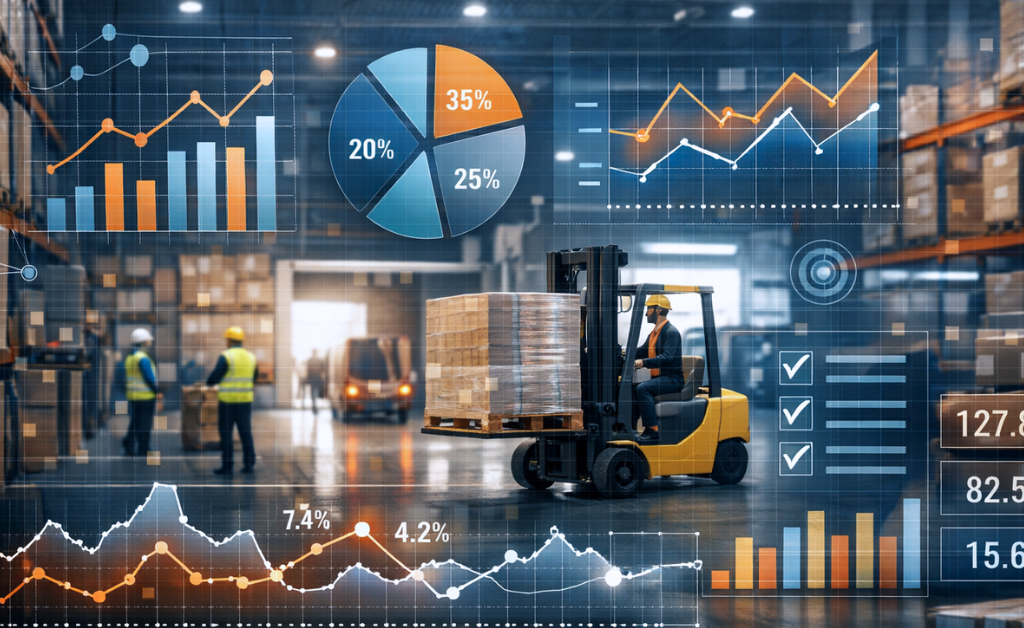
Fulfillment costs are examined piece by piece. Storage fees are reviewed separately from shipping. Labour is analysed in isolation. Returns are treated as an unavoidable expense rather than a controllable one. At scale, this fragmented view makes it difficult to understand what fulfillment actually costs the business.
A clearer picture emerges when fulfillment is viewed as a full cost system that affects margins at multiple points.
Warehousing and Storage Costs
Warehousing costs go beyond square footage. Storage fees are influenced by pallet positions, bin locations, and inventory velocity. Slow moving stock occupies space longer, increasing carrying costs and reducing flexibility.
For mid market and enterprise brands, excess inventory often becomes one of the largest hidden expenses. The longer products sit, the more they cost, even before a single order is shipped.
Pick and Pack Fees
Pick and pack costs reflect the labour required to process each order. These fees are shaped by order complexity, SKU variety, and packaging requirements. Multi item orders, kitting, or special handling increase labour time and cost.
Efficient fulfillment operations design workflows that minimise touches. Inefficient ones absorb these costs silently until margins start to compress.
Packaging Materials and Labour
Packaging is frequently underestimated. Boxes, dunnage, branded inserts, and labour all add up. Oversized packaging increases material costs and shipping fees, while inconsistent standards slow down packing teams.
Thoughtful packaging design balances protection, cost, and speed. At scale, small improvements here can generate meaningful savings.
Shipping and Last Mile Delivery Costs
Shipping is often the most visible fulfillment expense. Rates vary based on package dimensions, weight, delivery speed, and destination. In Canada, long distances and regional coverage make last mile delivery particularly costly.
Brands that lack inventory proximity to customers tend to absorb higher shipping costs or compromise on delivery speed. Both choices affect profitability and customer experience.
Returns and Reverse Logistics Costs
Returns introduce a second fulfillment cycle. Labour, transportation, inspection, and restocking all contribute to cost. Products that cannot be resold represent pure margin loss.
When return processes are slow or unclear, inventory remains tied up, reducing cash flow and increasing write offs.
Hidden Costs Brands Often Overlook
Some fulfillment costs never appear as line items. These include customer support time spent on delivery issues, lost sales due to stockouts, expedited shipping used to recover late orders, and operational disruptions during peak periods.
These indirect costs often outweigh visible fees, especially for brands operating at scale.
Understanding the true cost of ecommerce fulfillment allows brands to make informed decisions about optimisation and investment. It also clarifies why fulfillment strategy deserves executive level attention.
What Drives Fulfillment Costs Up or Down
Fulfillment costs are not fixed. They fluctuate based on operational decisions, customer behaviour, and how intentionally the fulfillment system has been designed. For established ecommerce brands, understanding these drivers is essential for controlling margins without compromising service quality.
Order Volume Variability
Predictable order volumes are easier and cheaper to fulfil. Sudden spikes or sharp drops create labour inefficiencies, underutilised space, or rushed staffing decisions. While some seasonality is unavoidable, brands that plan inventory and labour capacity using historical data tend to experience fewer cost shocks.
Consistency, even at higher volumes, often costs less than volatility at lower volumes.
SKU Complexity and Product Characteristics
A broad SKU catalogue increases picking complexity. Products with multiple variants, fragile materials, or special handling requirements take longer to process and require more training.
Larger or irregularly shaped items increase storage and shipping costs. When product design and packaging are not considered alongside fulfillment, costs rise in ways that are difficult to reverse later.
Geographic Distribution of Customers
Where customers are located matters as much as how many there are. A customer base concentrated near fulfillment centres allows for faster delivery at lower cost. A nationally distributed customer base requires either higher shipping spend or inventory placed across multiple locations.
In Canada, geography is often the single biggest cost driver in ecommerce fulfillment. Brands that ignore this reality usually pay for it in transit times or margins.
Delivery Speed Expectations
Same day and next day delivery improve conversion and customer satisfaction, but they also introduce tighter cut off times and higher service level costs. When delivery speed is promised without the operational foundation to support it, fulfillment teams end up relying on expensive workarounds.
Clear alignment between delivery promises and operational capability keeps costs under control.
Returns Rates and Product Categories
High return rates increase fulfillment costs across the board. Categories such as apparel and consumer electronics feel this impact more acutely. Returns affect labour, transportation, inventory availability, and resale value.
Brands that actively analyse return reasons and adjust product listings, sizing guidance, or packaging often see fulfillment costs decrease over time.
Cost control in fulfillment is rarely achieved through a single initiative. It comes from aligning multiple decisions across inventory, operations, and customer experience.
Common Ecommerce Fulfillment Challenges at Scale
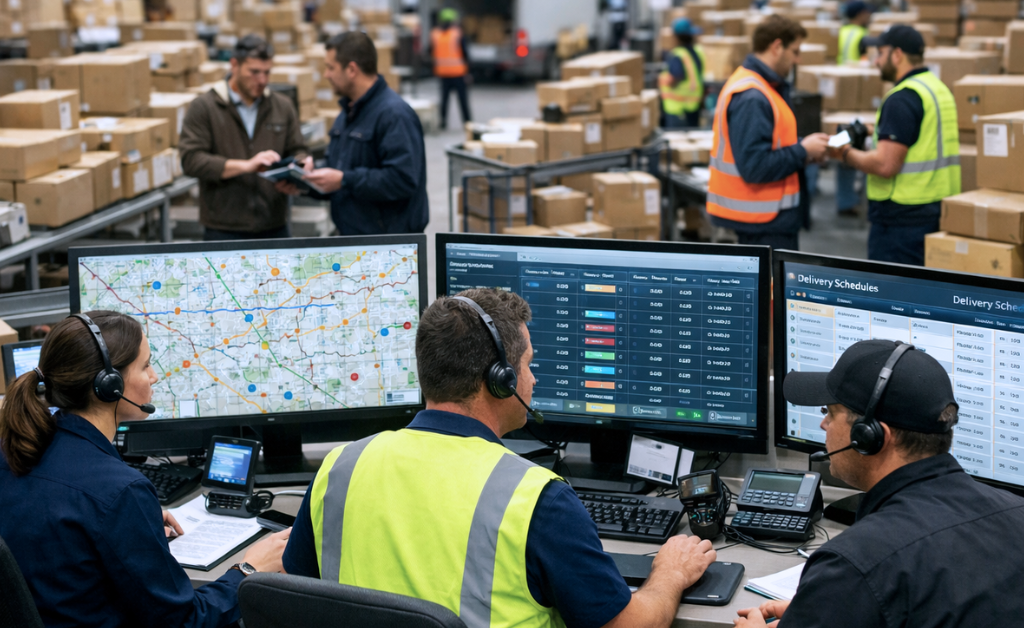
As ecommerce brands grow, fulfillment challenges tend to shift rather than disappear. What once felt manageable becomes fragile under higher volumes, tighter delivery expectations, and broader geographic reach. Many of these challenges are familiar, but they become far more expensive when left unresolved.
Inventory Inaccuracy and Overselling
Inventory errors often start small. A missed receipt, a delayed adjustment, or a return that never gets restocked. Over time, these gaps accumulate and lead to overselling, cancelled orders, and lost customer trust.
At scale, inventory accuracy is no longer an operational metric. It is a revenue protection mechanism. Brands that cannot trust their inventory data struggle to plan promotions, forecast demand, or commit to delivery timelines.
Slow Delivery Across Provinces
Meeting delivery expectations across Canada is difficult with a single fulfillment location. Customers in distant provinces experience longer transit times, while shipping costs rise to compensate.
Slow delivery affects more than satisfaction. It impacts repeat purchase rates, brand perception, and competitiveness. When faster delivery becomes the industry norm, delays feel more noticeable.
Rising Last Mile Delivery Costs
Last mile delivery continues to be one of the fastest growing cost centres in ecommerce. Carrier rate increases, fuel surcharges, and service level premiums add pressure each year.
Brands often absorb these costs quietly until margins begin to shrink. Without proactive optimisation, last mile delivery becomes a drag on profitability.
Limited Visibility Across Operations
As operations scale, visibility often declines. Inventory may live across systems. Order statuses may lag behind reality. Teams spend more time reconciling data than acting on it.
Lack of visibility slows decision making and increases risk. Issues are identified after customers notice them, not before.
Returns Overwhelming Fulfillment Teams
Returns volumes grow alongside order volumes. Without dedicated processes and space, returns disrupt outbound fulfillment, delay restocking, and create inventory blind spots.
When returns are treated as secondary work, they quickly become a bottleneck.
Scaling During Peak Without Service Degradation
Peak periods expose every weakness in fulfillment operations. Labour shortages, system limitations, and capacity constraints surface under pressure.
Brands that rely on last minute fixes during peak often experience service degradation that lingers well beyond the season.
These challenges rarely exist in isolation. They feed into one another, compounding impact across the fulfillment system.
Why Many Brands Struggle to Fix Fulfillment Internally
Most ecommerce leaders are aware when fulfillment is underperforming. The challenge is not recognising the problem. It is finding the time, resources, and organisational alignment to fix it without disrupting growth.
One common issue is tool sprawl. As brands scale, they add systems to solve specific problems. A warehouse management tool here, a shipping platform there, a returns solution layered on top. Each tool works in isolation, but together they create fragmentation. Data stops flowing cleanly, and teams spend more time managing integrations than improving operations.
Another barrier is the underestimation of operational complexity. Fulfillment looks straightforward from the outside, but running it efficiently at scale requires specialised knowledge across warehousing, transportation, labour planning, and systems. Internal teams are often asked to grow revenue and fix operations at the same time, which leads to incremental changes instead of structural improvements.
Timing also works against internal fixes. Fulfillment investments are frequently delayed until pain becomes visible to customers. At that point, changes are made under pressure, during peak seasons or high growth phases. Reactive decisions tend to prioritise speed over sustainability, locking in inefficiencies that persist for years.
There is also a natural tension between growth teams and operations teams. Marketing wants faster delivery promises. Sales wants wider geographic reach. Operations must deliver on those commitments within existing constraints. Without shared visibility and alignment, fulfillment decisions become reactive compromises rather than strategic choices.
For many mid market and enterprise brands, the issue is not capability. It is focus. Fulfillment requires dedicated expertise and long term thinking, which can be difficult to maintain internally while the business continues to scale.
What Effective Ecommerce Fulfillment Looks Like in Practice
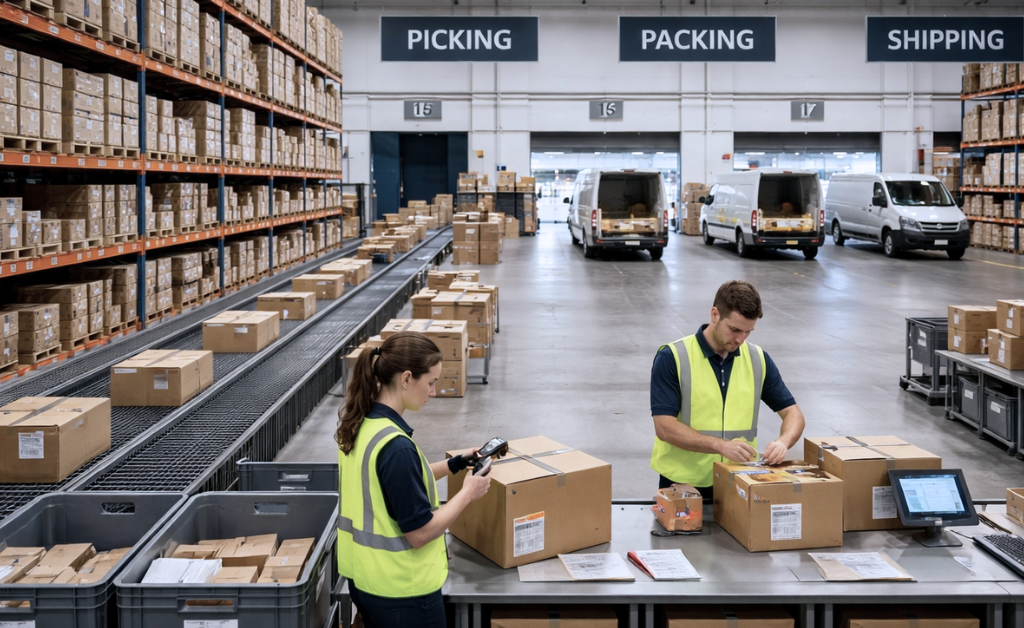
When ecommerce fulfillment works well, it rarely draws attention. Orders move smoothly, delivery promises are met consistently, and teams spend less time firefighting issues. Behind that apparent simplicity is a fulfillment operation designed with intent rather than patched together over time.
Effective fulfillment starts with inventory placed where it makes the most sense. Products are positioned closer to demand, reducing transit times and lowering last mile costs. Inventory levels are planned using a combination of historical data and real time signals, which limits both overstocking and stockouts.
Operational workflows are clearly defined and repeatable. Receiving, picking, packing, and shipping follow standard processes that scale with volume. This consistency improves speed and accuracy while reducing training time and dependency on individual team members.
Visibility is another defining characteristic. High performing fulfillment operations offer real time insight into inventory levels, order status, and delivery performance. Teams can identify issues early and respond before customers are affected. Decisions are driven by data that is timely and reliable, not delayed reports.
Returns are treated as part of the core fulfillment system rather than an exception. Dedicated processes ensure returned items are inspected and restocked quickly. Clear disposition rules protect margins and maintain inventory accuracy.
Most importantly, effective fulfillment supports growth without constant reinvention. Volume increases do not require fundamental changes to operations. The system is built to absorb demand, adapt to seasonality, and maintain service levels as the business evolves.
When fulfillment reaches this level of maturity, it stops being a constraint and becomes a quiet competitive advantage.
Choosing the Right Ecommerce Fulfillment Partner in Canada
For many mid market and enterprise ecommerce brands, choosing the right fulfillment partner is not about outsourcing work. It is about extending the business with capabilities that are difficult, time consuming, or expensive to build internally. The wrong choice creates friction. The right one removes it.
Geographic coverage should be one of the first considerations. Canada’s size makes location strategy critical. A fulfillment partner with warehouses positioned near major population centres can significantly reduce delivery times and last mile costs. National reach matters, but so does thoughtful placement of inventory across regions where demand is highest.
Delivery speed capabilities also deserve close scrutiny. Same day and next day delivery are no longer niche offerings in major Canadian cities. A partner should be able to support these service levels consistently, not just during promotional periods. This includes cut off times, carrier coordination, and contingency planning when volumes spike.
Returns handling is another area where differences between providers become clear. A strong partner treats reverse logistics as a core competency, not an afterthought. Fast inspections, clear restocking processes, and visibility into returned inventory protect margins and maintain customer trust.
Technology and visibility underpin all of this. A fulfillment partner should offer real time insight into inventory, orders, and delivery performance. Reporting needs to support action, not just audits. Integration with existing ecommerce platforms and systems should be stable and scalable.
Flexibility often separates adequate partners from strategic ones. Order volumes change. Product mixes evolve. New markets open. A strong fulfillment partner adapts alongside the brand rather than forcing rigid processes that limit growth.
Choosing a fulfillment partner is ultimately a strategic decision. It shapes customer experience, cost structure, and operational resilience. For brands operating at scale, this decision deserves the same level of diligence as any major growth initiative.
Conclusion: Building Fulfillment That Supports Growth, Not Just Orders
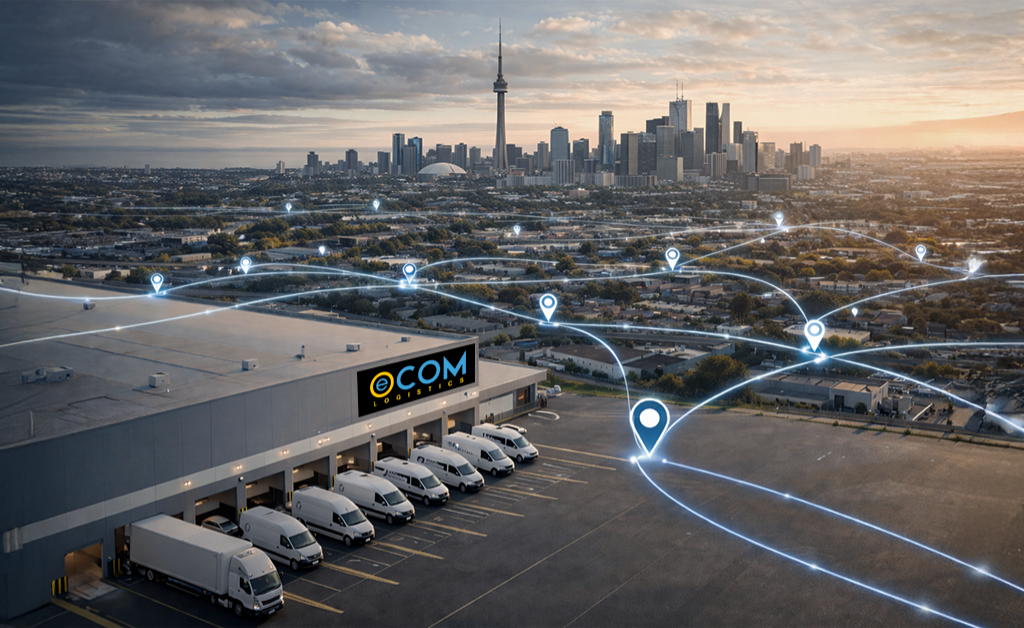
Ecommerce fulfillment is no longer a background function that can be managed on autopilot. For established brands already operating or looking to operate in Canada, it is a system that directly influences margins, customer experience, and the ability to scale with confidence. How inventory is positioned, how orders move through the warehouse, how quickly deliveries reach customers, and how returns are handled all shape business outcomes in ways that become more visible as volume grows.
The most successful ecommerce operations approach fulfillment as an integrated strategy rather than a collection of tasks. They design processes that work together, invest in visibility across the entire fulfillment lifecycle, and make decisions early, before operational pressure forces reactive fixes. This is what allows them to grow without constantly rebuilding their logistics foundation.
This is where the right logistics partner plays a critical role. Ecom Logistics works with mid market and enterprise ecommerce brands already operating across Canada or planning to, to build fulfillment operations that are designed for scale. From our strategically located warehouse and same day and next day delivery capabilities to efficient returns handling and real time operational visibility, our focus is on helping brands move faster while keeping costs under control.
If you are rethinking how your fulfillment strategy supports growth in 2026 and beyond, this is a good time to start that conversation. Connect with Ecom Logistics to explore how we can support your ecommerce operations and help turn fulfillment into a long term advantage.
Frequently Asked Questions
How long does it typically take to transition to a new ecommerce fulfillment partner?
Transition timelines vary based on inventory volume, SKU complexity, system integrations, and warehouse locations. For mid market and enterprise brands, a phased transition is often preferred to minimise risk. Planning, data migration, and testing are just as important as the physical inventory move.
Can ecommerce fulfillment support cross border shipping from Canada?
Yes, but cross border fulfillment introduces additional complexity around customs documentation, duties, taxes, and carrier coordination. Brands should evaluate whether cross border shipping is handled directly from Canadian facilities or through regional inventory placement closer to end customers.
How does fulfillment impact checkout conversion rates?
Delivery speed, shipping cost transparency, and delivery reliability all influence conversion. Fulfillment capabilities directly affect what brands can promise at checkout, which in turn shapes customer purchase decisions, especially for repeat buyers.
Is ecommerce fulfillment customisable for different product categories?
Effective fulfillment operations adapt processes based on product characteristics. Apparel, electronics, health products, and oversized goods each require different handling, storage, and returns workflows. One size fits all fulfillment models often struggle at scale.
How should ecommerce brands plan fulfillment capacity for peak periods?
Peak planning starts months in advance. Brands should use historical data to forecast demand, confirm labour and space availability, and stress test delivery capacity. Relying on last minute adjustments during peak typically leads to higher costs and service disruptions.
What role does sustainability play in modern ecommerce fulfillment?
Sustainability increasingly influences fulfillment decisions, from warehouse location and packaging choices to delivery routes and electric vehicle adoption. Many brands now balance speed and cost with environmental impact as part of their logistics strategy.
- About the Author
- Latest Posts