So many ecommerce brands focus intensely on marketing, product innovation, and customer acquisition. These areas understandably attract the most attention because they directly drive sales. Yet behind every successful ecommerce business sits an operational system that determines whether those sales can actually be delivered profitably. That system is ecommerce fulfillment.
When fulfillment works smoothly, customers rarely notice it. Orders arrive on time, products are correct, and returns are easy to process. When fulfillment fails, the consequences are immediate. Late deliveries, incorrect orders, missing items, and complicated returns quickly erode customer trust. At the same time, inefficient fulfillment quietly increases operational costs and reduces profit margins.
As ecommerce businesses grow, fulfillment becomes more complex. Higher order volumes, wider product catalogues, expanding shipping destinations, and increasing customer expectations all place pressure on logistics operations. Treating fulfillment as a purely operational function is no longer enough. Ecommerce fulfillment stategies have become essential for brands that want to scale efficiently while maintaining strong customer experiences.
What Is Ecommerce Fulfillment and Why Does It Matter for Growing Brands?
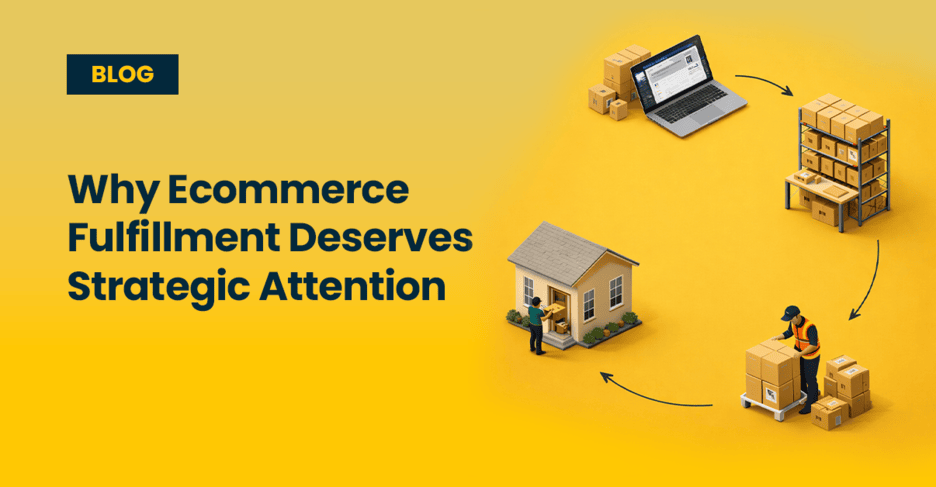
Ecommerce fulfillment refers to the complete operational process that takes place after a customer places an order online. It includes receiving inventory, storing products, processing orders, picking and packing items, shipping packages to customers, and managing returns. While these tasks may appear straightforward, they require precise coordination between technology, warehouse operations, and shipping networks.
For growing brands, fulfillment plays a central role in maintaining operational stability. A poorly designed fulfillment process can create delays, inventory discrepancies, and rising operational costs. A well structured system, on the other hand, ensures that orders move smoothly through each stage while maintaining accuracy and speed.
Several core components make up the fulfillment process. Inventory receiving and storage is the first step. Products arriving from manufacturers or suppliers must be verified for accuracy and placed in organised warehouse locations. Efficient storage systems make it easier for warehouse teams to locate items quickly when orders arrive.
The next stage involves order processing and picking. When a customer places an order, the warehouse management system identifies the correct items and directs staff to retrieve them from their storage locations. Efficient picking methods reduce processing time and minimise errors.
After items are picked, the packing and shipping stage prepares orders for delivery. Products are packed securely, labelled, and transferred to carrier networks that handle transportation to the customer’s address. Packaging quality and shipping coordination both influence delivery reliability.
The final stage involves returns management, which is an increasingly important part of ecommerce operations. Returned items must be inspected, restocked, or processed according to company policies. A structured returns workflow prevents operational bottlenecks and protects inventory accuracy.
Each stage of fulfillment directly affects both operational efficiency and customer satisfaction. When systems are poorly designed, small inefficiencies compound quickly as order volume increases.
Why Is Fulfillment No Longer Just an Operational Function?
For many years, fulfillment was viewed primarily as a warehouse activity. Marketing teams focused on generating demand, while logistics teams focused on processing orders. The two functions rarely intersected strategically.
That separation no longer works in modern ecommerce. Customer expectations have changed dramatically, largely influenced by large online marketplaces and fast delivery services. Today’s consumers expect fast, predictable, and transparent delivery regardless of the brand they purchase from.
Delivery speed has become a competitive factor. Customers often evaluate brands based not only on product quality but also on how quickly and reliably orders arrive. Real time tracking updates and flexible shipping options have also become standard expectations.
Fulfillment therefore plays a direct role in shaping the post purchase customer experience. A brand may invest heavily in advertising and website design, but the delivery experience ultimately determines whether customers return for future purchases.
Operational failures can also create hidden business costs. When deliveries are delayed or orders contain errors, customer support teams receive more inquiries. Refund requests increase, replacement shipments become necessary, and operational teams must spend additional time resolving problems. These disruptions reduce efficiency and negatively affect profit margins.
As ecommerce competition continues to intensify, brands that treat fulfillment strategically are far better positioned to maintain customer loyalty and operational stability.
How Does Fulfillment Affect Profit Margins in Ecommerce?
Fulfillment is one of the largest operational cost centres for ecommerce businesses. While shipping fees are often the most visible expense, the true cost structure is more complex.
Several factors contribute to overall fulfillment costs. Warehouse facilities require space, utilities, equipment, and operational management. Labour costs include employees responsible for receiving inventory, managing storage systems, picking items, packing orders, and handling returns. Packaging materials such as boxes, cushioning materials, labels, and sealing equipment also contribute to the cost per order.
Shipping costs depend on multiple variables including package weight, shipping distance, delivery speed, and carrier pricing agreements. Returns introduce additional expenses because returned items must be inspected, processed, and restocked or disposed of.
Many brands initially focus almost entirely on reducing shipping fees. While carrier negotiations can certainly improve margins, internal warehouse efficiency often plays an equally important role. Operational inefficiencies inside the warehouse can significantly increase fulfillment costs.
For example, poorly organised storage layouts increase the time required for staff to locate items. Manual data entry processes increase the risk of errors and slow down order processing. Inaccurate inventory records lead to stock discrepancies that require emergency shipments or customer refunds.
Even small inefficiencies can have a large financial impact when order volumes grow. A warehouse process that adds an extra minute to each order may appear insignificant, but at thousands of orders per day the labour costs increase dramatically. Strategic fulfillment planning helps identify and eliminate these inefficiencies before they become costly operational habits.
What Are the Most Common Fulfillment Challenges for Scaling Ecommerce Brands?
As ecommerce businesses grow, fulfillment operations face a new set of challenges. Processes that worked well during early growth stages may become inadequate when order volume increases.
One of the most common issues is limited inventory visibility. Without accurate real time data, brands struggle to maintain reliable stock levels. Inventory discrepancies can lead to overselling products that are no longer available or failing to restock high demand items quickly enough.
Another frequent challenge involves balancing stockouts and excess inventory. Overstocking increases storage costs and ties up capital in unsold products. Stockouts, however, result in missed sales opportunities and frustrated customers. Achieving the right balance requires accurate demand forecasting and coordinated supply chain planning.
Order processing speed can also become a problem as sales grow. Manual workflows often function well at low order volumes but quickly create bottlenecks during peak demand periods. Automated systems and optimised warehouse layouts help maintain speed and accuracy as order volumes increase.
Technology fragmentation creates additional complications. Many ecommerce brands use separate tools for inventory management, order processing, and shipping coordination. When these systems do not communicate effectively, teams spend valuable time transferring information between platforms. Integrated systems significantly improve operational efficiency by connecting ecommerce stores directly with warehouse operations.
Why Do High Growth Ecommerce Brands Partner With a 3PL?
Many ecommerce companies eventually reach a stage where internal fulfillment operations become difficult to manage. Warehouse capacity, technology limitations, and staffing requirements create operational pressure that slows growth.
This is where third party logistics providers (3PLs) play an important role. A 3PL specialises in managing logistics operations for ecommerce brands, allowing businesses to focus on product development, marketing, and customer engagement.
One major advantage of partnering with a 3PL is access to established infrastructure. Building and operating warehouses requires significant capital investment. Fulfillment providers already maintain warehouse facilities, technology platforms, and trained operational teams. Brands can therefore scale their logistics operations without building this infrastructure internally.
Another benefit is operational expertise. Logistics providers specialise in warehouse optimisation, shipping coordination, and inventory management. Their processes are designed to handle high order volumes efficiently while maintaining accuracy.
A strong fulfillment partner also enables faster geographic expansion. Reaching customers in new markets often requires strategically located warehouses that reduce delivery times. Distributed fulfillment networks allow inventory to be positioned closer to customer demand centres, improving both delivery speed and shipping efficiency.
How Does Strategic Fulfillment Improve Customer Experience?
Customer experience does not end when a purchase is completed. The delivery process strongly influences how customers perceive a brand. Strategic fulfillment planning ensures that the logistics side of the business supports a positive customer journey.
Faster delivery is one of the most visible outcomes of effective fulfillment operations. Efficient warehouse workflows and optimised shipping routes allow orders to reach customers more quickly. In many markets, customers now expect delivery within just a few days of placing an order.
Order accuracy is equally important. Customers expect to receive exactly what they purchased without errors or missing items. Structured warehouse processes and reliable inventory tracking systems significantly reduce the likelihood of incorrect shipments.
Returns are another important element of the ecommerce experience. A smooth returns process reassures customers that purchasing online is low risk. Efficient returns management allows returned items to be processed quickly while maintaining accurate inventory records.
When fulfillment operations are reliable and consistent, customers develop greater trust in the brand. That trust directly contributes to higher repeat purchase rates and stronger long term relationships.
What Role Does Technology Play in Modern Ecommerce Fulfillment?
Technology has transformed how fulfillment operations are managed. Modern logistics systems rely heavily on data driven processes to maintain efficiency and accuracy.
One of the most important tools is the warehouse management system (WMS). A WMS coordinates inventory locations, picking routes, order processing, and warehouse workflows. By organising these activities digitally, the system reduces errors and improves operational speed.
Data analytics also supports inventory forecasting and demand planning. Historical sales data and seasonal trends help brands anticipate demand fluctuations. Accurate forecasting allows businesses to adjust inventory levels before shortages or excess stock occur.
Real time tracking technology improves transparency throughout the delivery process. Customers receive updates about shipment status, expected delivery times, and potential delays. This visibility reduces uncertainty and decreases the number of customer support inquiries related to shipping.
Technology integration is particularly valuable when fulfillment systems connect directly with ecommerce platforms. Orders can be transmitted automatically to the warehouse, inventory levels update in real time, and tracking details flow back to customers without manual intervention.
How Can Ecommerce Brands Build a Scalable Fulfillment Strategy?
Some early-stage ecommerce businesses also experiment with Dropshipping models to reduce inventory holding costs, although this approach often provides less operational control as brands scale. A scalable fulfillment strategy ensures that logistics operations can grow alongside the business without creating operational bottlenecks. Developing this strategy requires careful planning and ongoing optimisation.
The first step involves choosing the right fulfillment model. Some brands prefer in-house fulfillment for control, while others partner with logistics providers that specialise in ecommerce fulfillment. The best approach depends on order volume, geographic reach, and available operational resources.
Inventory placement also plays a critical role in fulfillment efficiency. Storing products closer to major customer regions reduces shipping distances and shortens delivery times. Distributed inventory networks often provide the best balance between speed and cost efficiency.
Data analysis helps identify opportunities for continuous improvement. Key performance indicators such as order processing time, inventory turnover, order accuracy, and return rates provide valuable insights into operational performance. Monitoring these metrics allows brands to detect inefficiencies early and refine processes over time.
A well designed fulfillment strategy creates operational resilience. Instead of reacting to growth challenges, brands can scale confidently with systems that support increasing order volumes.
Why Should Ecommerce Leaders Treat Fulfillment as a Growth Lever?
Forward thinking ecommerce leaders recognise that fulfillment is not simply a logistical necessity. It is a powerful driver of both customer satisfaction and financial performance.
Reliable fulfillment systems directly influence revenue growth. Customers are more likely to return to brands that deliver consistently positive post purchase experiences. Fast delivery, accurate orders, and easy returns all contribute to repeat purchasing behaviour.
Operational efficiency also improves profitability. Streamlined warehouse processes reduce labour costs, minimise errors, and optimise shipping expenses. These efficiencies accumulate over time and significantly strengthen profit margins.
Perhaps most importantly, dependable logistics reinforces brand reputation. Customers associate smooth delivery experiences with professionalism and reliability. In competitive ecommerce markets, these perceptions strongly influence purchasing decisions.
Conclusion: Why Strategic Fulfillment Defines Ecommerce Success

Ecommerce fulfillment sits at the core of successful online retail operations. While it may operate behind the scenes, its impact reaches every aspect of the business. Delivery speed, operational efficiency, customer satisfaction, and profitability are all influenced by how effectively fulfillment systems are designed and managed.
As ecommerce brands grow, logistics complexity increases rapidly. Order volumes rise, product catalogues expand, and customer expectations become more demanding. Businesses that treat fulfillment as a strategic priority are far better prepared to handle this growth while maintaining operational control.
Ecom Logistics provides specialised ecommerce fulfillment services designed to support scaling brands. Our infrastructure, technology systems, and operational expertise help businesses streamline order processing, optimise inventory management, and deliver reliable customer experiences.
If your brand is preparing for the next stage of ecommerce growth, the right fulfillment strategy can make a significant difference.
Speak with our Team to Discover How.
FAQs
Most fulfillment providers integrate directly with ecommerce platforms such as Shopify, WooCommerce, and other online store systems. This allows orders to be transmitted automatically to the warehouse while inventory levels and tracking information update in real time.
Ecommerce fulfillment services support a wide range of industries including fashion, beauty, consumer electronics, health products, home goods, and subscription based businesses.
Many fulfillment providers support international shipping by coordinating with global carrier networks, managing customs documentation, and optimising shipping routes for international deliveries.
Fulfillment centres prepare for peak demand periods by adjusting staffing levels, optimising warehouse workflows, and using scalable technology systems that can process higher order volumes efficiently.
Important fulfillment metrics include order accuracy rate, order processing time, inventory turnover, shipping cost per order, and return rate. Monitoring these indicators helps identify operational improvements.
- About the Author
- Latest Posts