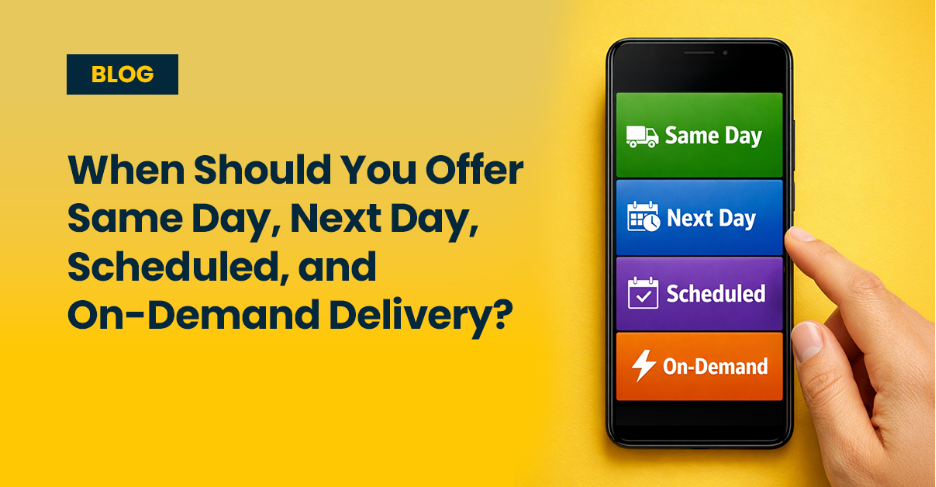
Delivery speed has quietly become one of the most influential factors in ecommerce performance. Not because faster is always better, but because the wrong delivery promise can increase costs without improving conversions.
The debate around same day vs next day delivery often starts with customer expectations. But the real decision sits deeper. It is about operational readiness, cost control, and whether speed actually drives value for your business.
Offering every delivery option is not a strategy. Choosing the right one is.
Same Day Vs Next Day Delivery: What Actually Changes for Your Business?
At a surface level, the difference between same day vs next day delivery is simple. One delivers within hours. The other delivers the following day.
Operationally, the gap is much wider.
Same day delivery service requires proximity. Inventory needs to be positioned close to customers, often within city limits. Orders must be processed almost immediately, leaving little room for batching or optimisation. This increases dependency on local infrastructure and last-mile coordination.
Next day delivery, on the other hand, allows for structured fulfillment cycles. Orders can be consolidated, routing can be optimised, and inventory can be managed across fewer locations. This reduces operational pressure while still meeting fast delivery expectations.
There is also a cost distinction.
Same day delivery tends to:
- Increase last-mile costs
- Require more distributed inventory
- Limit order processing flexibility
Next day delivery typically:
- Balances cost and speed
- Scales more predictably
- Works across wider geographies
This is where comparisons like same day vs express delivery often create confusion. Express delivery usually refers to expedited shipping within a defined timeframe, not necessarily within the same day. The operational demands are still significantly lower than true same day fulfillment.
The key takeaway is simple. The difference is not just speed. It is how your entire fulfillment system needs to be structured to support that speed.
When Does Same Day Delivery Actually Make Business Sense?
Same day delivery is not universally beneficial. In many cases, it increases costs without significantly improving conversion or retention.
It works best in specific conditions.
High-Intent, Time-Sensitive Purchases
Certain product categories naturally benefit from immediacy. These include essentials, last-minute purchases, or items tied to specific occasions.
In such cases, speed directly influences purchase decisions, making same day delivery a revenue driver rather than just a service upgrade.
Dense Urban Markets
Same day delivery becomes viable when customer density is high.
Shorter distances reduce last-mile costs and make routing more efficient. Urban environments also support faster delivery cycles due to better infrastructure and higher order concentration.
Without this density, offering same day delivery can quickly become cost-prohibitive.
Premium Customer Experience Strategy
For some brands, speed is not about necessity. It is about positioning.
Offering same day delivery as a premium option can elevate perceived value, especially when paired with high-quality products or services. However, this only works when the experience is consistent.
An unreliable same day delivery service can damage trust faster than not offering it at all.
Same day delivery makes sense when urgency, geography, and customer expectations align. Without that alignment, it often becomes an expensive feature with limited return.
When Is Next Day Delivery the Smarter Default?
For most ecommerce businesses, next day delivery is not a compromise. It is a strategic default.
It offers speed that meets customer expectations while maintaining operational control. Unlike same day delivery, it does not require extreme proximity or immediate processing.
This makes it far more scalable.
Next day delivery works particularly well when:
- Orders are spread across multiple regions
- Inventory is centralised or semi-distributed
- Demand is consistent but not hyper-local
From a cost perspective, it allows businesses to optimise routing, consolidate shipments, and negotiate better carrier rates. This directly reduces pressure on ecommerce shipping operations without sacrificing delivery speed.
It also aligns well with broader fast shipping options that customers expect today. While not instantaneous, next day delivery is often perceived as reliable and sufficient.
Most importantly, it provides operational breathing room. Orders can be processed efficiently, errors can be minimised, and delivery commitments are easier to maintain.
For scaling brands, next day delivery often delivers the best balance between customer satisfaction and cost efficiency.
Where Do Scheduled and On-Demand Delivery Fit In?
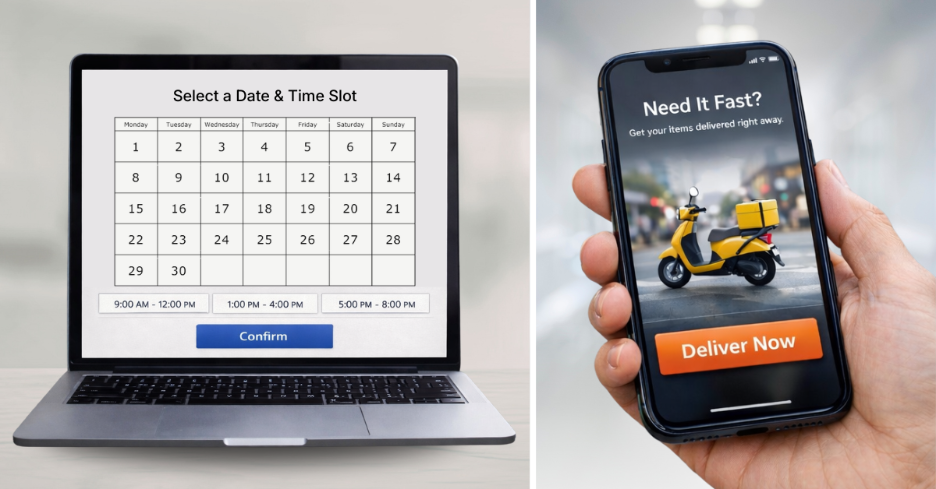
Same day and next day delivery are not the only options shaping customer experience. Scheduled delivery and on-demand delivery play distinct roles, especially in specific use cases.
Scheduled Delivery: Control And Convenience
Scheduled delivery allows customers to choose a specific date or time slot for receiving their order.
This is particularly useful for:
- Bulky or high-value items
- Deliveries requiring customer presence
- Planned purchases rather than impulse buys
From an operational perspective, scheduled delivery improves predictability. Orders can be planned, routes can be optimised, and delivery success rates tend to be higher.
It reduces failed delivery attempts and improves overall efficiency.
On-Demand Delivery: Flexibility With Higher Costs
On-demand delivery sits at the other end of the spectrum. It prioritises immediacy, often similar to same day delivery, but with even less lead time.
It is best suited for:
- Urgent, low-consideration purchases
- Hyper-local delivery models
- Businesses built around instant gratification
However, this flexibility comes at a cost.
On-demand delivery increases:
- Routing complexity
- Last-mile expenses
- Operational unpredictability
Without tight geographic coverage and strong infrastructure, it becomes difficult to sustain profitably.
Both scheduled and on-demand delivery are not replacements for standard delivery options. They are strategic additions, best used when they align with product type and customer behaviour.
How Customer Expectations Should Influence Your Delivery Strategy
Customer expectations around delivery are often misunderstood. Faster is not always better. Predictability, transparency, and reliability often matter just as much as speed.
Studies have consistently shown that while customers value faster delivery, they are not always willing to pay significantly more for it. What they do expect is clarity. Clear timelines, accurate tracking, and delivery that happens when promised.
This creates an important distinction.
Speed attracts attention. Reliability builds trust.
For many ecommerce businesses, offering only the fastest option can actually reduce efficiency without improving customer satisfaction. A more effective approach is to align delivery options with customer intent:
- Urgent purchases may justify same day or on-demand delivery
- Everyday purchases are often well served by next day delivery
- Planned purchases benefit from scheduled delivery
The goal is not to maximise speed across all orders. It is to match delivery speed with customer expectations and willingness to pay.
This is where a well-structured delivery strategy creates real value.
The Real Cost of Offering Faster Delivery Options
Speed comes at a cost, and in fulfillment, that cost is rarely limited to shipping alone. Offering faster delivery options impacts multiple layers of operations.
Inventory Placement And Micro-Fulfillment
Same day and on-demand delivery require inventory to be closer to the customer.
This often means:
- Multiple storage locations
- Higher inventory holding costs
- More complex inventory allocation
While this improves delivery speed, it increases operational overhead and requires stronger coordination.
Last-Mile Delivery Costs
The last mile is the most expensive part of the delivery process.
Faster delivery reduces the ability to optimise routes, batch orders, or consolidate shipments. This leads to:
- Higher cost per delivery
- Increased dependency on local courier networks
- Lower efficiency in order clustering
For many businesses, this is where fast shipping options begin to significantly impact margins.
Returns And Failed Deliveries
Faster delivery does not eliminate returns. In some cases, it increases them.
Impulse purchases enabled by fast delivery can lead to higher return rates. At the same time, failed delivery attempts become more expensive when timelines are tighter.
This adds pressure on reverse logistics and customer support, increasing overall operational costs.
Offering faster delivery is not just a pricing decision. It is a structural shift in how your fulfillment system operates.
How To Choose the Right Delivery Speed for Your Ecommerce Business
Choosing between same day vs next day delivery, or adding scheduled and on-demand options, should not be based on trends. It should be based on business realities.
A practical framework helps simplify this decision.
Product Type
Products with urgency or time sensitivity benefit from faster delivery. Others do not.
For example:
- Essentials and consumables may justify same day delivery
- Lifestyle or discretionary products often do not require it
Order Value
Higher-value orders can absorb higher delivery costs. Lower-value orders cannot.
Offering premium delivery options on low-margin products can quickly erode profitability.
Geography And Customer Density
Urban markets support faster delivery models. Distributed or low-density regions do not.
This directly affects feasibility and cost efficiency.
Customer Expectations
Every customer doesn’t expect the same level of speed.
Understanding your audience helps determine whether speed is a differentiator or simply an added cost.
The best delivery strategy is not the fastest one. It is the one that aligns with your product, market, and cost structure.
Should You Offer Multiple Delivery Options or Keep It Simple?
Offering multiple delivery options can improve conversion rates, but it also introduces complexity.
More choices mean:
- More operational coordination
- More inventory planning challenges
- Higher risk of inconsistencies
At the same time, fewer options can simplify operations but may limit customer flexibility.
The right approach depends on scale.
For growing brands, a tiered model often works best:
- Standard or next day delivery as the default
- Same day or on-demand as premium options
- Scheduled delivery for specific use cases
This structure provides flexibility without overwhelming operations or customers.
It also allows businesses to test demand for faster delivery options before fully committing to them.
Simplicity should not come at the cost of missed opportunities. But complexity should always be intentional.
Conclusion: Delivery Speed Should Be a Strategy, Not a Checkbox
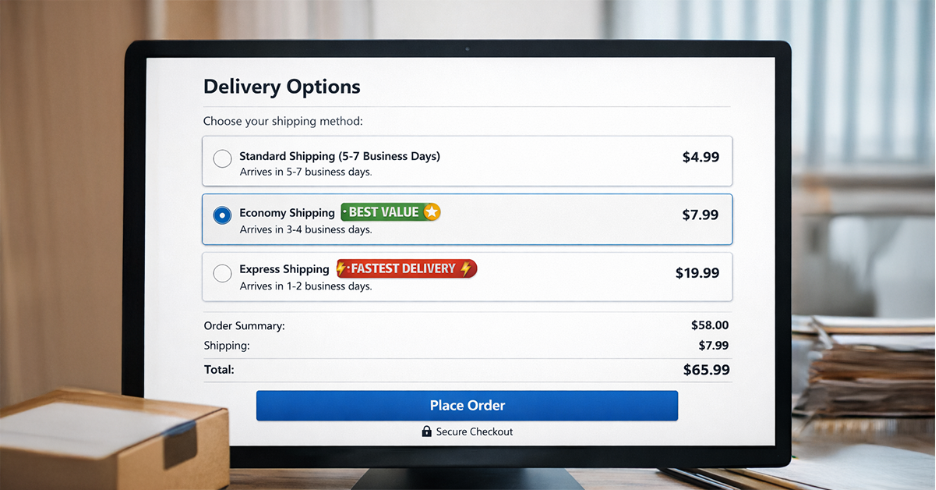
The conversation around same day vs next day delivery often focuses on speed. The real decision is about structure.
Each delivery option, whether same day, next day, scheduled, or on-demand, comes with its own cost implications, operational requirements, and impact on customer experience. Offering them without a clear strategy can increase complexity without delivering real value.
The brands that scale efficiently are not the ones offering the fastest delivery everywhere. They are the ones that align delivery speed with business goals, customer expectations, and operational capabilities.
Ecom Logistics works with ecommerce brands to design delivery strategies that are both efficient and scalable. From optimising fulfillment networks to enabling the right mix of delivery options, the focus is on helping businesses balance speed with cost and reliability.
If you are evaluating your delivery strategy or planning to expand your shipping capabilities, it is worth getting it right early.
Contact us to build a delivery experience that supports growth, not just speed.
Frequently Asked Questions
Same day delivery fulfils orders within hours, requiring local inventory and rapid processing. Next day delivery allows more structured operations, making it easier to scale while balancing cost and speed.
Same day delivery is only worth it when it drives higher conversions or customer value. It works best for urgent purchases, dense urban markets, or premium customer experience strategies.
Next day delivery allows batching, route optimisation, and centralised inventory. This reduces last-mile costs and improves operational efficiency compared to same day delivery.
Scheduled delivery works best for high-value, bulky, or planned purchases where customers prefer choosing a specific delivery time. It also improves delivery success rates.
On-demand delivery refers to immediate or near-instant delivery, typically within a few hours. It is commonly used for urgent, hyper-local orders but comes with higher operational costs.
The choice depends on product type, customer expectations, geography, and cost structure. Same day suits urgent, local demand, while next day works better for scalable operations.
Customers value speed, but reliability and cost matter just as much. Many prefer predictable next day delivery over inconsistent same day options.
Offering multiple options can improve conversions, but it should be structured. A mix of standard, next day, and premium fast delivery options often works best.
- About the Author
- Latest Posts