Most ecommerce brands think about fulfillment as a shipping problem. The real issue usually starts much earlier. If you do not know what you have in stock, where it sits, or how much you will need next month, faster carriers and better packaging will not fix the problem.
Inventory management in ecommerce fulfillment is the foundation everything else is built on. Get it wrong and the consequences ripple across your operations, your margins, and your customer experience. Get it right and fulfillment becomes a genuine competitive advantage rather than a recurring headache.
Why Inventory Management Is the Foundation of Ecommerce Fulfillment
Inventory accuracy determines whether fulfillment runs smoothly or becomes a series of firefighting exercises. When stock levels are accurate and properly tracked, orders move through the warehouse efficiently, picking errors decrease, and delivery promises are kept.
The Connection Between Inventory Accuracy and Order Fulfillment
Every fulfillment decision starts with a single assumption: the inventory data is accurate. When a customer places an order, your system checks availability, confirms the item, and triggers the pick, pack, and ship process.
If the data is wrong at that first step, everything downstream breaks. Orders fail, customers are disappointed, and your team spends time resolving issues that should never have existed. Businesses using real-time inventory data see a 35% improvement in stock accuracy, which directly translates into fewer failed orders and more consistent delivery performance.
How Poor Inventory Data Creates a Chain Reaction
Inaccurate inventory does not fail in isolation. A stockout leads to a cancelled order. A cancelled order leads to a complaint or a negative review. Overstocked items tie up warehouse space and capital that could be deployed elsewhere. Poor data makes demand forecasting guesswork, which turns purchasing decisions reactive rather than strategic.
In ecommerce, inventory errors do not stay in the warehouse. They follow the order all the way to the customer’s door.
The Real Cost of Inventory Mismanagement
Mismanaged inventory creates a cascade of operational problems that affect both your margins and your customer experience. The financial impact compounds quickly, which is why addressing inventory early in your growth matters significantly.
Stockouts: Lost Sales and Lost Customers
Stockouts are among the most damaging events in ecommerce. Globally, they account for $1 trillion in missed sales every year, and the customer impact goes well beyond the immediate lost sale.
69% of online shoppers will abandon their purchase and buy from a competitor when their desired item is out of stock. That is rarely a recoverable situation. The customer you lose to a stockout does not typically return, particularly if they had a smooth experience with whoever had the item ready to ship.
Overstocking: Capital Tied Up, Costs Rising
Overstocking is the less visible but equally costly problem on the other side. Carrying excess inventory increases storage costs by 20 to 30%, tying up working capital that scaling brands need for product development and growth. In a fulfillment center environment, dead stock takes up space meant for faster-moving items, creating bottlenecks across the entire operation.
The goal is not to have as much stock as possible. It is to have the right stock, in the right location, at the right time.
The Revenue Hit Is Larger Than Most Brands Realise
When you add up the cost of stockouts, overstocking, emergency reorders, and the operational time spent fixing inventory errors, the total impact becomes significant. Poor inventory management costs businesses up to 11% of their annual revenue on average. For a scaling brand, that is not an abstract figure. It is margin that should be funding growth, being absorbed by inefficiency instead.
How Inventory Management Impacts the Customer Experience
Inventory management is not just an operational function. It directly shapes how customers experience your brand, from the moment they place an order through delivery. Getting this right improves fulfillment speed, reduces returns, and builds the operational foundation for reliable, scalable growth.
On-Time Delivery Starts With Accurate Inventory
The link between inventory accuracy and delivery speed is direct. When stock levels are accurate and inventory is correctly positioned across a fulfillment network, orders are processed and dispatched faster. Fulfillment delays are frequently traced back to inventory discrepancies rather than carrier failures. A customer who expects next-day delivery and receives a cancellation notice 12 hours later has had a poor order experience that had nothing to do with the last mile. The failure happened in the warehouse before the order ever moved.
Multi-Warehouse Visibility Across Canada
For brands selling across Canada, inventory positioning is a strategic decision, not just an operational one. Storing inventory only in one location means longer delivery windows for customers in other regions, higher shipping costs, and a slower response to regional demand spikes.
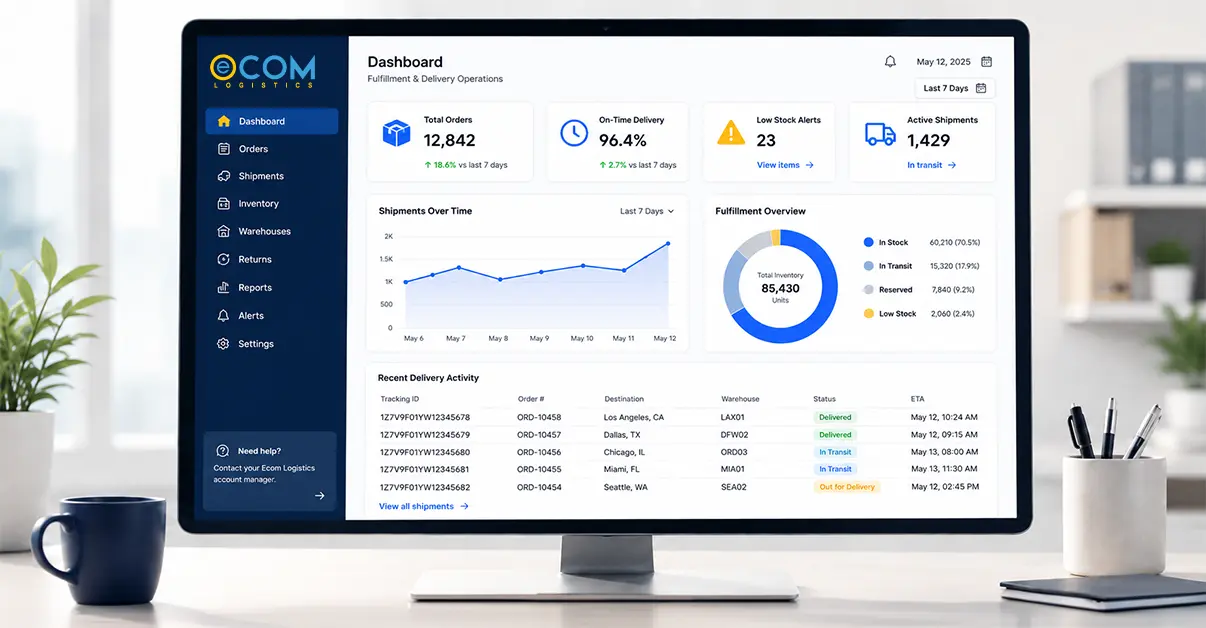
Real-time, multi-warehouse visibility allows brands to see stock levels across all locations simultaneously, route orders from the nearest fulfillment point, and replenish proactively. This is particularly relevant for brands using ecommerce fulfillment services Canada wide, where the geographic spread makes smart inventory placement a direct lever on both cost and delivery speed.
Manual Tracking vs. Automated Inventory Management
43% of small businesses still do not track inventory or rely on outdated manual systems, despite the availability of modern, affordable solutions. Manual tracking works at very low order volumes. It breaks down quickly as SKU counts grow, sales channels multiply, and fulfillment locations expand. The errors that come from spreadsheets and manual counts are not just inefficient. They compound, and they show up directly in the customer experience.
Automated systems give brands real-time visibility across every sales channel and fulfillment location simultaneously. Orders are tracked from placement through dispatch. Reorder points trigger automatically. Demand forecasting draws on actual sales data rather than estimates. And integration between the inventory system and the warehouse management system is what makes all of this work at scale.
Best Practices for Inventory Management in Ecommerce Fulfillment
Strong inventory practices are built on consistency, visibility, and data-driven decision making. These core practices form the foundation of fulfillment operations that scale without losing accuracy or efficiency.
Demand Forecasting to Prevent Stockouts
Reactive inventory management means you are always catching up. Proactive management means using historical sales data, seasonality patterns, and promotional calendars to anticipate demand before it arrives.
Brands that invest in demand forecasting reduce both stockout frequency and overstock situations simultaneously, improving cash flow and fulfillment consistency together. The more granular your forecasting, the better: accounting for channel-specific demand, regional buying patterns, and supplier lead times gives you a picture that is far more accurate than a blanket monthly average.
Setting Reorder Points and Safety Stock Levels
A reorder point is the stock level at which a new purchase order should be triggered. Safety stock is the buffer inventory held above that threshold to absorb unexpected demand spikes or supplier delays. Many brands set these figures once and forget them, which causes problems as order volumes and lead times shift.
Reorder points and safety stock levels should be reviewed regularly, particularly ahead of peak seasons or when you change suppliers. Getting this right means you are never caught short, but also never holding more stock than necessary.
Regular Cycle Counts and Audits
Rather than relying on a disruptive annual physical count, leading brands run regular cycle counts on rotating portions of their inventory throughout the year. This keeps data accurate continuously without shutting down warehouse operations. Discrepancies are caught early, before they result in a failed order or a customer complaint.
A well-structured cycle count programme also makes it easier to spot patterns, such as specific SKUs that consistently show variances, which often points to a process or handling issue worth addressing at the root.
ABC Analysis for Smarter Stocking Decisions
ABC analysis categorises inventory into three tiers based on sales velocity and revenue contribution. A items are high-value, fast-moving products that require tight management and reliable stock levels. B items are moderate performers. C items move slowly and need minimal reorder frequency. This framework helps brands allocate warehouse space intelligently, set reorder priorities, and avoid the cost of managing every SKU with the same level of attention. Treating a slow-moving C item with the same urgency as your top-selling A item wastes time, space, and money.
SKU Rationalisation
Growing ecommerce brands have a tendency to accumulate SKUs over time, often without reviewing whether each one is earning its place in the warehouse. Excess SKUs increase picking complexity, inflate storage costs, and make demand forecasting harder.
Regular SKU rationalisation, reviewing which products are contributing to revenue versus consuming space, keeps your inventory lean and your operations focused. Discontinuing or consolidating low-performing variants is one of the fastest ways to free up warehouse capacity and reduce carrying costs without changing anything else about your fulfillment process.
Platform and Channel Integration
Selling across multiple channels without a centralised inventory system is a reliable path to overselling, stockouts, and manual errors. When your inventory management system integrates directly with your ecommerce platform, marketplace listings, and order management tools, stock levels update in real time across every channel the moment an order is placed. This single source of truth eliminates the discrepancies that come from managing channels separately and gives your team the accurate data they need to make purchasing decisions with confidence.
First In, First Out (FIFO) Stock Rotation
FIFO is a straightforward principle: the oldest stock ships first. For most ecommerce categories, particularly consumables, health products, and anything with a shelf life or packaging that can date, FIFO is not optional. Failing to apply it results in older stock sitting at the back of the warehouse while newer units ship, creating spoilage, write-offs, and quality complaints that erode both margin and customer trust. A well-organised warehouse with clear labelling and bin management makes FIFO easy to execute consistently.
The 3PL Advantage for Inventory Management at Scale
Outsourcing inventory management to a 3PL removes the complexity of managing multiple warehouse locations, integrations, and systems while keeping you in control of your inventory strategy and decisions.
Why Brands Outgrow In-House Inventory Management
In-house inventory management works until it does not. The point of failure is usually a combination of growing SKU complexity, multiple sales channels, and the inability to scale warehouse operations without significant capital investment. The decision to outsource is rarely about losing control. It is about gaining infrastructure and expertise that would take years to build internally. Before making that call, the comparison of outsourcing vs in-house fulfillment is worth reading carefully.
What a Good Canadian 3PL Brings to Inventory Management
A 3PL brings more than warehouse space. The right partner provides a cloud-based warehouse management system with real-time inventory visibility, multi-location stock management across key Canadian markets, integration with your existing ecommerce platform, and the operational expertise to handle demand spikes without losing accuracy.
For growing brands, this combination removes the need for in-house systems, in-house staff, and the compounding cost of inventory errors. Understanding the full picture of ecommerce fulfillment costs is the right starting point for evaluating whether a 3PL partnership makes financial sense to you.
The Last Mile Is Only as Good as the Inventory Behind It

Every fast, reliable delivery starts with an accurate pick. Every accurate pick starts with clean inventory data.
Brands that invest in getting their inventory right find that fulfillment performance improves across every metric, from order accuracy to delivery speed to return rates. Those that treat inventory management as a back-office admin task continue fighting the same operational fires at scale.
Ecom Logistics works with ecommerce brands across Canada to provide real-time inventory visibility, multi-city warehousing, and the fulfillment infrastructure to support consistent, scalable growth. If your current inventory management is creating more problems than it solves, get in touch with our team.
Frequently Asked Questions
Inventory management in ecommerce fulfillment is the process of tracking, controlling, and optimising stock levels across a fulfillment network. It covers receiving and storing inventory, monitoring stock accuracy, forecasting demand, and ensuring the right products are available when orders come in.
Inaccurate inventory is one of the most common causes of fulfillment delays. When your system does not reflect what is physically in the warehouse, orders get cancelled or delayed regardless of how fast your carriers are. Accurate inventory is what makes same-day and next-day fulfillment reliably possible at scale.
The most common mistakes are relying on manual tracking for too long, skipping regular cycle counts, failing to forecast demand around seasonal peaks, and concentrating all inventory in a single location. Each of these creates compounding inefficiencies that become increasingly expensive as order volumes grow.
A quality 3PL uses a cloud-based warehouse management system that provides real-time inventory visibility across all storage locations. Stock levels update automatically as orders are processed. Brands access inventory data through a dashboard, set reorder alerts, and track fulfillment performance without managing the warehouse directly.
Inventory management software tracks stock levels, forecasts demand, and manages purchase orders. A warehouse management system controls the physical movement of stock within the warehouse, including pick paths, bin locations, and labour allocation. Many 3PL providers combine both within a single integrated platform.
Combining demand forecasting with safety stock calculations based on supplier lead times and historical sales data is the most effective approach. Regular cycle counts keep inventory data accurate, and ABC analysis ensures the tightest management is applied to your highest-value, fastest-moving products.
Multi-warehouse inventory management allows brands to store stock across multiple fulfillment centers, such as Toronto, Montreal, and Vancouver, and route each order from the nearest location. This reduces shipping costs, shortens delivery windows, and improves resilience when one location faces delays. Real-time visibility across all locations is essential for this to function accurately.
The clearest signals are rising inventory error rates, missed delivery windows, storage capacity constraints, and in-house fulfillment costs that exceed what outsourcing would cost. If your team is spending more time fixing fulfillment problems than building the business, it is time to evaluate a 3PL partnership seriously.
- About the Author
- Latest Posts