For most ecommerce brands, peak season preparation focuses on one thing: volume. More orders, more stock, more staff. What that framing misses is that marketplace peak season demand operates under a completely different set of rules from direct-to-consumer. The volume spike is the same, but the consequences of getting it wrong are not.
On your own site, a delayed shipment creates a dissatisfied customer. On a marketplace, the same delayed shipment can trigger a late shipment rate violation, suppress your listing, or put your seller account under review during the highest-revenue window of the year. Marketplace fulfillment peak season preparation is not just an operational challenge but a risk management one too.
If you have not already read how to prepare your ecommerce fulfillment strategy for peak season, that is the right place to start before diving into the marketplace-specific detail this blog covers.
Why Marketplace Fulfillment Peak Season Demand Is Harder Than It Looks
The numbers make the stakes clear. Q4 drives 30 to 35% of annual seller revenue on Amazon. Nova’s analysis of Amazon seller statistics reports that 86% of top Amazon sellers use FBA, and that 73% of all active sellers rely on it as their primary fulfillment method. But FBA is not the only path. Sellers running FBM, Seller Fulfilled Prime, or multi-channel fulfillment carry the operational weight of peak season in their own operation or with their 3PL partner. And even FBA sellers own everything upstream of the fulfillment center: forecasting, prep, labeling, and getting inventory received and checked in before the cut-off.
What makes marketplace peak season particularly demanding is the combination of three pressures arriving simultaneously: volume spikes that would stress any operation, platform SLA requirements that carry real account consequences when missed, and compressed timelines that leave no room for reactive problem-solving.
What Separates Prepared Marketplace Sellers from Unprepared Ones
Before getting into the preparation steps, it is worth being honest about what the gap looks like in practice. The brands that perform consistently through marketplace peak season are not necessarily the ones with the largest operations. They are the ones that prepared the right things, in the right order, before the volume arrived.
| Factor | Unprepared Marketplace Seller | Prepared Marketplace Seller |
| Inventory | Reacting to stockouts mid-peak, missing Buy Box | SKUs forecasted and stocked at peak marketplace velocity |
| Platform SLA awareness | Generic shipping targets, not marketplace-specific | Each platform’s late shipment thresholds known and planned for |
| Fulfillment capacity | Single channel optimised, multi-channel breaks under volume | Multi-channel throughput tested and confirmed pre-peak |
| Carrier strategy | Single carrier, no contingency for disruptions | Multiple carriers in place, delivery SLAs matched to platform requirements |
| Inbound deadlines | Late inventory sends, missed platform-specific deadlines, stranded or unavailable stock during peak | Platform inbound and handling deadlines confirmed for every channel. |
| Returns process | Reactive, platform returns creating metric pressure | Marketplace return workflows defined and ready for January volume |
| Technology | WMS and order management not synced across channels | Real-time inventory sync across all marketplace and DTC channels |
Start Earlier Than You Think, and Earlier Than Last Year
Marketplace peak season preparation is governed by inbound deadlines, not by the sale dates everyone plans around. Amazon does not publish one universal Q4 cut-off. The dates are segmented by event and by how you send inventory, and they are arrival deadlines, not ship-by deadlines.
For 2026, Amazon’s published cut-offs for Prime Big Deal Days are September 2 for Amazon Warehousing and Distribution shipments, September 9 for FBA shipments using minimal shipment splits, and September 16 for FBA shipments using Amazon-optimized shipment splits. For Black Friday Week and Cyber Monday, the dates are October 14, October 21, and October 28 respectively. Inventory arriving after these dates is not guaranteed to be processed in time.
Arriving is not the same as being sellable. Amazon advises scheduling delivery appointments at least seven days before a cut-off, or arranging pickup at least fourteen days ahead when using Amazon Partnered Carriers. Fulfillment centres focus on receiving through September and October, then shift to outbound order processing in November and December, and capacity limits can tighten as inbound delivery slots fill.
The preparation timeline that holds up: demand forecasting in Q2, FBA shipment plans and carrier conversations confirmed in early Q3, warehouse capacity and staffing stress-tested by mid-Q3, and every marketplace integration tested before the first inbound deadline. October is not a quiet execution month for FBA sellers. It contains the Black Friday and Cyber Monday inbound window, which means October is when the last real decisions get made.
Step 1: Audit Your Inventory at Marketplace Velocity, Not Average Velocity
Inventory forecasting for marketplaces requires a different input than DTC forecasting. Marketplace velocity during peak can be three to five times average, and it can shift rapidly based on algorithm changes, competitor stockouts, and promotional event timing.
The questions to answer before peak season: what did each of your top SKUs sell per day on each marketplace during the equivalent period last year? How does that compare to current average velocity? Where is inventory positioned relative to FBA fulfillment centres or your own warehouse? Is safety stock calibrated to peak daily sales, not average weekly sales?
Overstocking in FBA carries storage fee risk. Understocking means losing the Buy Box at exactly the moment when marketplace traffic is highest. What role inventory management plays in ecommerce fulfillment success covers the operational frameworks behind getting this right, including reorder points, safety stock calculations, and demand signal accuracy.
Step 2: Know Each Marketplace’s Peak Season Fulfillment Requirements Before Peak Arrives
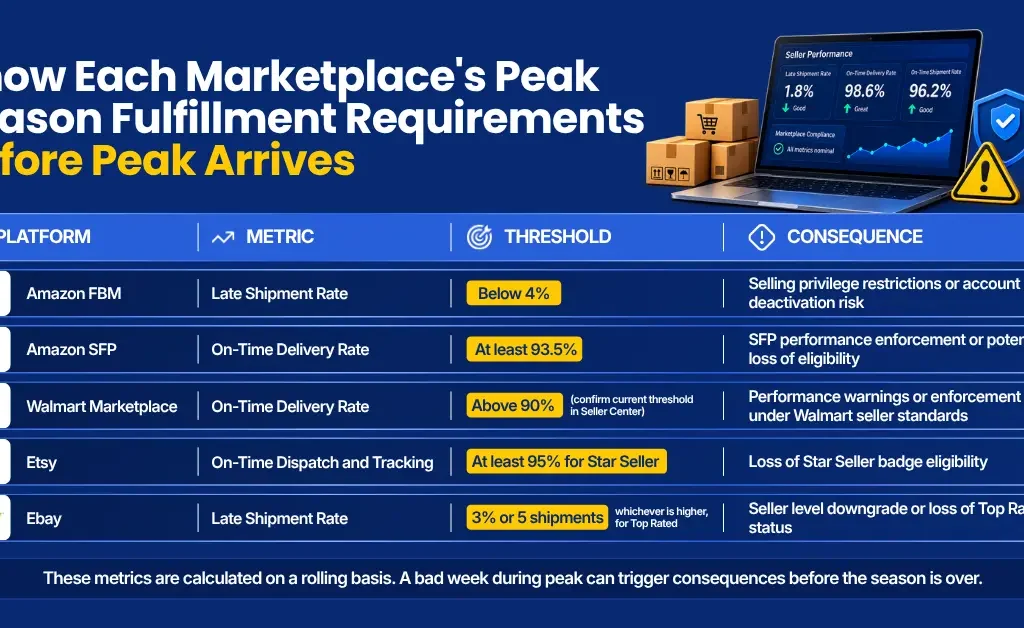
Standards checked against publicly available platform documentation retrieved in August 2026. Thresholds and enforcement vary by marketplace, account, program, country, and evaluation window. Confirm current figures in each seller dashboard before peak season.
This is the step most multi-marketplace sellers underinvest in. Each platform has its own performance thresholds, its own handling time requirements, and its own consequences for missing them during peak.
Amazon FBM and Seller-Fulfilled Prime: Amazon seller-fulfilled orders are measured on two shipping metrics, not one. Late shipment rate must stay below 4%, and on-time delivery rate must stay at or above 90% measured without promise extensions, which is the stricter version of the metric Amazon uses for enforcement. Since February 2026, Amazon deactivates the specific listings dragging that rate down rather than the whole catalogue, though sustained underperformance still puts broader selling privileges at risk. Seller Fulfilled Prime adds a 93.5% on-time delivery requirement reviewed weekly, alongside valid tracking and cancellation thresholds. None of this applies to FBA orders, because Amazon owns the delivery promise on those.
Walmart Marketplace: Walmart publishes separate standards for its US and Canadian marketplaces, which matters if you sell on both. The US marketplace requires on-time delivery of 90% or above and a valid tracking rate of 99% or above, alongside cancellation, response, return, and late shipment thresholds, all evaluated over the last 30 or 60 days. Walmart Canada sets on-time delivery above 90% but valid tracking above 95%, with a different cancellation and refund rate structure. Assuming your US thresholds apply north of the border is a straightforward way to miss a standard you did not know existed.
Etsy and eBay: Etsy requires at least 95% of orders to ship on time with valid tracking for Star Seller eligibility, reviewed monthly across a rolling three-month window. Etsy states the badge does not directly affect search ranking, so what you lose is buyer confidence rather than visibility. On eBay, late shipment rate is a Top Rated requirement rather than a minimum standard: Top Rated sellers must stay at or below 3% of transactions or five late shipments, whichever is higher. eBay’s minimum standards are driven by cases closed without seller resolution and transaction defect rate instead, so a bad shipping week costs you the Top Rated badge rather than your account standing.
The practical takeaway is that marketplace SLAs are not abstract targets. They are performance requirements backed by real account consequences. Every marketplace you sell on has a specific number. Know it, and build your peak season fulfillment operation around hitting it with margin to spare, not just at the threshold.
Step 3: Stress-Test Your Fulfillment Operation for Multi-Channel Volume
Peak season does not spike one channel. It spikes all of them simultaneously. Your own site, your Amazon storefront, your Walmart listings, and any other marketplaces you sell on all accelerate at the same time. A fulfillment operation built and tested around single-channel volume will show that limitation clearly when multi-channel orders arrive together.
Whether you manage fulfillment in-house or through a 3PL partner, the questions to answer before peak are: what is your maximum daily order output across all channels combined? Can your WMS handle the order velocity without creating processing delays? Are marketplace orders and DTC orders being routed correctly without manual intervention? Why ecommerce fulfillment breaks as you scale identifies the specific pressure points that tend to surface when multi-channel volume spikes simultaneously: most of them are predictable and preventable with the right preparation.
If you are working with a 3PL, confirm their capacity ceiling at your projected peak volume specifically, and ask whether your account receives the same service level when every brand on their network is surging simultaneously. That question matters more for marketplace sellers than almost anyone, because the cost of a missed SLA is not just a customer complaint.
“The marketplace sellers that struggle in Q4 are almost always the ones who tested their fulfillment operation at normal volume and assumed it would hold at three times that,” says Tammy Huynh at Ecom Logistics. “Multi-channel peak season volume needs to be stress-tested before October, not discovered in November.”
Step 4: Build Carrier Diversification Before Peak, Not During It
Marketplace SLAs are tied to delivery performance, not just dispatch performance, which means your carrier’s reliability shows up directly in your seller metrics. How much of it lands on you depends on the platform. Some marketplaces distinguish between delays you caused and delays the carrier caused, and some offer protections when tracking shows you handed the shipment over on time. Walmart separates seller-accountable drivers like late handover and missing scans from non-accountable ones like carrier exceptions and weather. eBay removes late shipments for disruptions outside your control. Amazon’s on-time delivery rate is measured without promise extensions, which means the version used for enforcement is stricter than the delivery window your customer sees. The practical point is that no platform protects you completely, the protections differ, and none of them apply until after the damage to your metrics has already happened. That makes carrier diversification a marketplace-specific risk decision, not just an operational preference.
Single-carrier dependency during peak is one of the fastest ways to create a seller metrics problem. When every brand is competing for the same carrier capacity simultaneously, disruptions during Q4 are predictable. Having multiple carrier partnerships in place before the season starts, with clear routing logic for which carrier handles which shipment type, removes that single point of failure.
Canadian sellers have seen how fast carrier concentration turns into an operational problem. During the 2025 national strike, Canada Post halted processing and delivery, suspended service guarantees, and stopped accepting new items. In its third quarter that year the corporation reported a $541 million loss before tax, its largest ever, with parcel revenue down 39.8% and parcel volume down 42.5% against the same quarter a year earlier. Canada Post attributed the decline to strike activity and uncertainty pushing customers toward competitors that could offer delivery stability. Businesses with a second carrier already integrated were in a position to reroute. Businesses without one were building a new shipping workflow while orders sat.
For sellers using FBM or SFP, carrier delivery performance is directly visible to Amazon in your on-time delivery rate, and Amazon’s minimum for seller-fulfilled listings is 90%. A carrier that comfortably clears that in Q3 can drift below it in Q4 when the network is under pressure, and the gap between a carrier’s normal performance and its peak performance is rarely something they will volunteer. Ask for peak season delivery data specifically before committing your Q4 volume, not annual averages.
Step 5: Plan Your Marketplace Returns Process Before January Arrives
Marketplace returns during peak season follow a predictable pattern: the volume arrives in January, driven by the December orders that fulfilled successfully. Most brands plan their peak season fulfillment operation entirely around outbound flow and absorb the reverse logistics consequences reactively when January arrives.
On marketplaces, this creates a compounding problem, and where the return physically lands depends on how the order was fulfilled. FBA and Walmart Fulfillment Services returns go back into the platform’s network and are assessed there, which removes the handling burden but also removes your visibility into condition and disposition until the inventory reappears, or does not. Seller-fulfilled returns, including FBM, Seller Fulfilled Prime, and removal orders coming back out of FBA, land at your warehouse or your 3PL. Most multi-channel brands are running both at once, which means two different return flows arriving in the same January.
For the returns you do receive, the risk is process rather than volume. If there is no defined receiving workflow, no condition assessment process, and no system update connecting the return to inventory and refund status, the result is inventory that is physically present but not counted, delayed refunds that generate platform complaints, and metric pressure when the return reason is one the platform holds you responsible for.
The time to design the inbound returns workflow for marketplace volume is before peak, not after. Our blog on common ecommerce fulfillment mistakes includes a detailed breakdown of how return process failures compound during high-volume periods and what a properly structured reverse logistics process looks like.
Common Marketplace Fulfillment Mistakes in Peak Season
These are the errors that come up consistently, and most of them are avoidable with preparation that starts before Q3 ends.
Sending FBA inventory that is not fully prepped is a new mistake this year, and it now applies on both sides of the border. Amazon ended its prep and item labeling services for US FBA shipments on January 1, 2026, and for Canadian FBA shipments on July 1, 2026, which means bagging, bundling, and FNSKU labeling are entirely the seller’s responsibility in both marketplaces. The change covers inventory sent directly to FBA as well as inventory routed through Amazon Warehousing and Distribution, Amazon Global Logistics, Amazon SEND, and the Supply Chain Portal. Shipments created after the applicable date that arrive without proper prep and labeling may still be processed, but Amazon says the affected inventory will not be eligible for reimbursement if it becomes damaged or untraceable. This is the first peak season where that applies in either market, and prep capacity at third-party providers fills up well before the inbound deadlines do.
Sending FBA inventory too late is the most common and the most preventable. Amazon’s inbound cut-off deadlines are published well in advance. Missing them means your inventory may not be available for Prime-eligible fulfillment during peak, regardless of how well everything else is managed.
Treating all marketplaces as having the same SLA requirements is the second most common error. Each platform has different thresholds and different consequences. Applying a single fulfillment standard across all channels without accounting for platform-specific requirements is how sellers end up with a Walmart listing demotion they did not anticipate.
Not having a contingency for volume spikes above forecast is the third. Peak season volume rarely lands exactly on projection. The brands that hold their SLAs through peak are the ones that built capacity for 20% above their forecast, not exactly at it.
For a broader view of how to structure your fulfillment operation to hold up at peak volume, working with the right ecommerce fulfillment partner in Canada covers the criteria that separate partners that perform under pressure from those that do not.
Marketplace Peak Season Fulfillment Readiness Checklist
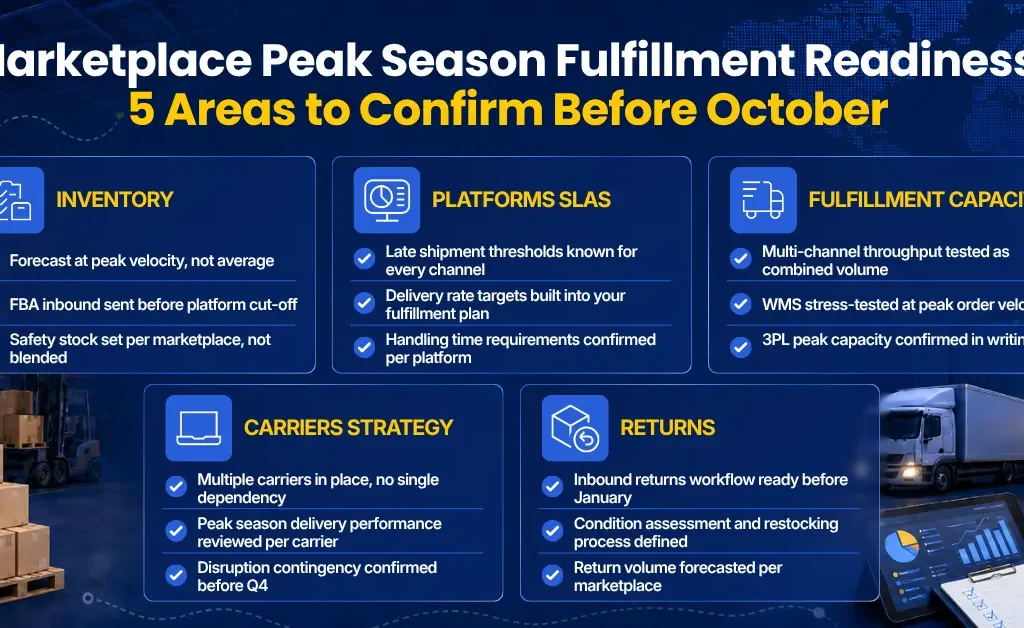
Marketplace peak season does not give you time to discover gaps mid-season. Unlike your own site, where a fulfillment failure creates a customer service problem, a fulfillment failure on a marketplace creates a metrics problem that the algorithm acts on automatically, often before you are even aware something went wrong. Use this checklist in Q3 as an operational audit, not a pre-shipping reminder. If any of these are not confirmed before October, the gap will show up in your seller metrics, not just your operations.
Conclusion: Marketplace Peak Season Is Won Before Q4 Starts
Marketplace fulfillment peak season performance is not decided in November. It is decided by the inventory positioning, carrier conversations, SLA reviews, and capacity confirmations that happen in Q2 and Q3. The brands that consistently perform through peak are the ones that treated preparation as a strategic priority, not a September checklist.
Ecom Logistics provides ecommerce fulfillment across Canada and the United States, including FBA prep and labeling now that Amazon no longer offers it, multi-channel order management, and a fulfillment infrastructure built to hold performance at peak volume.
If your marketplace fulfillment operation has gaps that need closing before Q4 arrives, talk to our team.
Frequently Asked Questions
Marketplace peak season is the Q4 period of dramatically elevated order volume on platforms like Amazon and Walmart. Unlike DTC, missed fulfillment SLAs on a marketplace trigger algorithmic penalties, listing demotions, and account consequences that affect visibility well beyond the peak period itself.
DTC peak season creates customer experience pressure. Marketplace peak season creates that plus platform compliance pressure. Missed SLAs on a marketplace are enforced automatically, often before you are aware something went wrong.
Q2 for demand forecasting, early Q3 for FBA shipment plans and carrier conversations, and all systems tested before the first inbound deadline. Amazon’s 2026 cut-offs are September 2, 9, and 16 for Prime Big Deal Days and October 14, 21, and 28 for Black Friday Week and Cyber Monday, depending on shipment type. Because these are arrival deadlines rather than ship-by dates, preparation that begins in September is already late.
Sending FBA inventory too late, applying the same SLA assumptions across all platforms, relying on a single carrier, not stress-testing multi-channel capacity before peak arrives, and failing to plan for January returns volume.
Each platform enforces its own set of thresholds on a rolling basis, so a poor performance window during peak can affect offer eligibility, visibility, or account standing well after the season ends. On Amazon, seller-fulfilled orders are measured against a late shipment rate below 4% and an on-time delivery rate of at least 90%, with Seller Fulfilled Prime adding a 93.5% on-time delivery requirement reviewed weekly. Walmart’s standards differ by country: the US marketplace requires an on-time delivery rate of 90% or above alongside a 99% valid tracking rate, while Walmart Canada sets on-time delivery above 90% with valid tracking above 95%. The consequences vary by platform and by how long the underperformance persists, ranging from performance warnings through to listing suppression and account suspension.
FBA for Prime-eligible inventory on top SKUs, with a well-resourced FBM or 3PL operation for overflow and slower-moving stock. FBA inventory must be positioned before the inbound cut-off, with carrier diversification in place for FBM orders.
Marketplaces measure different events. Some track ship confirmation or the first carrier scan, others track delivery against the promised date, and several offer protections when a delay is clearly outside the seller’s control. Carrier diversification reduces concentration risk, but it only protects your metrics if the alternate carrier’s service levels can actually meet each platform’s promise dates and tracking requirements in the regions you ship to. Reviewing carriers on peak season performance rather than annual averages is what makes the backup option worth having.
Plan for January before December. Define the inbound receiving workflow, condition-based routing, and inventory system updates before peak begins. Returns from peak sales arrive predictably in Q1 and will create metric pressure if the process is not ready.
- About the Author
- Latest Posts