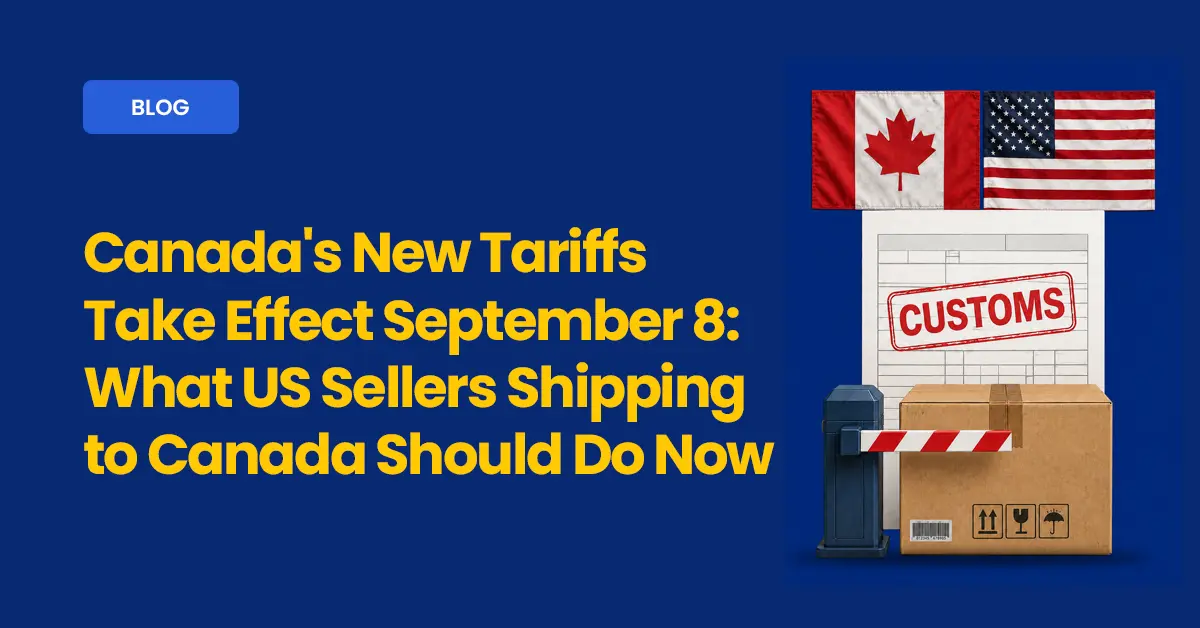
For years, US brands selling into Canada could plan around fairly predictable border costs. That changed this week. Canada’s new tariffs on US goods take effect September 8, 2026, applying duties of 15%, 25%, and up to 50% to more than 700 American product tariff items.
The countermeasures respond directly to a fresh round of US tariffs on Canadian goods that took effect August 22. Ottawa is matching Washington “dollar for dollar,” and this round reaches well beyond headline industries into everyday ecommerce categories: steel, dairy, paper goods, apparel, cosmetics, and more.
If your business ships products from the US into Canada, the question is no longer whether this trade escalation affects you. It is whether your specific SKUs are on the list, and what you do about it before September 8. For background on the broader tariff environment, Ecom Logistics’ earlier breakdown of the Section 338 tariffs on Canadian goods covers how this trade dispute started.
What Triggered Canada’s September 8 Tariffs on US Goods
Canada’s countermeasures are a direct response to Washington. After trade talks between the two countries broke down, the United States imposed a 50% tariff on roughly US$27.6 billion worth of Canadian goods, effective August 22, 2026, under Section 338 and Section 232 authority.
Ottawa answered in kind. As Reuters reported, Canada’s Department of Finance confirmed it will impose tariffs of 15%, 25%, and 50% on an equivalent US$27.6 billion of US-origin goods, matching the American measures dollar for dollar. Canadian Prime Minister Mark Carney acknowledged the retaliation will raise costs for Canadians too, but said the government was not prepared to leave the US measures unanswered.
This is not Canada’s first round of retaliatory tariffs since the trade dispute began, earlier counter-tariffs on US autos, steel, and aluminum remain separately in place and are not replaced by this new list.
What’s Actually on Canada’s Tariff List
Canada’s Department of Finance has focused the new tariffs on sectors most affected by the US measures: steel, dairy, appliances, agricultural equipment, pulp and paper, and electronics. But as with the US tariffs on Canadian goods, the published list runs far broader than those headline categories once you look at the tariff item detail.
| Sector | Why It’s Targeted | Example Products Covered | Tariff Rate |
| Steel Products | Matches U.S. Section 232 tariffs on Canadian steel and aluminum | Steel coils, bars, rods, plated and coated steel sheet | 50% |
| Dairy | Matches U.S. Section 338 dairy tariffs on Canadian dairy exports | Milk and cream powder, whey, casein, natural honey | 50% |
| Cheese | Separate tariff line within the dairy category | Cheddar, mozzarella, parmesan, processed cheese | 25% |
| Paper & Packaging | Broadens pressure into everyday consumer and shipping goods | Toilet paper, tissue, envelopes, cartons, kraft paper | 25% to 50% |
| Apparel & Textiles | Targets high-volume consumer categories | T-shirts, jackets, dresses, gloves, carpets | 25% to 50% |
| Cosmetics & Personal Care | Consumer goods exposure outside the headline sectors | Perfumes, makeup, hair and skin preparations | 50% |
| Wood & Building Materials | Reflects ongoing softwood lumber and plywood disputes | Plywood, laminated wood, wood pulp, wood charcoal | 25% to 50% |
All rates are set at the specific Harmonized System tariff item level, not at the level of a general product category. A product that sounds unrelated to steel, dairy, or paper may still appear in the official list.
How the Tariff Rates Are Determined
Each product on Canada’s list carries a rate of 15%, 25%, or 50%, and the rate is not arbitrary. Section 338 and Section 232 are US trade laws, the same authorities Washington used to impose its tariffs on Canadian goods. Canada has matched each tariff item’s rate to the rate the United States applies to the equivalent Canadian good under those two US measures. In effect, Ottawa built its retaliation list as a mirror of Washington’s.
This means a general product description is not enough to determine exposure. Two products in the same broad category, apparel for example, can carry different rates depending on fibre content, construction, and their exact tariff classification. Businesses need to check their specific Harmonized System code against Canada’s published list rather than assuming based on category name alone.
Why the September 8 Customs Entry Date Matters
Canada’s countermeasures take effect at 12:01 a.m. Eastern Time on September 8, 2026. Like most tariff measures, what matters is not when an order is placed or when a shipment leaves the US, but when the goods are accounted for at the Canadian border.
There is one notable difference from the US Section 338 tariff on Canadian goods, which applies with no in-transit exemption at all. Canada’s countermeasures do carry a transit exception. Goods already in transit to Canada on September 8, when the measures come into force, are not subject to the new tariff. Businesses relying on this exception should keep clear shipment and transit documentation, since CBSA is expected to require proof of transit status at the border.
Beyond that exception, the entry date is what counts. A shipment that leaves a US warehouse before September 8 but clears Canadian customs afterward should still be treated as exposed to the new duty unless it qualifies as in transit.
What This Means for US Sellers Shipping to Canada
The most immediate effect is a reset in landed cost for every covered product moving into Canada. A product with a customs value of US$100 that previously cleared Canadian customs under standard duty treatment could now carry an additional US$15 to US$50 in tariff, before brokerage fees, GST, and provincial taxes are added.
For sellers operating on standard ecommerce margins, that is not a rounding error. It changes the underlying economics of shipping into Canada for any affected SKU.
Sellers need to recalculate landed cost across their full catalogue rather than assuming only the headline sectors apply, and decide who absorbs the new duty on Canadian orders, the business or the customer, before September 8. Delivered Duty Paid shipping prevents surprise charges at the Canadian customer’s door but requires the cost to be built into pricing ahead of time. Delivered Duty Unpaid arrangements risk refused deliveries and damaged customer experience once Canadian buyers start seeing unexpected bills.
5 Things US Sellers Must Do Before September 8
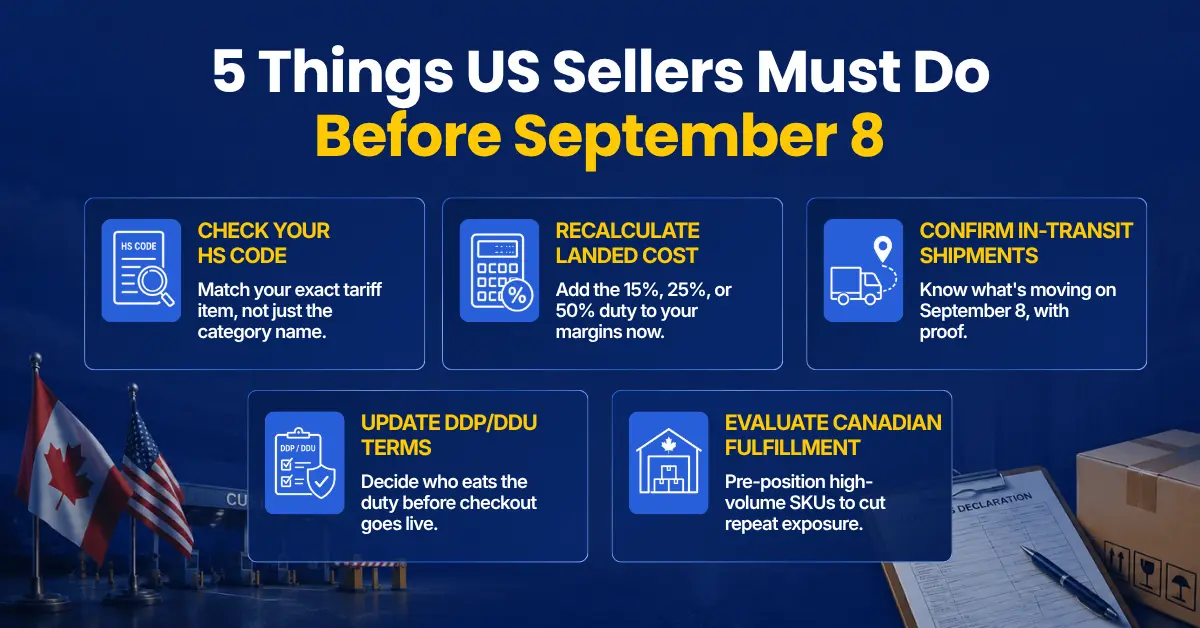
1. Know Your Exact HS Code, Not Just Your Product Category
“Apparel” or “steel products” won’t tell you what you actually owe. Canada’s tariff list is built at the specific Harmonized System line, and two products in the same general category can carry completely different rates. Pull the precise tariff code for every SKU you ship to Canada and check it against the published list yourself. Don’t rely on a general sense of what industry you’re in.
2. Stress-Test Your Margins Before the Duty Hits
Take your affected SKUs and run the numbers with 15%, 25%, or 50% added to landed cost. Some products will absorb it fine. Others may no longer be worth shipping to Canada at your current price point. It’s far better to find that out in a spreadsheet this week than on a customer’s invoice, or your own bottom line, after September 8.
3. Get Ahead of Your In-Transit Shipments
Talk to your carrier and customs broker now about what’s already moving toward Canada. The transit exception only protects goods that were in transit when the tariff took effect, and proving that status requires documentation, not just a shipping date on an invoice. Get clarity on what qualifies before your goods reach the border, not while they’re sitting there.
4. Decide Who’s Paying the New Duty
This isn’t just a customs question, it’s a pricing decision. If you ship DDP, that 15% to 50% needs to be built into your checkout price before the deadline. If you ship DDU, your Canadian customers will be the ones facing an unexpected bill at delivery, and they’ll blame you for it regardless of the legal fine print. Pick a lane now and update your terms accordingly.
5. Rethink Where Your Inventory Actually Sits
If Canada makes up a meaningful share of your sales, ask whether it still makes sense to ship every single order across the border. Positioning inventory inside Canada removes the tariff question from each individual sale once that stock has cleared customs. It won’t make sense for every seller, but for anyone with steady, high-volume Canadian demand, it’s worth running the numbers before assuming the status quo still works.
Could These Tariffs Still Change?
These countermeasures arrive against a backdrop of ongoing Canada-US trade tension. Talks between the two governments broke down before this latest round of tariffs, but both sides have signaled they remain open to further negotiation.
Canada’s Department of Finance has confirmed that existing remission programs, including the one covering steel, remain available, and is expected to extend relief consideration to some of the newly listed products, pending government approval. New remission requests are also being accepted for exceptional cases. Businesses that believe a specific product warrants relief should raise this with their customs broker rather than assuming none is available.
Section 338 and Section 232 authority, on the US side, carries no fixed expiration date, and Canada’s countermeasures are structured the same way. Absent a negotiated agreement or a new government order, businesses should plan around September 8 as the operative date while watching for updates from Canada’s Department of Finance and the CBSA.
How Canadian Fulfillment Can Support Your Cross-Border Strategy
For US ecommerce brands with steady Canadian demand, holding inventory inside Canada removes the per-order tariff exposure this new round of countermeasures creates. Once inventory has cleared Canadian customs and is sitting in a Canadian fulfillment centre, individual customer orders ship domestically, without a border crossing, a brokerage fee, or a customs charge attached to every single sale.
“What we’re telling US brands right now is the same thing we told Canadian brands facing the US tariffs in August: don’t wait to see how the trade dispute plays out before you act,” says Tammy Huynh at Ecom Logistics fulfillment team. “Holding your highest-volume SKUs inside Canada takes the tariff question out of every single order, whichever way the broader trade relationship goes.”
Ecom Logistics operates fulfillment centres across Canada, supporting US brands that need Canadian-based inventory, order processing, pick-and-pack, domestic Canadian shipping, and returns handling, all managed through a real-time inventory system. For sellers reassessing their Canadian fulfillment strategy before September 8, this kind of setup can absorb the tariff question at the inventory level rather than at every individual order.
The right approach will vary by product, order volume, and customs classification. Sellers should review their specific situation with a licensed customs broker alongside their fulfillment partner.
The Bottom Line: Prepare, Don’t Panic
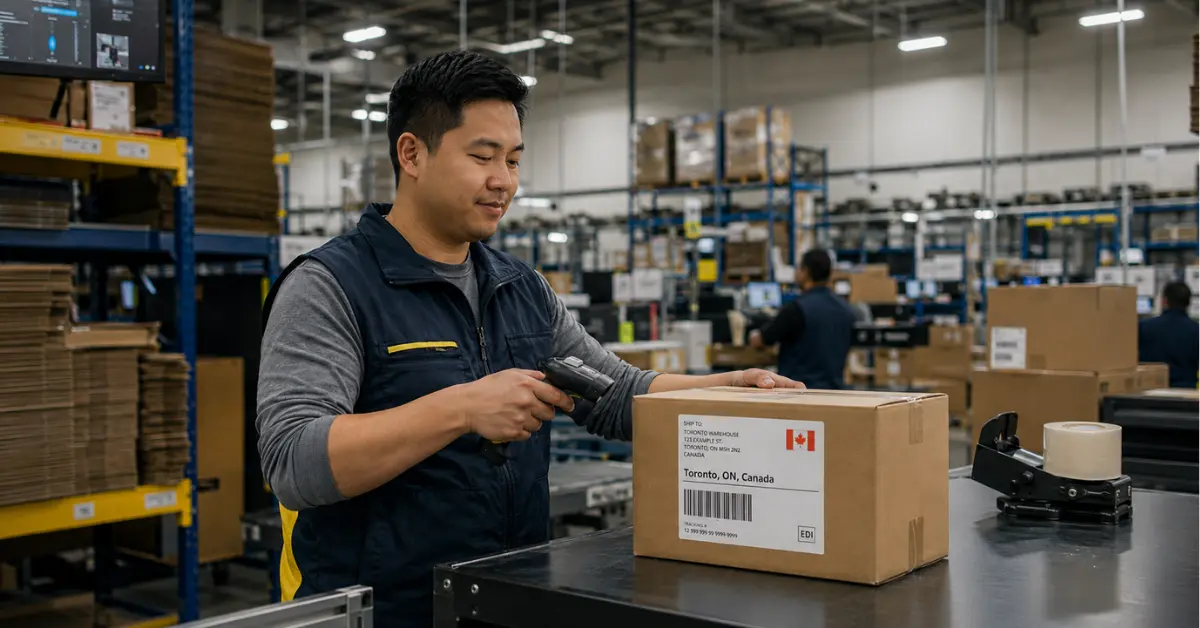
A US-based fulfillment or warehouse worker scanning a box labeled for a Canadian address, calm and in-control, conveying readiness rather than crisis.
The cross-border model many US sellers have relied on assumed relatively stable and predictable Canadian duty treatment. For the products now covered, that assumption no longer holds after September 8.
The right response is preparation, not panic. Check your Harmonized System codes, recalculate your landed costs, confirm your in-transit shipments, and assess whether Canadian inventory positioning makes sense for your highest-volume products. These are the right operational steps regardless of how the broader trade dispute resolves.
Ecom Logistics offers ecommerce fulfillment across Canada and the United States. If you’re reassessing your cross-border strategy before September 8, now is the time to act.
Ready to talk through your Canadian fulfillment options? Contact Us Today
Frequently Asked Questions
Effective 12:01 a.m. Eastern Time on September 8, 2026, Canada is applying tariffs of 15%, 25%, and 50% on more than 700 categories of US-origin goods, covering roughly US$27.6 billion in imports. The measures match, dollar for dollar, the 50% US tariff on Canadian goods that took effect August 22, 2026.
Canada is responding directly to the United States, which imposed a 50% tariff on approximately US$27.6 billion of Canadian goods after trade talks between the two countries broke down. Canada’s Department of Finance has said the goal is to match the US measures dollar for dollar.
The list focuses on sectors most affected by the US tariffs: steel, dairy, appliances, agricultural equipment, pulp and paper, and electronics. Within those sectors, coverage extends to specific items including cheese, whey, toilet paper, cartons, cosmetics, apparel, carpets, plywood, and various steel products. The exact Harmonized System tariff item, not the general category, determines whether a specific product is covered.
Canada set each rate to match the rate the United States applies to the equivalent Canadian good under its own Section 338 and Section 232 tariffs. Rates vary by product even within the same broad category, so businesses need to check their specific tariff classification rather than relying on the category name.
It depends on transit status, not shipping date alone. Canada’s countermeasures include an exception for US goods that are already in transit to Canada on September 8, when the measures take effect. Businesses relying on this exception should keep clear transit documentation, since goods that arrive and clear customs after the deadline without qualifying transit proof may still face the new duty.
Yes, in one important respect. The US Section 338 tariff on Canadian goods applies with no in-transit exemption at all. Canada’s September 8 countermeasures do include a transit exception, making the treatment of in-transit shipments more favourable on the Canada-bound side than on the US-bound side.
Holding inventory inside Canada can reduce repeated cross-border duty exposure on individual customer orders once that inventory has cleared Canadian customs and is available for domestic fulfillment. It is not a guaranteed exemption from the tariff on the initial import, which still depends on product classification, origin, and entry timing. Confirm your specific situation with a licensed customs broker.
There is no fixed expiration date built into either country’s current measures. Canada has said existing remission programs remain available and may extend to some newly listed products, and both governments have signaled openness to further negotiation. Until an official change is announced through Canada’s Department of Finance or the CBSA, businesses should plan around the September 8 effective date.
- About the Author
- Latest Posts