Every ecommerce brand knows Q4 is coming. The dates do not change. The volume spike is predictable. And yet, peak season shipping costs catch a significant share of brands unprepared every single year, not because they did not know rates would rise, but because they did not act on that knowledge early enough to do anything about it.
The difference between a brand that holds its margins through Q4 and one that watches them compress is almost always a preparation gap. The brands that protect their margins made carrier decisions in Q2 and Q3. The ones absorbing the cost made them in October, when every option was already more expensive.
This blog is part of the peak season fulfillment strategy series and focuses specifically on the cost side of peak season: what drives peak season shipping costs up, where the hidden charges are, and the practical steps that keep your per-order economics from deteriorating during your highest-revenue window of the year.
Why Peak Season Shipping Costs Hit Harder Than Brands Expect
The rate increase is not a single line item. It is a stack of compounding charges that arrive simultaneously, and the total impact is consistently larger than brands budget for when they are working from last year’s rates rather than modelling this year’s announced surcharges.
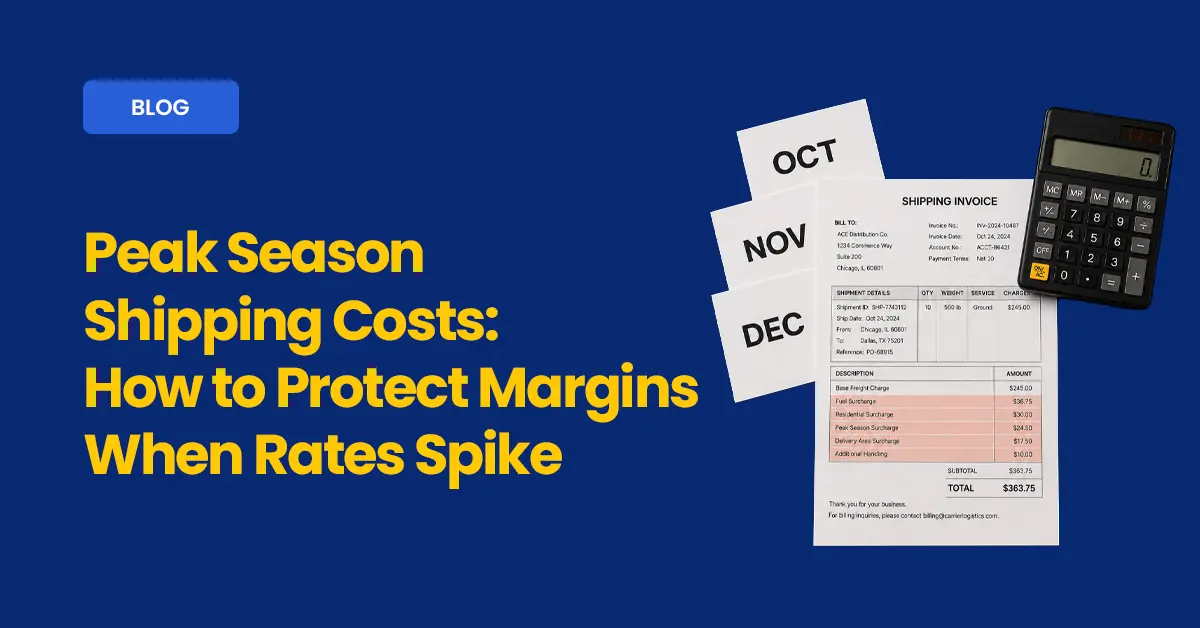
2026 holiday surcharges are up as much as 23% compared to prior benchmarks, according to Deposco’s analysis of peak season carrier surcharge data. That figure does not land as one clean increase on a rate card. It compounds across peak surcharges, fuel surcharges, residential delivery fees, and dimensional weight adjustments, each of which applies independently to every shipment during the peak window.
Per-package ground delivery rates were already 31.2% above their 2018 baseline by Q3 2025, with costs forecast to climb further in Q4 driven by peak season surcharges and dimensional rounding changes, according to Supply Chain Dive’s analysis of FedEx and UPS pricing. The baseline is already elevated before peak surcharges are added.
For brands selling on marketplaces, the cost pressure is compounded further by platform SLA requirements that make switching to slower, cheaper shipping options during peak impractical. If your marketplace fulfillment peak season operation depends on hitting on-time delivery thresholds, your carrier options during Q4 are not as flexible as they might appear on paper.
Peak Season Shipping Costs Comparison: Prepared vs Unprepared
The gap between a brand that has prepared for peak season shipping costs and one that has not, shows up across every cost variable simultaneously.
| Factor | Unprepared Brand | Prepared Brand |
| Carrier agreements | Negotiating in October at peak demand | Rates locked in Q2 or Q3 before peak pricing |
| Peak surcharge exposure | Full published surcharge on every shipment | Negotiated surcharge caps or pre-agreed structures |
| Fuel surcharge | Variable, unmodelled, absorbed mid-season | Factored into Q4 pricing and margin models upfront |
| Carrier diversification | Single carrier, no alternative routing | Multiple carriers with dynamic routing by lane and cost |
| Residential delivery fees | Applied at full rate, no mitigation strategy | Modelled into per-order cost and pricing decisions |
| Dimensional weight | Oversized packaging generating DIM premiums | Packaging audited and right-sized before peak |
| Cost pass-through strategy | Decided reactively when invoices arrive | Deliberate DDP or DDU decision made pre-season |
| Per-order cost at peak | Rising unpredictably, margin compression mid-Q4 | Modelled and managed, margin protected through peak |
What Is Actually Driving Ecommerce Shipping Costs In Q4
Understanding what is in the bill is the first step to managing it. Peak season shipping costs are not a single fee. They are a combination of charges that stack on top of each other across every shipment.
Peak Surcharges
Peak surcharges, also called demand surcharges, are temporary per-package fees that carriers add during high-volume periods to offset the cost of expanded capacity, additional staffing, and extended operating hours. Major carriers typically run their peak surcharge windows from late September through mid-January, which means the period that matters most for your Q4 revenue is also the period when every shipment costs more at the carrier level.
These surcharges are not a surprise. Carriers announce their peak season rate schedules months in advance. The brands that model their Q4 shipping costs against the published surcharge schedule before the season starts are the ones that do not encounter unexpected line items on November invoices.
Fuel Surcharges
Fuel surcharges are a separate, ongoing charge calculated as a percentage of the base shipping rate and adjusted weekly or monthly based on fuel price indices, compounding the impact of the peak surcharge already applied to the same shipment.
Unlike peak surcharges, fuel surcharges are not capped or pre-announced for specific windows. They are variable throughout the year and can shift between the time a carrier contract is negotiated and the time the Q4 invoices arrive. Brands that do not account for fuel surcharge variability when modelling their Q4 shipping economics routinely underestimate the true cost of their peak season carrier spend.
Residential Delivery Fees
Every direct-to-consumer ecommerce order delivered to a home address triggers a residential delivery surcharge on top of the base rate and any applicable peak or fuel surcharges. Residential deliveries are operationally more expensive for carriers: fewer stops per route, lower density, more failed delivery attempts. During peak season, when residential delivery volume is at its highest, this surcharge applies to virtually every order in your network.
For brands with a high proportion of residential shipments, the residential delivery fee is often the largest single surcharge component on a per-order basis. It can be overlooked because it is often embedded in carrier pricing and may appear under abbreviated or unfamiliar accessorial codes rather than as an obvious headline charge on standard invoices.
Dimensional Weight Pricing
Dimensional weight, or DIM weight, pricing charges based on the volume a package occupies in a delivery vehicle rather than its actual weight, when the dimensional weight exceeds the actual weight. During peak season, carriers are more particular about strictly applying DIM weight calculations as compared to the rest of the year, and any packaging that is oversized relative to its contents generates a higher rate than the product weight alone would suggest.
Brands that have not reviewed their packaging against DIM weight thresholds before peak are routinely paying more than they need to on every oversized shipment. A packaging audit before Q4 is a margin protection exercise as much as an operational one.
How to Protect Your Margins Before Rates Spike
Lock In Carrier Rates and Agreements Before Peak Season Starts
The single highest-impact action a brand can take on peak season shipping costs is to have carrier conversations and rate agreements in place before Q4 begins. Volume commitments, negotiated rate caps, and pre-agreed peak surcharge structures are all significantly easier to secure in Q2 or Q3 than in October, when carriers are managing inbound demand from every brand simultaneously and have less incentive to negotiate.
Brands that approach carrier conversations in September are negotiating from a weak position. Carriers know what the volume curve looks like and they know that a brand arriving in October has fewer alternatives than one that approached them in July.
Carrier Diversification as a Cost Protection Strategy
Single-carrier dependency during peak is both a cost problem and a risk problem. When every shipment goes through one carrier, there is no leverage in rate negotiations, no alternative routing when that carrier’s network tightens, and no contingency when peak season disruptions cause delays that affect your delivery SLAs.
Carrier diversification during peak season means routing orders across multiple carriers based on destination, delivery speed requirement, and cost, so that no single carrier’s rate increase or capacity constraint controls your entire Q4 shipping economics. It also means that when one carrier’s peak surcharge makes a specific lane uneconomical, volume can shift to an alternative without disrupting the operation.
For brands managing marketplace orders alongside DTC volume, carrier diversification is directly connected to platform performance. As the marketplace fulfillment peak season guide covers, marketplace on-time delivery rates are calculated on actual delivery performance. A single carrier disruption during peak that affects delivery timing is a seller metrics problem, not just a customer experience one.
Work With a 3PL That Has Pre-Negotiated Carrier Rates
One of the clearest operational advantages of working with a 3PL during peak season is access to carrier rate structures that individual brands cannot negotiate independently. A 3PL shipping at consolidated volume across its entire client network has leverage that a single brand shipping its own Q4 volume does not.
That leverage translates into lower base rates, better peak surcharge structures, and access to carrier capacity that may not be available to brands negotiating independently at the same time of year. The true cost of ecommerce fulfillment covers this in detail, but the short version is that the per-order savings a 3PL’s carrier relationships generate during peak often exceed the cost of the 3PL relationship itself.
For brands evaluating whether their current fulfillment setup is positioned to protect margins in Q4, choosing the right ecommerce fulfillment partner in Canada covers the criteria that matter specifically for peak season performance.
Audit Your Packaging Before Peak Arrives
A packaging audit before Q4 is one of the fastest margin protection actions available, and it is frequently overlooked because it does not feel like a shipping cost decision. But every shipment where the dimensional weight exceeds actual weight is a shipment paying more than it needs to.
The audit does not need to be complex. Map your top 20 SKUs against the DIM weight thresholds for each carrier you use. Identify which products are being shipped in packaging that generates a dimensional weight premium. Reduce box sizes or introduce right-sized packaging options where the math justifies it. The per-order saving is small, but at peak season volume, it compounds into a material margin difference.
Decide Early How You Will Handle Cost Pass-Through
The question of whether your brand absorbs holiday shipping rates or passes them to customers is a strategic decision that needs to be made before peak, not discovered mid-season when invoices arrive. Both approaches are defensible, but neither works well if it is decided reactively.
Delivered Duty Paid arrangements, where shipping costs are factored into pricing upfront, protect the customer experience but require pricing decisions that account for peak surcharges before they are invoiced. Passing shipping costs to customers at checkout preserves margin but risks cart abandonment if the final shipping cost at checkout is significantly higher than customers expect.
Brands that have modelled their Q4 shipping cost scenarios, including peak surcharges, fuel surcharges, and residential delivery fees at expected volume, have the information they need to make this decision deliberately. Brands that have not are making it by default when the first November invoice arrives.
What the Brands That Hold Margins Through Peak Do Differently
“The brands that call us in Q3 asking about peak season rates are the ones that protect their margins in Q4,” says Piyush Chojar, Senior Director – Last Mile Delivery & Operations at Ecom Logistics. “The ones that call in October are already absorbing costs they could have avoided. Peak season shipping is entirely predictable. The surcharge schedules are published months in advance. The only variable is whether a brand has done the work to model it and act on it before the window closes.”
The pattern is consistent. Brands that hold their per-order economics through peak season are not the ones with the most sophisticated logistics operations. They are the ones that treated carrier strategy as a Q2 planning decision rather than a Q4 emergency response. The preparation looks the same regardless of order volume: know what rates will be, secure agreements before they are needed, diversify carrier exposure, and model the full cost stack before peak begins.
Peak Season Shipping Costs Checklist: What to Have in Place Before October
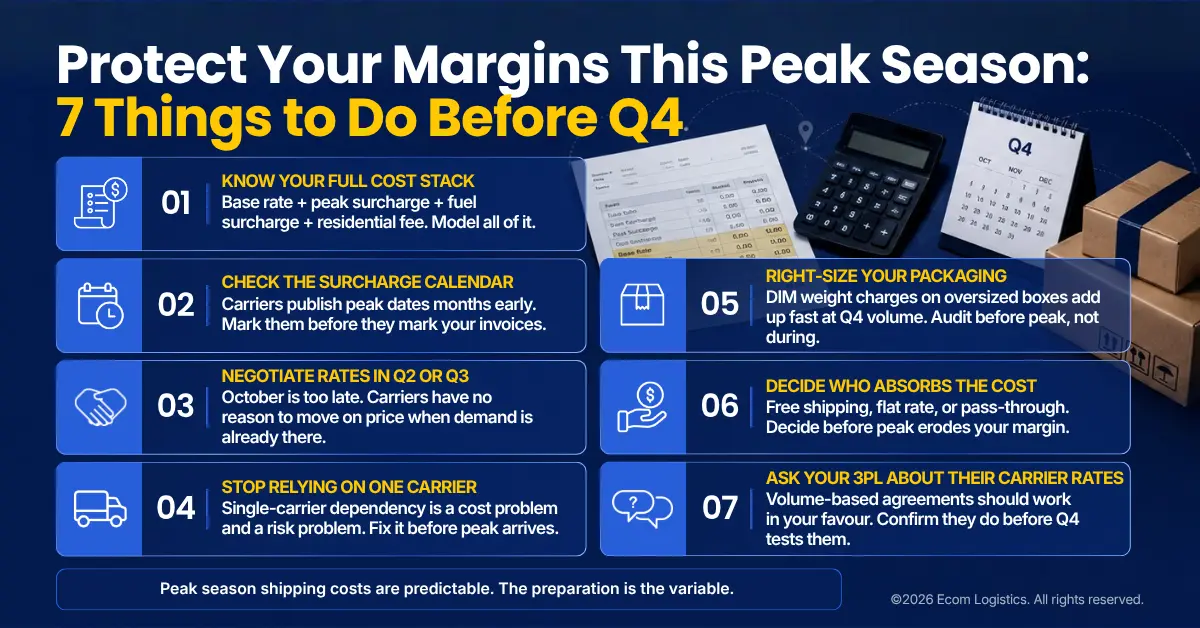
Most brands know peak season is expensive. The ones that protect their margins are the ones that treated it as a planning problem, not a reactive one. The seven actions below are where the difference is made, and almost all of them need to happen before Q4 begins.
1. Model Your Full Cost Stack
Do not plan your Q4 shipping budget around base rates alone. Pull the carrier rate cards for every provider you use and build a per-order cost model that includes peak surcharges, fuel surcharges, residential delivery fees, and any dimensional weight adjustments that apply to your typical shipment profile. Run the model at your expected peak volume, not your average volume. The number that comes out is the one your margins need to survive.
2. Review Published Surcharge Schedules
Major carriers publish their peak season surcharge schedules months before Q4 begins. The dates, the amounts, and the specific service categories affected are all available before the season starts. Brands that review these schedules in Q3 can model their exposure accurately and make carrier decisions with full cost visibility. Brands that do not review them discover the numbers for the first time on a November invoice.
3. Negotiate Carrier Rate Agreements in Q2 or Q3
Volume commitments, rate caps, and pre-agreed peak surcharge structures are all available to brands that approach carrier conversations before Q4 demand arrives. By October, carriers are managing inbound volume from every brand simultaneously and have significantly less reason to negotiate. The leverage window closes earlier than most brands realise, and the cost of missing it compounds across every Q4 shipment.
4. Diversify Your Carrier Mix Before Peak Arrives
A single-carrier dependency during peak is both a cost exposure and an operational risk. When all your volume runs through one network, that carrier’s peak surcharge applies to every shipment with no alternative, and any disruption to that network becomes your brand’s problem with no contingency. Building multiple carrier partnerships before Q4, with clear routing logic for which carrier handles which lane, gives you rate flexibility and a fallback when peak season network pressure creates delays.
5. Audit Your Packaging Against DIM Weight Thresholds
Dimensional weight charges apply when a package’s volume-based weight exceeds its actual weight, and carriers enforce DIM weight calculations strictly during peak. If your packaging is oversized relative to product dimensions, you are paying a premium on every affected shipment. At normal volume the impact is manageable. At peak volume it becomes a significant per-order cost that a packaging audit before Q4 could have reduced. Map your top SKUs against the DIM weight thresholds for each carrier you use and right-size where the saving justifies it.
6. Set Your Shipping Price Strategy Before Peak Arrives
Whether your brand absorbs peak season shipping costs or passes them to customers is a decision that needs to be made before Q4 invoices arrive, not after. The three main options each carry a different trade-off: offering free shipping absorbs the full cost but protects conversion rates and customer experience; flat rate shipping caps your exposure to a predictable per-order amount but may leave margin on the table for lighter shipments and compress it on heavier ones; real-time carrier rates at checkout pass the true cost to the customer but risk cart abandonment if the number is higher than they expect. None of these approaches works well when decided reactively mid-season. Model your Q4 shipping cost scenarios first, then decide which pricing structure your margins and your customer base can sustain through peak.
7. Confirm What Your 3PL’s Carrier Agreements Actually Cover
If you work with a fulfillment partner, their volume-based carrier relationships should be working in your favour during peak. But that is only true if their negotiated rate structure applies to your account at your Q4 volume, and if their carrier mix gives you meaningful routing options rather than a single network. Ask specifically: what peak carrier rates apply to our shipments, do your volume-based agreements cover our projected Q4 volume, and what happens to our per-order shipping cost when we spike above forecast? The answers will tell you whether your 3PL relationship is a margin protection asset during peak or simply a neutral arrangement.
Conclusion: Peak Season Shipping Margins Are Decided Before Q4 Starts

Reducing shipping costs during peak season is not about finding a cheaper carrier in October. It is about the decisions made in the months before: locking in rates, diversifying carrier exposure, auditing packaging, and modelling the full cost stack before surcharges arrive on invoices rather than after.
Ecom Logistics offers same-day and next-day last mile delivery across major Canadian cities with no peak surcharges, and no peak load charges on our delivery network. What you are quoted is what you pay, regardless of Q4 volume.
If your peak season shipping costs are compressing your Q4 margins and you want to understand what a better structure looks like, talk to us today.
Frequently Asked Questions
Peak season shipping costs are the total per-shipment charges during the Q4 holiday period, including base carrier rates, peak surcharges, fuel surcharges, and residential delivery fees. They increase because carriers add temporary demand surcharges to offset the cost of expanded capacity, additional staffing, and extended operations during the highest-volume shipping period of the year.
A peak surcharge, also called a demand surcharge, is a temporary per-package fee that carriers add during high-volume periods. Major carriers typically apply these from late September through mid-January. For ecommerce brands, peak surcharges add directly to the cost of every shipment during Q4, compounding with fuel surcharges and residential delivery fees to create a significantly higher total cost per order than at baseline rates.
A fuel surcharge is a variable fee calculated as a percentage of the base shipping rate and adjusted periodically based on fuel price indices. Because it is variable and adjusted independently of peak surcharges, it creates additional cost uncertainty for brands modelling their Q4 shipping economics.
The most effective strategies are: locking in carrier rate agreements before Q4 begins, diversifying across multiple carriers to reduce single-carrier dependency, auditing packaging to eliminate dimensional weight premiums, working with a 3PL that has pre-negotiated carrier rates, and modelling the full cost stack including all surcharges before peak begins rather than after invoices arrive.
Q2 is the right starting point for carrier conversations. By Q3, rate agreements should be confirmed. Approaching carriers in October means negotiating at peak demand when carriers have the least incentive to offer favourable terms and limited capacity to guarantee volume commitments.
Carrier diversification means working with multiple carriers and routing shipments based on destination, speed requirement, and cost rather than sending all volume through a single provider. During peak season, it reduces cost exposure to any single carrier’s surcharge structure, provides alternative routing when capacity tightens, and protects delivery performance when one carrier’s network is disrupted.
Dimensional weight pricing charges based on the volume a package occupies in a carrier vehicle when that volume-based weight exceeds the actual package weight. Carriers apply DIM weight calculations throughout the year but more strictly during peak season. Brands with oversized packaging relative to product size pay a DIM weight premium on every affected shipment. A packaging audit before Q4 that right-sizes boxes to product dimensions can produce meaningful per-order savings at peak volume.
A 3PL shipping at consolidated volume across its client network has carrier leverage that individual brands cannot replicate independently. That leverage translates into lower base rates, better peak surcharge structures, and access to carrier capacity during Q4. For brands whose current carrier arrangements expose them to full published peak surcharges with no negotiated cap, the rate advantage a well-resourced 3PL provides can materially change the per-order economics of peak season.
- About the Author
- Latest Posts