Most ecommerce brands do not struggle to get orders. They struggle to fulfil them well.
Growth brings pressure. More orders, tighter delivery timelines, and rising customer expectations. What once felt manageable can quickly turn into delays, rising costs, and operational inefficiencies that directly impact customer experience.
Fulfillment is not just about moving packages. It is an intricate system that defines how reliably and efficiently your business operates at scale, influencing everything from inventory flow to last-mile delivery.
And within that system, the choice of ecommerce fulfillment models becomes critical. Whether you manage operations in-house, rely on a third party logistics partner, or use dropshipping, each approach shapes your costs, control, and ability to scale.
The real question is not which model exists, but which one works best for your brand at its current stage.
What Are Ecommerce Fulfillment Models and Why Do They Matter So Much?
Ecommerce fulfillment models define how your business stores inventory, processes orders, and delivers them to customers. It sounds simple, but this system quietly controls some of the most critical aspects of your operations.
Every order passes through this system. From the moment a customer clicks “buy” to the final delivery, fulfillment determines speed, accuracy, and reliability. Different ecommerce logistics models approach this journey differently. Some prioritise control, others flexibility, while some focus on minimising upfront investment.
The impact goes far beyond operations. Late deliveries, damaged products, or poor return experiences can undo even the strongest marketing efforts. On the other hand, consistent and fast delivery builds trust, repeat purchases, and long-term brand loyalty.
Costs are equally tied to your model. Storage, labour, shipping, and returns all add up, and inefficient systems can quietly erode margins as order volumes grow. This is why leading brands invest in refining their ecommerce order fulfillment strategies instead of treating fulfillment as a secondary function.
The right model does not just support growth. It also makes growth sustainable.
What is In-House Fulfillment and How Does It Work?
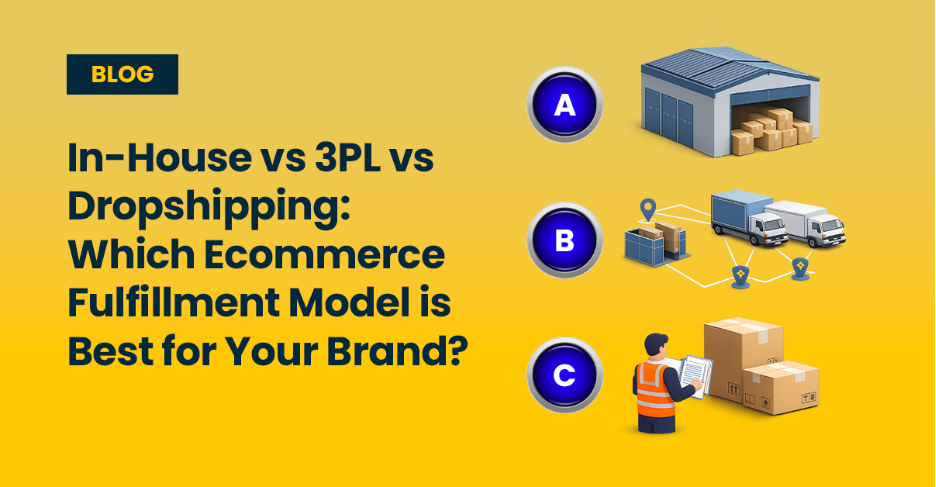
In-house fulfillment is one of the most direct ecommerce fulfillment models. The brand manages everything internally, from storing inventory to picking, packing, and shipping orders through courier partners.
The biggest advantage here is control. Packaging can be customised, quality checks can be enforced at every step, and inventory remains fully visible. For brands that prioritise customer experience or product precision, this level of control can be a significant advantage.
But control comes with responsibility and cost.
When comparing in house fulfillment vs 3PL, the limitations begin to surface as order volumes increase. Managing warehouse space, hiring staff, and coordinating shipping operations require continuous investment. During peak periods, even small inefficiencies can lead to delays and errors.
What works well at a smaller scale often becomes difficult to sustain over time. Growth starts to expose operational gaps. Fixed costs rise, flexibility decreases, and scaling requires more infrastructure rather than smarter systems.
In-house fulfillment is ideal for early-stage brands or those with highly specialised requirements. It offers precision and ownership, but for many businesses, it eventually becomes a stepping stone rather than a long-term solution.
What is a 3PL Fulfillment Model in Ecommerce?
A third party logistics model ecommerce setup shifts fulfillment operations from the brand to a specialised partner. Instead of managing storage, packing, and shipping internally, businesses rely on a 3PL provider that already has the infrastructure, technology, and network in place.
This model is designed for efficiency at scale. Inventory is stored across strategically located warehouses, orders are processed through optimised systems, and shipping is handled through established courier networks. The biggest shift here is not just outsourcing operations, but upgrading them.
For growing brands, this becomes a turning point. Managing fulfillment internally can slow down expansion, especially when demand becomes unpredictable. A 3PL introduces flexibility. You can scale storage space, increase processing capacity, and improve delivery timelines without building everything from scratch.
When comparing in house fulfillment vs 3PL, the difference becomes most visible during periods of growth. In-house operations often struggle with sudden spikes in orders, while a 3PL is built to absorb that demand. This makes it a preferred scaling ecommerce fulfillment model for brands that want to expand without operational bottlenecks.
That said, it requires trust in the partner. Processes are no longer directly controlled, and performance depends on the provider’s capabilities. But for brands focused on growth, the ability to scale efficiently often outweighs the need for complete control.
What is Dropshipping and How Does It Compare?
Dropshipping is one of the most accessible ecommerce fulfillment models, especially for businesses looking to start with minimal upfront investment. In this model, the brand does not hold inventory. Instead, products are sourced from suppliers who ship directly to the customer once an order is placed.
The appeal is straightforward. There is no need to invest in warehousing, inventory management, or fulfilment operations. This makes it an attractive option for testing new products or entering the market quickly. It lowers the barrier to entry, but also limits operational control.
When analysing dropshipping vs 3PL fulfillment, the trade-offs become clear. A 3PL offers structured processes, faster shipping, and better consistency, while dropshipping depends heavily on supplier reliability. Delivery timelines are often longer, and quality control becomes difficult to maintain.
Margins can also be tighter. Since suppliers handle fulfillment, costs per order may be higher compared to optimised 3PL operations at scale. Customer experience can suffer if delays or inconsistencies occur, especially when expectations are shaped by fast delivery standards.
Dropshipping works best as an entry strategy or for product validation. It allows brands to move quickly without operational commitments. However, as order volumes increase and customer expectations rise, its limitations make it less suitable as a long-term scaling approach.
In-House vs 3PL vs Dropshipping: Ecommerce Fulfillment Model Comparison
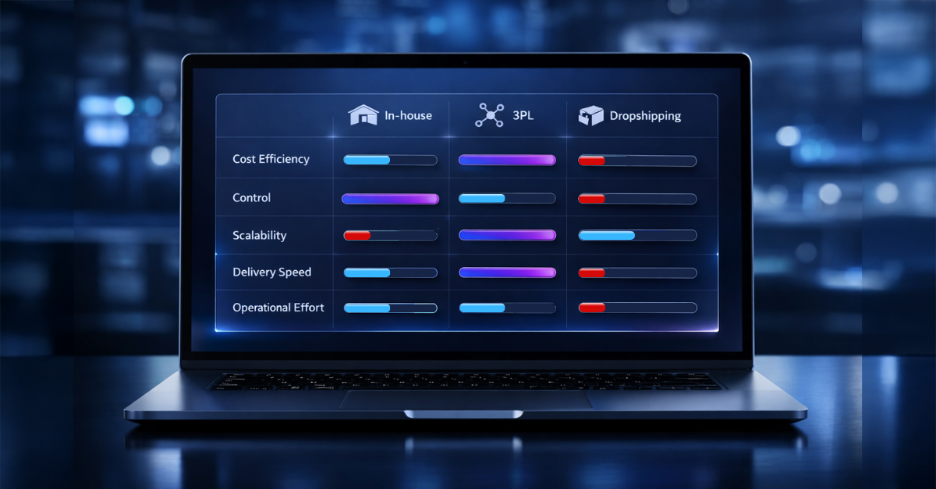
Choosing between different ecommerce fulfillment models becomes easier when you break them down across key operational factors. Each model offers a distinct balance of cost, control, scalability, and customer experience.
Cost Structure
In-house fulfillment requires upfront investment in warehousing, staffing, and systems. Costs remain relatively fixed, even when order volumes fluctuate. Dropshipping eliminates these upfront costs but often comes with higher per-order expenses. A 3PL sits in between, offering variable pricing that aligns with order volumes, making it more efficient as you scale. This is where a clear ecommerce fulfillment model comparison helps identify long-term cost implications.
Control and Customisation
In-house operations offer the highest level of control. Every aspect, from packaging to delivery standards, can be managed directly. Dropshipping offers the least control, as fulfillment depends entirely on suppliers. A third party logistics model ecommerce setup provides moderate control, with some customisation options depending on the provider.
Scalability and Growth
This is where differences become significant. In-house fulfillment requires continuous investment to support growth. Dropshipping scales easily in terms of operations but struggles to maintain consistency. A 3PL, on the other hand, is built as a scaling ecommerce fulfillment model, allowing brands to grow without constantly expanding infrastructure.
Delivery Speed and Customer Experience
Fast delivery is obviously non-negotiable. However as per McKinsey’s logistics industry insights many customers prioritise reliability over speed, preferring deliveries they can trust to arrive within the promised window rather than faster but unpredictable options.
In-house fulfillment can be efficient locally but becomes complex across regions. Dropshipping often results in longer shipping timelines. A 3PL leverages distributed networks to improve delivery speed and reliability, which directly impacts customer satisfaction.
Operational Complexity and Risk
Managing fulfillment internally increases operational burden. Dropshipping reduces this burden but introduces dependency on suppliers. A 3PL reduces day-to-day complexity while maintaining structured processes.
No single model is universally better. The right choice depends on where your business stands and where it is heading.
Which Ecommerce Fulfillment Model is Best for Scaling Brands?
Every ecommerce fulfillment model isn’t built to support growth. What works at 100 orders a month often breaks at 1,000.
In the early stages, brands tend to rely on in-house operations or even dropshipping. Both offer simplicity. One gives control, the other reduces upfront investment. But as order volumes increase, these models begin to show strain. Delays become more frequent, operational costs rise, and maintaining consistency becomes harder.
This is where the shift towards a third party logistics model becomes imperative. A 3PL is designed to support scaling ecommerce businesses. It brings structured processes, optimised warehousing, and faster shipping capabilities that are difficult to replicate internally without significant investment.
That said, scaling does not always mean a complete transition. Many brands evolve gradually. They may retain certain operations in-house while outsourcing high-volume or geographically distant orders. This creates a more flexible system that balances control with efficiency.
The best fulfillment model for scaling is not fixed. It evolves with your business. The key is recognising when your current setup is limiting growth and being ready to adapt before it impacts customer experience.
When Should You Switch Your Ecommerce Fulfillment Model?
Knowing when to switch between ecommerce fulfillment models can be the difference between smooth scaling and operational breakdown.
One of the earliest signs is increasing order volume paired with declining efficiency. Orders take longer to process, errors become more frequent, and customer complaints start to rise. What once felt manageable begins to feel reactive.
Cost is another indicator. As businesses grow, in-house operations often require more space, more staff, and more coordination. Without strong ecommerce order fulfillment strategies, these costs can increase faster than revenue. At the same time, inconsistent delivery timelines can start affecting repeat purchases.
There are also strategic triggers. Expanding into new regions, launching new product lines, or handling seasonal spikes can expose the limitations of your current model. In such cases, relying solely on internal systems or dropshipping may not be sustainable.
Shifting to a more scalable setup, such as a third party logistics model or a hybrid approach, allows businesses to handle growth without overextending resources.
The risk is not in switching too early. It is in waiting too long and letting inefficiencies compound.
What is a Hybrid Ecommerce Fulfillment Model and When Should You Use It?
A hybrid fulfillment model combines multiple ecommerce fulfillment models to create a more flexible and efficient system. Instead of relying entirely on one method, businesses split their operations based on what works best for different types of orders.
For example, a brand may handle premium or customised products in-house to maintain control, while outsourcing bulk or high-volume orders to a 3PL. Some may even continue using dropshipping for specific product categories while managing core inventory separately.
This model is not about complexity. It is about optimisation.
Hybrid setups allow brands to balance cost, control, and scalability more effectively than relying on a single system. They also provide a safety net. If one part of the operation faces disruption, the entire fulfillment process does not come to a halt.
From a strategic perspective, hybrid models are becoming more relevant as customer expectations evolve. Faster delivery, consistent quality, and operational resilience are no longer optional. Businesses need systems that can adapt quickly.
Among modern ecommerce logistics models, the hybrid approach offers one of the most practical paths forward. It allows brands to scale without fully giving up control, making it especially useful during transition phases.
For many growing businesses, hybrid fulfillment is not a temporary fix. It becomes a long-term strategy.
How To Choose The Right Ecommerce Fulfillment Model For Your Brand
Choosing between different ecommerce fulfillment models is not about finding a perfect option. It is about finding the right fit for your current stage, product type, and growth plans.
Start with order volume. Low and unpredictable volumes often work well with dropshipping, while stable and growing demand requires more structured ecommerce order fulfillment strategies. Product type also plays a role. Fragile, high-value, or customised items may need tighter control, making in-house or hybrid models more suitable.
Geography is another key factor. If your customers are spread across multiple regions, relying on a single location can slow down deliveries and increase costs. This is where scalable ecommerce logistics models, particularly those supported by a third party logistics, become more effective.
Cost structure should be evaluated carefully. Upfront savings in one model can lead to higher long-term expenses if inefficiencies are not addressed. Similarly, customer expectations cannot be ignored. Faster delivery, easy returns, and consistent service are now baseline expectations.
The right decision comes from aligning your fulfillment model with both your current operations and your future growth. As your business evolves, your model should evolve with it.
Conclusion: Choosing The Right Fulfillment Model for Long-Term Growth
Ecommerce fulfillment models are often treated as operational decisions, but in reality, they define how well a business can scale, compete, and retain customers. The difference between steady growth and constant firefighting usually comes down to how fulfillment is structured.
There is no single model that works for every brand. In-house operations offer control, dropshipping offers flexibility, and a third party logistics offers scalability. The challenge lies in knowing when to use each, and how to transition without disrupting operations.
This is where the right partner makes a measurable difference.
Ecom Logistics works with growing brands to simplify and strengthen their fulfillment operations. With a focus on scalable infrastructure, efficient processes, and reliable delivery networks, the goal is not just to manage orders, but to improve how your entire fulfillment system performs. Whether you are moving away from in-house operations, comparing dropshipping vs 3PL fulfillment, or building a hybrid fulfillment model ecommerce strategy, the right guidance can save time, cost, and operational strain.
Ecommerce fulfillment should support your growth, not slow it down.
If you are evaluating your current setup or planning the next stage of your business, it is worth having a conversation.
Explore how Ecom Logistics can support your ecommerce order fulfillment strategies.
Frequently Asked Questions
For small businesses, dropshipping is often the most cost-effective starting point since it eliminates inventory and warehousing costs. However, as order volumes grow, costs per order can increase and margins can shrink. Many brands eventually shift to more structured ecommerce fulfillment models such as 3PL to optimise long-term costs. Ecom Logistics helps businesses evaluate when to make that shift so cost efficiency improves as you scale.
Shipping costs can be reduced by optimising warehouse locations, consolidating shipments, and using data-driven ecommerce order fulfillment strategies. A third party logistics model ecommerce setup often provides access to better courier rates due to higher volumes. Ecom Logistics leverages established networks and smart routing to help brands lower shipping costs without compromising delivery speed.
When comparing in house fulfillment vs 3PL, the answer depends on scale. In-house works well for control at smaller volumes, but becomes resource-heavy as demand increases. A 3PL offers scalability, faster delivery, and operational efficiency, making it a better fit for growth-stage brands. Ecom Logistics supports this transition by providing infrastructure that grows with your business.
Yes, many brands adopt a hybrid fulfillment model ecommerce approach. This allows businesses to manage certain operations in-house while outsourcing others to a 3PL. It creates flexibility and reduces risk.
Fulfillment timelines vary depending on the model and location. In-house operations may be fast locally but slower across regions. Dropshipping can take longer due to supplier dependencies. A well-structured 3PL setup within modern ecommerce logistics models can significantly reduce delivery timelines through distributed warehousing.
Common challenges include inventory mismanagement, delayed shipping, high operational costs, and inconsistent customer experience. These issues often arise from choosing the wrong ecommerce fulfillment models for your stage of growth. Ecom Logistics helps identify and resolve these gaps with scalable systems and process optimisation.
The shift from dropshipping vs 3PL fulfillment typically happens when order volumes stabilise and customer expectations increase. If delivery delays, quality concerns, or margin pressures start affecting your business, it may be time to switch. Ecom Logistics helps brands transition smoothly without disrupting operations.
Modern ecommerce logistics models rely on warehouse management systems, order tracking tools, and automation to improve accuracy and efficiency. These technologies enable real-time visibility and better decision-making.
- About the Author
- Latest Posts