Picking the wrong ecommerce fulfillment partner in Canada shows up gradually in your error rate, your customer complaints, your carrier surcharges, and eventually in your repeat purchase numbers. By then, switching is painful and the damage to customer trust is already done.
Canada’s ecommerce market is estimated at USD 42.33 billion and is projected to reach USD 67.46 billion by 2030. As the market grows, so does the operational pressure on the brands competing in it. And the fulfillment partner you choose will either support that growth or quietly limit it. If you are evaluating your options, the complete guide to ecommerce fulfillment is a useful foundation before you start asking 3PLs for quotes.
This blog covers what actually separates a good ecommerce fulfillment partner in Canada from one that looks right on a sales call but underdelivers in practice.
What to Look for in an Ecommerce Fulfillment Partner in Canada
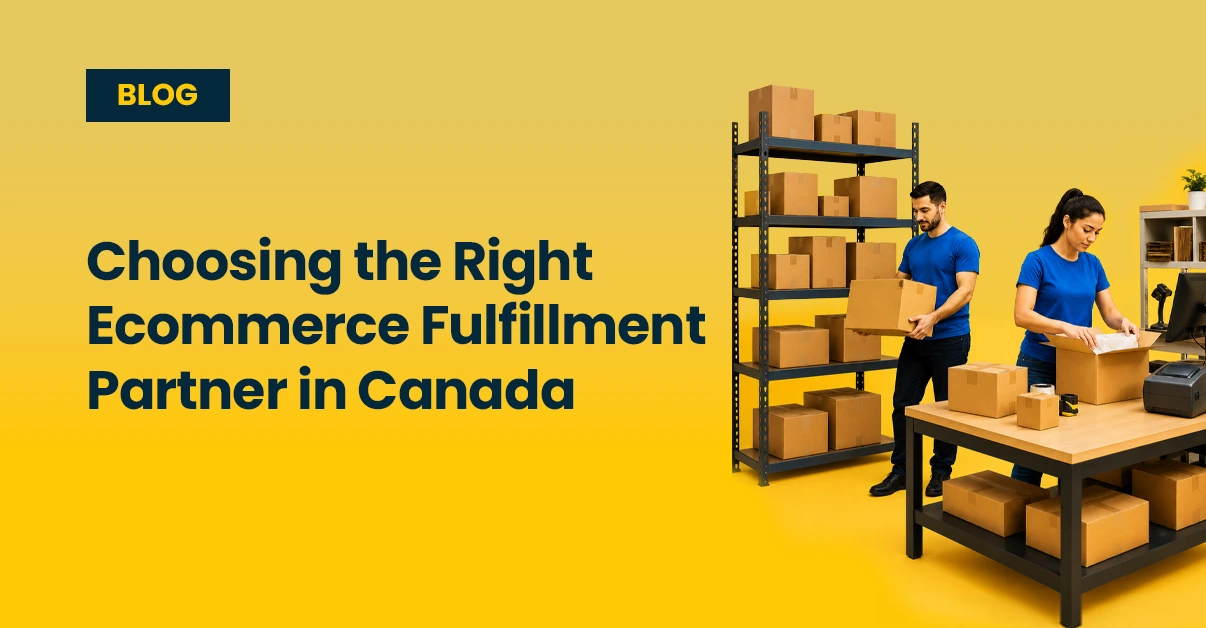
Most brands approach this decision with a short list of practical questions: where are your warehouses, what do you charge per pick, can you integrate with Shopify? Those questions matter, but they are the floor, not the ceiling. The right ecommerce fulfillment partner in Canada should be able to support your operation not just at today’s volume, but at twice it.
Technology and Real-Time Inventory Visibility
A cloud-based warehouse management system that syncs inventory in real time across every sales channel is the baseline. Not periodic updates, not manual counts. Real time. When your inventory data is accurate, overselling stops, customer cancellations drop, and your team stops firefighting problems that should not exist in the first place.
Ask specifically: does their WMS integrate directly with your sales platforms, and do you have live access to inventory levels without needing to request a report?
Order Accuracy and Pick and Pack Performance
Order accuracy is the metric that most directly affects your customer experience and your cost base simultaneously. A mispicked order costs you the reshipment, the return, the customer service time, and often the customer. Well-run fulfillment operations typically hold order accuracy rates above 99%. Ask for documented accuracy rates, not just assurances.
Carrier Network and Delivery Coverage Across Canada
Canada’s geography is one of the most operationally demanding in the world for ecommerce logistics. A fulfillment center that works well in Ontario does not automatically translate to reliable delivery in British Columbia, Alberta, or Atlantic Canada. Ask about regional coverage, multi-carrier capability, and whether they offer same-day or next-day delivery in major metros. A single-carrier operation is a single point of failure, and in Canada that risk is amplified by distance.
Scalability: What Happens When Your Volume Spikes
This is the question most brands forget to ask until it is too late. A 3PL partner for ecommerce in Canada that performs at 500 orders a month does not automatically perform at 5,000. Ecommerce fulfillment tends to break at specific pressure points as brands scale, and the most common one is a fulfillment partner that was not built for the volume it is now handling. Ask how they manage peak season surges, what their capacity ceiling is, and whether your account will receive the same service level at higher volumes.
Transparency, Communication, and Account Management
When something goes wrong, which will, you need a team that tells you before the customer does. Ask whether you will have a dedicated account manager, how exceptions are communicated, and what their process is when an order is delayed or lost. A fulfillment partner that goes quiet when there is a problem is a partner that will cost you customers.
The Real Costs of Choosing the Wrong Fulfillment Partner
The quoted per-pick price is rarely the number that matters most. The real cost of the wrong warehousing and fulfillment in Canada shows up elsewhere: in the carrier surcharges you cannot explain, the returns that sit unprocessed and create inventory discrepancies, the reshipments for mispicked orders, and the customer acquisition cost of replacing the buyers you lost.
“Most brands that come to us have been absorbing these costs for longer than they realise,” says Tammy Huynh at Ecom Logistics. “The per-pick rate looked competitive, but the error rate and the hidden fees were quietly eating the margin. Once you build a full picture of what fulfillment is actually costing the business, the decision usually becomes straightforward.”
Comparing fulfillment partners on headline pricing alone is one of the most common and costly evaluation mistakes. The true cost of ecommerce fulfillment includes accuracy rates, returns handling, technology fees, and the customer retention impact of delivery performance.
Why Canadian Brands Need a Canada-Specific Ecommerce Logistics Partner
An ecommerce logistics partner in Canada brands can rely on is not simply one with a Canadian postal code. It is one that understands the operational realities of shipping across Canadian geography, navigating regional carrier relationships, and meeting the delivery expectations of Canadian consumers who increasingly benchmark speed against the same standards as US shoppers.
Same-day delivery has shifted from a premium extra to a baseline expectation
Same-day delivery has become a baseline expectation in Toronto, Vancouver, Calgary, Ottawa, and Montreal, with retailers adopting the service reporting a 10% revenue uplift. A fulfillment partner without the infrastructure to support that in key markets is already behind. And the stakes are higher than most brands account for: 63% of consumers choose a different retailer for their next purchase after a slow delivery experience, which means for a partner that cannot meet Canadian delivery expectations it’s not just an operational problem, it is a retention one. For a deeper look at what scaling fulfillment in Canada specifically requires, how Canadian ecommerce brands can scale fulfillment without losing control covers the operational decisions that matter most at each stage of growth.
Questions to Ask Before Signing With a Canadian 3PL Provider
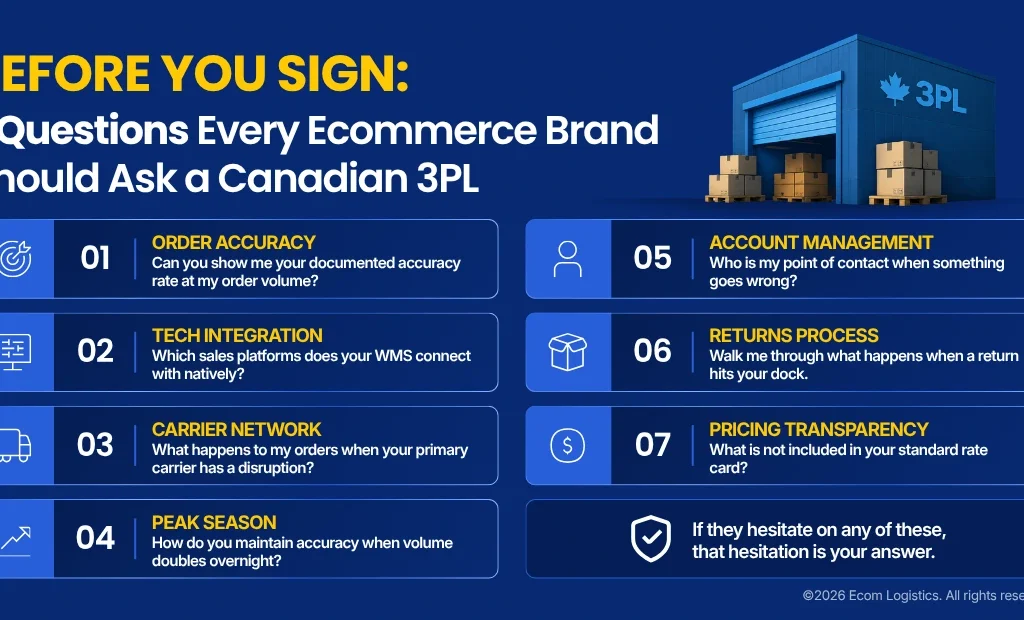
Before committing to any ecommerce fulfillment partner in Canada, these are the questions that separate a confident decision from one you will revisit in twelve months. Most brands ask about pricing and location. Those matter, but they are also the easiest things for a 3PL to say the right thing about on a sales call. The questions below are harder to answer convincingly without the operational reality to back them up. If a potential partner hesitates on any of these, that hesitation is the answer.
- Order accuracy: What is your documented order accuracy rate, and can I see it at my expected volume?
- WMS integration: Which ecommerce platforms does your system integrate with natively?
- Carrier network: What carriers do you work with, and how do you handle carrier disruptions?
- Peak season: How do you manage volume spikes without degrading accuracy?
- Account management: Do I have a dedicated account manager, and how are exceptions communicated?
- Returns: What does your returns receiving and processing workflow look like operationally?
- Pricing: Are there any fees not included in the standard rate card?
Fulfillment Partner Comparison: What Good Looks Like
The gap between the right fulfillment partner and the wrong one is not always obvious from a sales call. It shows up in your day-to-day operations, and it rarely announces itself all at once.
It starts with small things. An inventory count that takes a day to update instead of happening in real time. A returns pile that grows slowly on the warehouse floor because there is no defined process to move it. None of these feel catastrophic in isolation. But they compound. And by the time the pattern is visible in your customer retention numbers or your carrier invoices, the damage is already done.
The difference between a fulfillment partner that performs and one that does not almost always comes down to the same set of variables: how accurately they pick and pack at your volume, how well their systems integrate with yours, how they handle disruptions, and how they communicate when something goes wrong. A partner that scores well across all of these does not just reduce your error rate. They remove an entire category of operational risk from your business.
The table below puts the contrast in concrete terms across each of those variables.
| Criteria | Wrong Fit | Right Fit |
| Inventory visibility | Manual updates, periodic syncs | Real-time inventory sync across all sales channels |
| Order accuracy | 96-97%, issues handled reactively | 99%+, proactive exception management |
| Carrier coverage | Single carrier, limited regions | Multi-carrier, national Canadian coverage |
| Scalability | Fixed capacity, peaks cause errors | Flexible infrastructure, consistent accuracy at volume |
| Returns process | Ad hoc, slow to restock | Defined workflow, real-time inventory updates |
| Communication | Reactive, slow to flag issues | Dedicated account manager, proactive updates |
| Pricing transparency | Hidden fees, unclear rate card | Clear pricing, no surprise surcharges |
Conclusion: The Right Fulfillment Partner Grows With You, Not Against You

Choosing an ecommerce fulfillment partner in Canada is not a one-time operational decision. It is a structural one that will shape your customer experience, your unit economics, and your ability to scale for years. The brands that get it right are the ones that evaluate on the things that matter at volume: accuracy, technology, carrier coverage, transparency, and scalability, not just who quoted the lowest pick fee.
Ecom Logistics operates fulfilment centres across Canada and USA with real-time inventory management, multi-carrier delivery coverage including same-day and next-day options in major Canadian cities, and a team structure built around proactive account management. Every standard in this blog is one we hold ourselves to. See for yourself. Talk to our team.
Frequently Asked Questions
The most important criteria are order accuracy rates, real-time inventory visibility, carrier network breadth across Canada, scalability at your projected volume, returns handling capability, and transparent pricing. Headline pick rates matter less than the total operational cost of the partnership.
A 3PL, or third-party logistics provider, handles warehousing and fulfillment in Canada, so ecommerce brands outsource to a specialist rather than managing in-house. You send inventory to their fulfillment center, they store it, pick and pack orders as they come in, and ship through their carrier network. In Canada, the right 3PL will have regional coverage and carrier relationships suited to the country’s geography.
The clearest signals are a rising order error rate, slow or absent communication when things go wrong, carrier surcharges you cannot explain, returns sitting unprocessed, and a sense that your account is being managed reactively. If fulfillment is consistently creating customer experience problems, the partnership is not the right fit.
Canada’s geography, regional carrier networks, cross-border complexity with the US, and the delivery expectations of Canadian consumers all require operational expertise that a generic fulfillment provider may not have. A Canada-specific ecommerce logistics partner will have established carrier relationships, regional warehouse positioning, and local knowledge that directly affects delivery performance.
It is one of the most important factors. A WMS that syncs inventory in real time, integrates with your sales channels, and gives you live visibility into order status is the operational foundation everything else depends on. Without it, inventory accuracy, order accuracy, and returns processing all suffer.
Fulfillment costs include storage, pick and pack fees, shipping, returns handling, and technology fees. The headline per-pick rate is rarely the full picture. Error rates, reshipments, carrier surcharges, and the customer churn caused by poor fulfillment performance all factor into the true cost. Our ecommerce fulfillment costs guide breaks down what drives costs up and down in detail.
The clearest signal is when fulfillment errors are recurring and in-house fixes are not holding, or when the fixed cost of operating your own warehouse is growing faster than your order volume justifies. A comparison of in-house vs 3PL fulfillment models covers the decision in practical terms.
Yes, but not all Canadian 3PL providers are equally equipped for it. Cross-border fulfillment between Canada and the US involves customs compliance, carrier coordination, and inventory positioning decisions that require genuine expertise. Ask specifically about cross-border capability and how they handle customs documentation before committing.
- About the Author
- Latest Posts