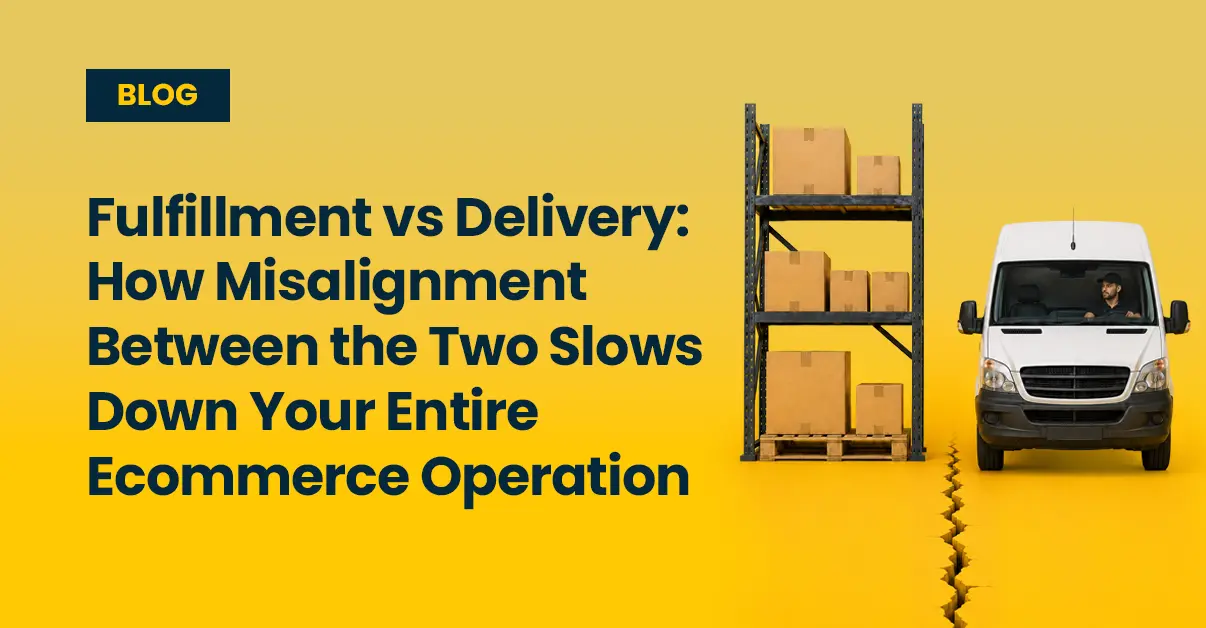
The order was packed correctly. The label was printed. It left the warehouse on time. But the customer still did not get their order when they expected it. So where did it go wrong?
This is one of the most frustrating patterns in ecommerce operations, and it happens consistently when brands do not have a clear distinction between fulfillment vs delivery. The two functions look like one continuous process from the outside, but operationally they are separate, with different owners, different systems, and completely different failure modes. When the line between them is blurry, accountability disappears into the gap, and the customer absorbs the cost.
This blog breaks down exactly where that gap opens up, what it costs when it does, and how to close it. If your operation is producing delivery failures that feel impossible to diagnose, understanding how the fulfillment process works end to end is the right place to start.
Fulfillment vs Delivery: What Each Function Actually Covers
Most brands use these terms interchangeably. That is where the confusion starts. Fulfillment and delivery describe two operationally distinct functions, and treating them as one is the root cause of most handoff failures this blog covers.
What the Fulfillment Process Covers
The fulfillment process ecommerce operations depend on covers everything that happens inside the warehouse. Receiving inventory and logging it accurately. Storing it in the right location. Processing orders as they come in. Picking the right items, packing them correctly, labelling the shipment, and preparing it for carrier collection. Fulfillment ends the moment a package is handed to a carrier.
Everything before that handoff is a fulfillment responsibility. Inventory accuracy, order processing speed, pick and pack error rates, and packaging quality all sit within this function. Inventory discrepancies that go unresolved inside the warehouse are fulfillment failures regardless of what happens downstream. For instance, a cancelled order caused by a stock error that was never caught at the warehouse level is not a delivery problem. It never reached delivery.
What Delivery Operations Cover
Delivery begins exactly where fulfillment ends, at the carrier handoff, and covers everything that follows. Routing, transit, last-mile execution, tracking updates, proof of delivery, failed delivery handling, and the return leg when a customer sends something back.
The delivery layer does not control what is in the box or whether the right item was packed. It controls whether that box reaches the right address within the promised window, with the right visibility along the way. Last-mile delivery alone accounts for 53% of total shipping costs, which is why delivery operations demand as much strategic attention as what happens in the warehouse. When brands cannot separate delivery performance from fulfillment performance, they end up investing in the wrong fixes and wondering why nothing improves.
The distinction between the two functions is cleaner in practice than most brands realise. The table below puts it side by side.
Fulfillment vs Delivery: A Side-by-Side Comparison
| Aspect | Fulfillment | Delivery |
| Where it happens | Inside the warehouse | From carrier handoff onward |
| What it owns | Inventory, pick and pack, order accuracy, carrier handoff | Routing, transit, last-mile, tracking, proof of delivery |
| Common failure modes | Inventory errors, late carrier handoff, mispacks, incomplete manifests | Failed deliveries, shipping delays, lost parcels, missed windows |
| Who feels it first | Operations team | The customer |
| How misalignment shows up | Orders dispatched late, incorrect carrier data, returns with no process | Delivery delays, surcharges, unresolved customer complaints |
| What integration looks like | WMS updates carrier platform in real time | Delivery exceptions visible to warehouse team immediately |
Fulfillment vs Delivery: Where the Misalignment Happens
Knowing the definitions is the easy part. The harder one is recognising the specific points in the operation where the gap between these two functions causes real damage. Here are the four most common.
Fulfillment Timelines Do Not Match Carrier Cutoffs
Every carrier that collects from a warehouse operates on fixed pickup cutoffs. Miss that window and the order sits overnight, often without anyone flagging it and without the customer knowing until they check their tracking and find nothing has moved.
For brands promising next-day or same-day delivery, a fulfillment team that runs thirty minutes behind schedule can invalidate every delivery promise made at checkout. This is not a carrier problem, but a sequencing issue. When fulfillment operations are not designed around carrier cutoff windows as a fixed constraint, the two functions are effectively working on different clocks.
Inventory Data Does Not Reach the Delivery Layer Accurately
Carriers build their operations around manifests: the data that tells them what they are collecting, how heavy it is, where it is going, and whether there are any special handling requirements. When that data is incomplete, inaccurate, or delayed, it creates friction before a single van has left the depot.
Weight discrepancies trigger surcharges. Address errors cause failed deliveries and re-routing costs. Missing references create delays at sorting facilities. None of these are visible to the fulfillment team once the package has left the building, and the delivery team has no way to correct information that was never accurate to begin with.
Returns Arrive With No Clear Ownership
Reverse logistics is where most brands’ fulfillment and delivery alignment completely breaks down. A customer initiates a return, the delivery network brings it back to the warehouse, and it arrives with no clear receiving process waiting for it, no condition assessment workflow, and no system update to record that the inventory is back in the building.
The result is stock that is physically present but not counted, refunds that are delayed, and customer service teams fielding complaints they cannot resolve because neither side has closed the loop. When the average ecommerce return rate sits at 16.9%, driven largely by apparel, footwear, and electronics, a returns process that relies on informal handoffs between delivery and fulfillment is not a minor operational gap. It is a structural liability that compounds with every order that comes back through the door.
Warehouse and Carrier Technology Operate in Silos
The warehouse management system running fulfillment operations and the transport management system or carrier platform running delivery are often completely separate. They do not share data in real time. An order that has been picked and packed is not automatically visible to the delivery layer as ready for dispatch. A delivery exception is not automatically visible to the fulfillment team as a problem that needs attention.
This technology gap means both functions are operating on partial information. Real-time visibility, the kind customers expect and brands need to manage exceptions before they become complaints, is structurally impossible without deliberate integration across both systems.
What Misalignment Actually Costs

“The misalignment between fulfillment and delivery is one of those costs that does not show up cleanly on any report,” says ABC, XYZ at Ecom Logistics. “It hides in your surcharges, your return processing backlog, and your support volume. Which is exactly why it tends to stick around.”
The cost of the fulfillment vs delivery gap rarely appears as a single line item. It spreads across several places simultaneously, which is part of why it persists for longer than it should.
As per UpCounting 85% of shoppers will not return to a retailer after a bad delivery experience. A single misaligned handoff between fulfillment and delivery, a missed carrier window, an incorrect manifest, a return with no receiving process, can be the moment a customer decides not to come back. Beyond customer retention, there are direct financial costs: carrier surcharges from manifest errors, wasted labour on unprocessed returns, inventory inaccuracies that trigger overselling, and the customer service overhead of enquiries that should not have been necessary. For direct-to-consumer shipping brands operating at volume, these are not edge cases. They are predictable, recurring costs that a well-integrated operation does not incur.
For a detailed breakdown of where fulfillment costs concentrate and what drives them up, the ecommerce fulfillment costs guide covers the full picture.
How to Close the Gap Between Fulfillment and Delivery
Most fulfillment and delivery problems are not solved by working harder inside either function. They are solved by closing the space between them. That means shared data, aligned timing, and a returns process that both sides own. The steps below are where that work actually happens.
Align on Shared Metrics That Span the Handoff
If fulfillment is measured on pick accuracy and delivery is measured on on-time rate, neither team has any incentive to optimise around the point where responsibility transfers. Adding a shared metric, such as order-to-doorstep cycle time or carrier-ready-on-time rate, creates accountability that does not stop at the dock door.
Build Fulfillment Schedules Around Carrier Cutoffs
The carrier pickup window should be a fixed constraint that the entire fulfillment operation is designed around, not an afterthought. This means knowing cutoff times for every carrier used, building picking and packing workflows that reliably hit those windows at normal volume, and having a contingency process for when volume spikes. Planning carrier diversification and fulfillment timing ahead of peak season is one of the most effective ways to ensure the two functions stay in sync when operational pressure is highest.
Integrate Your Systems
A WMS and a carrier platform that share data in real time remove most of the information gap that causes manifest errors, surcharges, and blind-spot failures. When an order is marked ready in the warehouse system, the carrier platform should know it immediately. When a delivery exception occurs, the warehouse team should see it without having to chase it. This does not require a bespoke technology build. Most modern fulfillment and carrier integrations support this natively.
Build a Returns Process That Both Functions Own
Returns need a defined receiving workflow, a condition assessment step, and a system update that closes the loop on inventory and customer refunds. The delivery function brings the return back. The fulfillment function processes it. Both need a clearly defined handoff, not an informal arrangement that relies on whoever happens to be near the dock when a return arrives.
Work With a Partner That Owns Both Sides
For many ecommerce brands, the fastest path to fulfillment and delivery alignment is working with a 3PL like Ecom Logistics that operates both functions under one roof. When the warehouse team and the delivery network are part of the same operation, the handoff is internal, the data is shared, and accountability does not fall into the space between two separate vendors.
Conclusion: Fulfillment and Delivery Work Together or They Work Against You
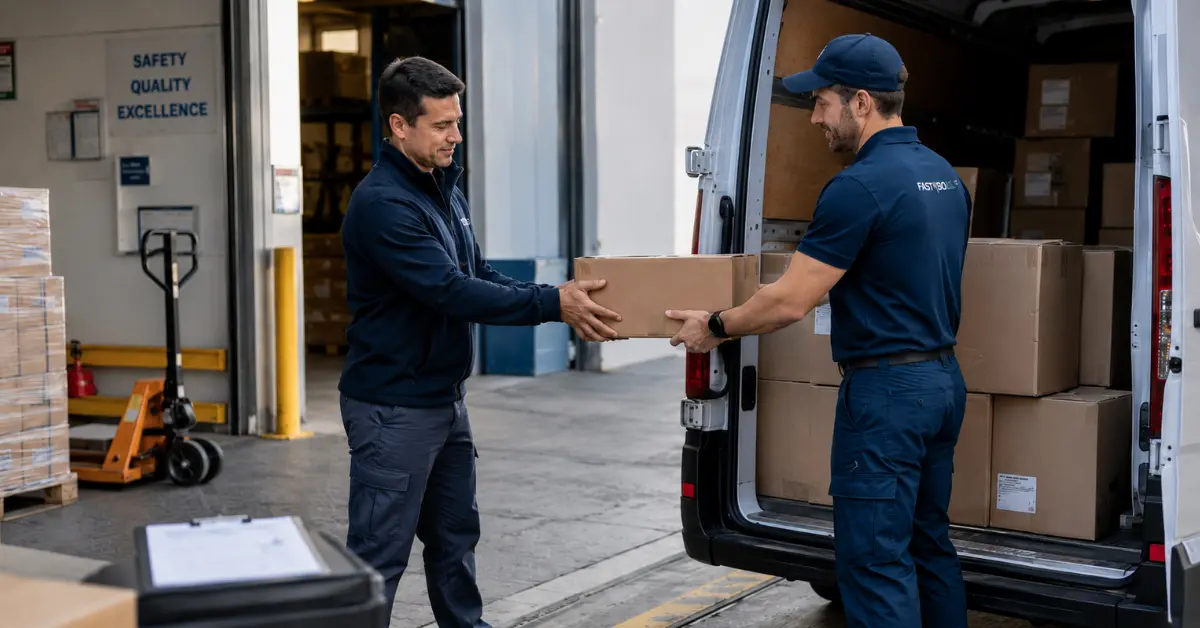
The brands that consistently meet their delivery promises are not necessarily the ones with the fastest warehouse teams or the best carrier contracts. They are the ones that have closed the gap between those two functions so the handoff is clean, the data is shared, and when something does go wrong, both sides can see it and respond before the customer notices.
Ecom Logistics operates fulfillment centres across North America with a delivery network that connects directly to the same operation, giving brands a single point of accountability across the full order to door journey. So if the gap between your fulfillment and delivery operations is starting to show in your results, it’s time to get in touch with our team.
Frequently Asked Questions
Fulfillment covers everything inside the warehouse: receiving, storing, picking, packing, and handing orders to a carrier. Delivery begins at that carrier handoff and covers routing, transit, last-mile execution, and proof of delivery. They are distinct functions with different owners, and treating them as one is where most operational problems begin.
The most common cause is a timing mismatch. Fulfillment teams that do not build workflows around carrier cutoff windows regularly miss dispatch slots. Orders that were picked and packed correctly still arrive late because they sat overnight in the warehouse after missing collection. Inaccurate manifests passed to carriers compound the problem further along the chain.
The fulfillment process ecommerce operations rely on covers inventory receiving, storage, order processing, pick and pack, labelling, and carrier handoff. It ends when the package leaves the warehouse. Everything before that is a fulfillment responsibility. Everything after it belongs to delivery operations.
Fulfillment errors such as incorrect weights on manifests, wrong addresses, or late carrier handoffs directly create problems in the delivery layer. Carriers cannot correct information they were never given accurately. The result is surcharges, routing delays, failed deliveries, and customer complaints that trace back to a fulfillment failure the delivery team had no visibility into.
Direct-to-consumer shipping means brands ship individual orders directly to end customers rather than through retail intermediaries. In this model, the entire order journey is the brand’s responsibility. There is no retail buffer to absorb a missed carrier window or a manifest error, which makes fulfillment and delivery alignment structurally more critical.
The most effective steps are building fulfillment schedules around carrier cutoffs, integrating warehouse and carrier systems so data is shared in real time, creating a defined returns process both functions own, and establishing shared metrics that create accountability across the handoff rather than stopping at the dock door.
It means a warehouse management system and a carrier platform sharing data in real time. When an order is marked ready in the WMS, the carrier knows immediately. When a delivery exception occurs, the warehouse team sees it without having to chase it. This removes the information gaps that produce most manifest errors, surcharges, and tracking blind spots.
For most scaling brands, yes. When fulfillment and delivery are managed by the same partner, the handoff is internal, data flows automatically, and accountability does not fall into the gap between two separate vendors. It is one of the most structurally reliable ways to close the misalignment problems this blog covers.
- About the Author
- Latest Posts