Sustainability in last mile delivery used to be a brand values conversation. But it has now become an operational one. Consumers are paying attention to how their orders arrive, not just how quickly, and the brands that have built a sustainable last mile delivery strategy are finding that the operational changes involved do not necessarily increase costs. In many cases, they reduce them.
This blog covers what a genuinely sustainable last mile delivery strategy looks like in practice, which levers actually move the needle on both emissions and cost, and how to build one without compromising delivery performance. If you are already familiar with the biggest last mile delivery challenges facing ecommerce brands, you will recognise most of these as problems that sustainability-focused improvements help solve rather than create.
What a Sustainable Last Mile Delivery Strategy Actually Involves
The word sustainable gets applied loosely in logistics. For the purposes of building a real strategy, it means three things operating together: reducing the environmental impact of deliveries, maintaining or improving delivery performance, and doing both without meaningfully increasing cost per order.
Those three objectives are more compatible than most brands assume. The inefficiencies that drive up emissions in last mile delivery, excess vehicle miles, failed first-attempt deliveries, poor route density, are the same inefficiencies that drive up cost. A strategy that addresses them does both jobs simultaneously.
According to SmartRoutes’ analysis of last mile delivery data, 25% of consumers would switch retailers if green delivery options were unavailable, and 27% would pay a premium for sustainable shipping. The demand signal is real. The opportunity for ecommerce brands is to meet it through operational improvements rather than by adding a green surcharge customers will resent.
The Levers Behind Last-Mile Delivery Optimisation: What to Look for in a Delivery Partner
Most ecommerce brands do not operate their own delivery fleet. What they do control is which delivery partner they choose, and whether that partner has the infrastructure to deliver sustainably without passing the cost on. The questions below are what to ask when evaluating one.
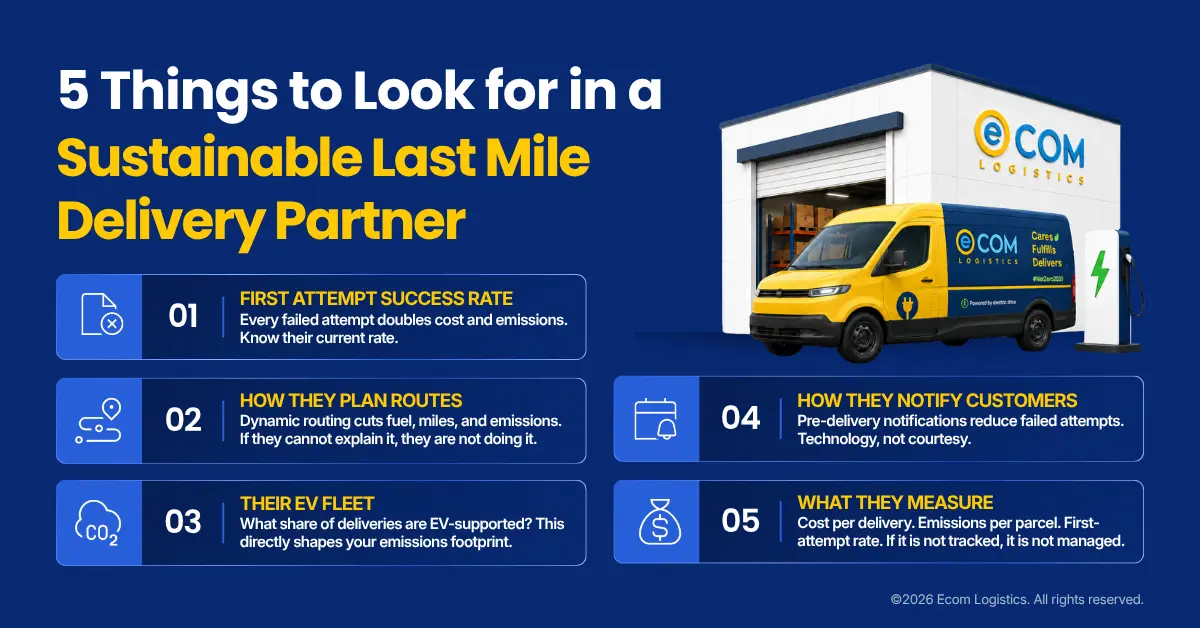
Does Your Delivery Partner Use AI-Powered Route Optimisation?
This is the single most impactful capability to ask about. A partner using dynamic route optimisation is actively reducing fuel consumption, cutting unnecessary miles, and lowering emissions per parcel on every run. A partner still working from static or manually planned routes is not.
The results of proper route optimisation are documented: McKinsey research cites 10 to 20% savings on transportation costs as consistently achievable through analytics-based optimisation. Ask your delivery partner directly: how do you optimise routes, and how does that change with volume? If the answer is vague, that is important information.
How Does Your Partner Handle Failed First-Attempt Deliveries?
Every failed delivery attempt doubles the vehicle miles and emissions required to complete that order. It also doubles the cost. A delivery partner with a strong first-attempt success rate, supported by proactive customer notifications, flexible delivery windows, and accurate address validation, is delivering a more sustainable and more cost-effective operation simultaneously.
Ask for their documented first-attempt delivery success rate. Ask how they communicate with recipients before a delivery arrives. What Canadian customers now expect from delivery in 2026 makes clear that proactive communication is the baseline, not a premium feature. A partner who cannot demonstrate it is costing you more than you realise.
Is Your Partner Transitioning to an Electric Vehicle Fleet?
An EV fleet reduces per-delivery carbon emissions directly, but it also eliminates fuel surcharge exposure and reduces vehicle maintenance costs over time. In Canada, federal and provincial EV incentive programmes have accelerated fleet transitions for logistics providers, and the cost differential between EV and fossil fuel delivery is narrowing.
Ask your delivery partner what percentage of their fleet is electric, which routes those vehicles operate on, and what their transition plan looks like. A partner with no EV capability and no transition plan is a liability as consumer expectations and regulatory pressure around sustainable delivery continue to grow.
Sustainable Last Mile Delivery: What It Costs to Get Wrong
The cost of an unsustainable delivery operation is not just environmental. It shows up in your carrier invoices, your failed delivery re-attempt costs, your fuel surcharges, and increasingly in your customer retention numbers as consumers actively factor delivery sustainability into their brand loyalty decisions.
“Sustainability and cost efficiency in last mile delivery are not competing priorities,” says Piyush Chojar, Director, Sales and Delivery at Ecom Logistics. “What we consistently see is that brands paying less per order are also the ones with the lowest emissions per parcel. The two outcomes are not in tension. They follow from the same operational decisions.”
According to SmartRoutes, AI-driven route optimisation has achieved up to 20% reduction in delivery costs across major logistics providers, and optimised routes can cut carbon emissions by 5 to 25%, with some documented fleet studies showing reductions of up to 40%. The financial and environmental cases are not separate arguments: they are the same argument.
Most brands already have the data to know where they are losing ground. The question is whether they are measuring the right things across both dimensions simultaneously. An operation tracking cost per delivery but not emissions per parcel, or tracking failed delivery rates but not re-attempt costs, is only seeing half the picture. The table below puts the full contrast in concrete terms, across every variable where an optimised operation consistently outperforms an unoptimised one.
Sustainable vs Unoptimized Last Mile Delivery: A Comparison
The gap between an optimised, sustainable delivery operation and an unoptimised one is measurable. As an ecommerce brand, these are the variables to evaluate when choosing a delivery partner.
| Criteria | What to Avoid | What to Look For |
| Route Planning | Manual or static routes with no dynamic adjustment | AI-powered optimisation that adapts in real time |
| Failed Delivery Management | Limited tracking, no exception alerts, reactive resolution | Real-time tracking, automated customer alerts, address verification technology |
| Fleet Type | Fossil fuel only, no transition plan | Active EV integration on high-density routes with a clear fleet roadmap |
| Emissions Tracking | No measurement, no reporting | Emissions per parcel tracked and reported transparently |
| Cost Per Delivery at Scale | Rising with volume, hidden surcharges | Declining through network efficiency, clear and predictable pricing |
| Customer Communication | Reactive, post-failure contact only | Proactive pre-delivery notifications as standard |
If your operation sits closer to the left column than the right on more than two of these, the gap is costing you money and emissions simultaneously. The good news is that the path from one column to the other does not require a complete operational overhaul. It requires a sequenced set of improvements, each of which pays for the next.
Building Your Sustainable Last Mile Delivery Strategy: Key Steps
Most brands approach this as a large infrastructure project and stall before starting. It does not have to be. The practical path is sequential, starting with the changes that deliver the fastest cost and emissions reduction and building from there.
The steps below outline that sequence. They are designed as a framework your team can evaluate against your current operation, not a checklist to complete in one quarter.
Sustainable Last Mile Delivery Strategy: Where to Start
- Audit your failed delivery rate – Calculate your current first-attempt delivery success rate. Every failed attempt is a direct cost and emissions multiplier. Even a 5% improvement compounds significantly at volume.
- Check how your partner plans routes – Ask your delivery partner how they optimise routes dynamically. This is the single highest-return capability to look for. If they cannot demonstrate it, it is worth reconsidering the relationship.
- Review your carrier mix – If you are using one carrier for all shipments, you are leaving both cost and efficiency gains on the table. Multi-carrier routing should be standard, not an upgrade.
- Ask about your partner’s EV fleet – Find out what share of their deliveries are EV-supported and which routes those cover. A partner with no EV capability and no transition plan is a gap worth flagging now.
- Find out how your partner communicates with customers – Ask specifically about pre-delivery notifications, flexible delivery windows, and address verification. These are technology capabilities your delivery partner should already have in place.
- Set measurable sustainability targets – Cost per delivery, emissions per parcel, and first-attempt delivery rate are the three metrics that tell you whether your strategy is working. Track them together.
A sustainable last mile delivery strategy is not a single decision. It is a series of operational improvements that compound over time.
Conclusion: The Right Sustainable Last Mile Delivery Strategy Is Already Paying for Itself
The brands building a sustainable last mile delivery strategy right now are not doing it at the expense of cost efficiency. They are doing it because the two goals are operationally aligned. Reduce delivery costs by optimising routes, cutting failed deliveries, and diversifying carriers, and you also reduce emissions. The investment in sustainability pays for itself through the operational improvements it requires.
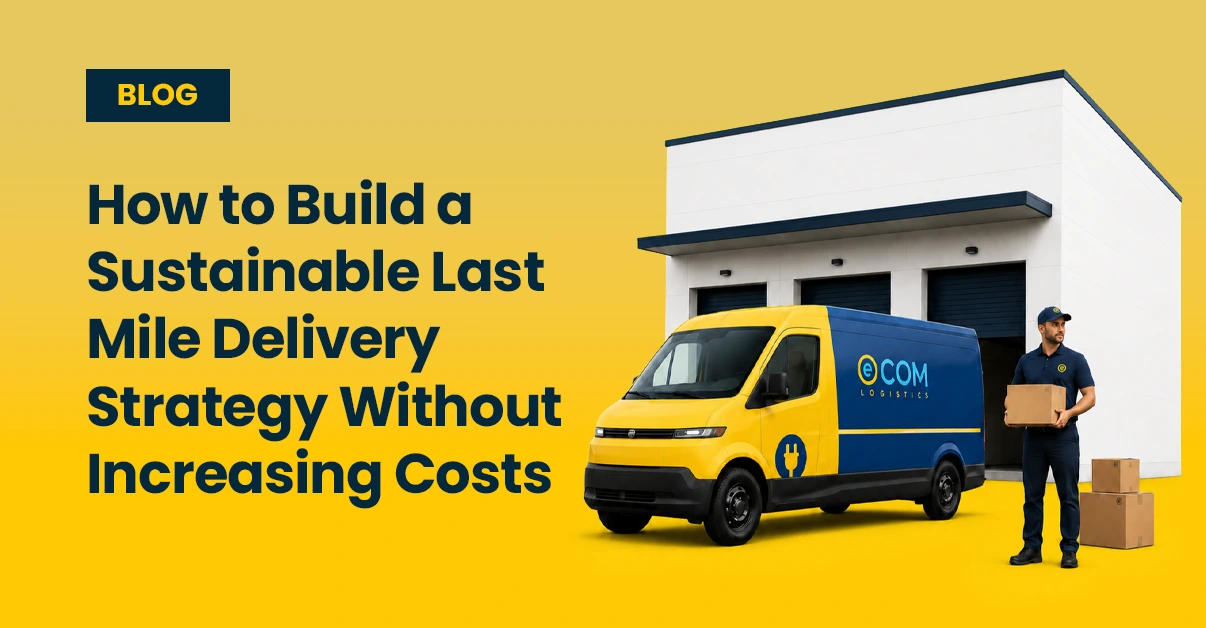
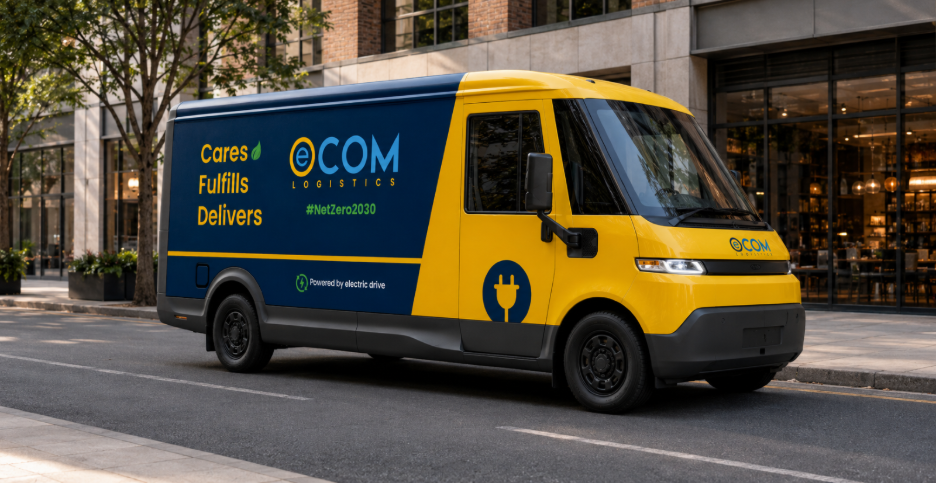
Ecom Logistics offers same-day and next-day last mile delivery across major Canadian cities, backed by a fleet of over 500 vehicles including a growing EV fleet that already delivers millions of packages with zero emissions. Delivery starts at $5 with no hidden fees, no fuel surcharges, and no peak load charges. Every shipment includes real-time tracking and proof of delivery integrated seamlessly through API and EDI connections. Each account is managed by a dedicated account manager, and all drivers are trained in-house, held to the same standard your brand is.
If that is the delivery standard your operation needs, talk to our team.
Frequently Asked Questions
A sustainable last mile delivery strategy is an operational approach that reduces the environmental impact of deliveries, primarily emissions and fuel consumption, while maintaining or improving delivery performance and cost efficiency. It typically involves route optimisation, electric vehicle integration, reduced failed deliveries, and multi-carrier routing.
Not necessarily, and often the opposite is true. The operational changes that reduce emissions, better route planning, fewer failed deliveries, smarter carrier selection, also reduce cost per delivery. The most sustainable operations tend to be the most cost-efficient ones.
Last-mile delivery optimisation refers to improving the efficiency of the final stage of the delivery journey, from depot to customer doorstep. It covers route planning, carrier selection, delivery density, and exception management. It matters because last mile delivery accounts for 53% of total shipping costs, making it the highest-leverage point for both cost and emissions reduction.
Route optimisation reduces fuel consumption, driver hours, and vehicle wear by sequencing deliveries more efficiently and dynamically adjusting for traffic, cancellations, and weather. Research from McKinsey cites 10 to 20% savings on transportation costs as achievable through analytics-based route optimisation. Fewer miles driven also means lower emissions per parcel.
Electric vehicles eliminate fuel costs and fuel surcharge exposure on the routes they serve, reduce maintenance costs over time, and directly cut per-parcel carbon emissions. They perform best on high-density urban routes where charging infrastructure is accessible. In Canada, federal and provincial EV incentive programmes also reduce the capital cost of fleet transition.
A failed first-attempt delivery doubles the vehicle miles and emissions required to complete that order. At a 15 to 25% failure rate, a significant portion of a delivery operation’s total emissions and costs are generated by re-attempts that proper pre-delivery communication and flexible delivery windows could have prevented.
A cost-effective delivery strategy combines dynamic route optimisation, multi-carrier routing, high first-attempt delivery rates, and a returns process that does not require unnecessary vehicle trips. At scale, working with a delivery partner that has already built this infrastructure typically produces a lower per-order cost than managing it in-house.
The most effective approach is optimising delivery route efficiency within your existing network before making capital investments. Dynamic route planning, improved pre-delivery communication to cut failed attempts, and carrier diversification are all changes that reduce cost without affecting delivery speed. For brands scaling nationally, a delivery partner with existing route density and EV capability in key Canadian cities removes the infrastructure cost of building this independently.
- About the Author
- Latest Posts