The delivery partner you choose is one of the most consequential operational decisions your ecommerce business makes. It is also one of the most underestimated. Most brands spend months selecting a fulfillment centre but hardly enough to select who actually delivers the order to the customer’s door. And that imbalance shows up quickly.
Choosing a last mile delivery provider is not just a logistics decision. It is a customer experience decision as 98% of consumers say that the delivery experience impacts their brand loyalty. The provider you choose is the last interaction your brand has with the customer on every single order. Getting it wrong is expensive in ways that go well beyond re-delivery costs.
So if you are currently evaluating your options, understanding the biggest last mile delivery challenges brands face is a useful starting point before diving into provider comparisons. This blog gives you the seven questions to ask before signing with anyone.
Choosing a Last Mile Delivery Provider: Why the Right Questions Matter
Most brands go into delivery partner conversations focused on price. That is understandable, but price is also the easiest variable for a provider to present favourably. The questions that actually reveal whether a provider will perform for your business are the ones about technology, transparency, scalability, and what happens when things go wrong.
62% of consumers hold the retailer fully or jointly responsible when deliveries go wrong, regardless of which delivery provider actually handled the order. That means your provider’s failure becomes your brand’s problem in the eyes of your customer, every single time. What Canadian customers now expect from delivery makes it clear that the bar is high and rising. The seven questions below are designed to surface the providers who can meet it from those who cannot.
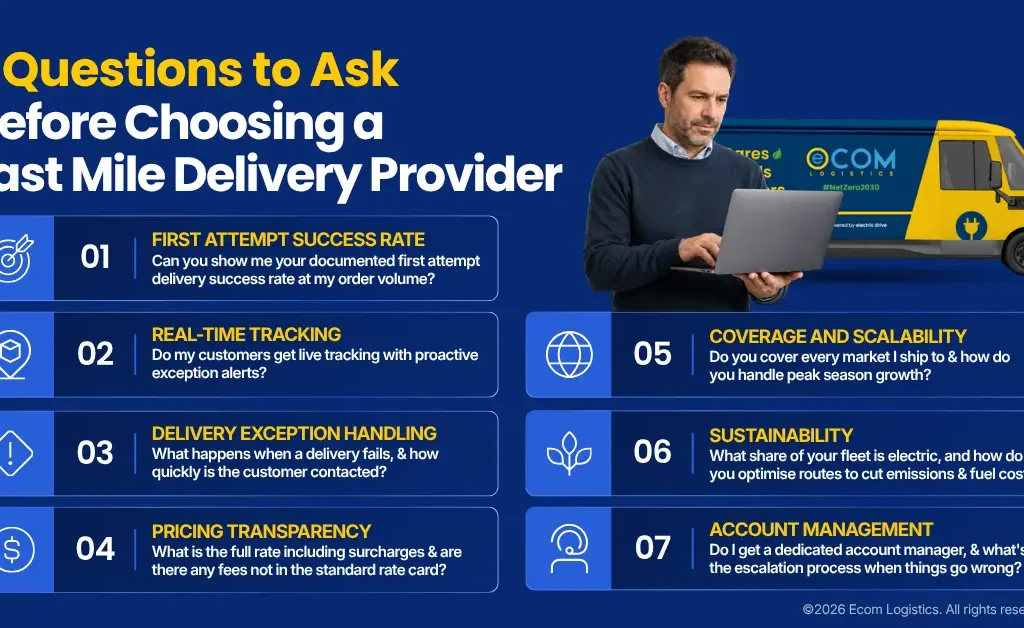
Question 1: What Are Your First Attempt Delivery Success Rates?
This is the single most revealing metric you can ask for. A provider with a high first attempt delivery success rate has the address verification technology, the pre-delivery communication infrastructure, and the route planning capability to get it right the first time. A provider who hedges on this number, or cannot produce documented data, is telling you something important.
Industry benchmarks for well-run operations sit above 95%. Top performers consistently achieve 98% and above. Ask for the rate at your expected volume and in your specific delivery markets. A number that looks strong nationally can look very different in the specific cities you ship to most. For more detail on what drives first attempt success rates and how to evaluate them, the guide to reducing failed deliveries covers the operational factors in depth.
Question 2: What Does Your Real-Time Tracking and Visibility Look Like?
Customers who cannot see where their order is will contact your support team. That is a predictable, scalable cost that compounds with every order you ship. Real-time tracking is not a feature: it is the operational baseline for any delivery provider worth considering in 2026.
Ask specifically: what does the tracking experience look like for the customer? Is it a branded notification with a live map, or a generic carrier link that updates infrequently? Do you receive exception alerts when a delivery stalls, before the customer contacts you, or after? A provider with genuine real-time visibility infrastructure removes an entire category of customer service overhead from your operation.
Question 3: How Do You Handle Delivery Exceptions and Failed Attempts?
Every delivery operation produces exceptions. Packages that cannot be delivered, addresses that cannot be found, recipients who are unavailable. The question is not whether exceptions happen but what the provider does when they do.
Ask for the process: what triggers an exception alert, who is notified, how quickly, and what options are available to resolve it before a second attempt is required? A provider that contacts the customer proactively before a failed attempt, and gives them a way to redirect or reschedule, will produce a meaningfully better customer experience and a lower re-delivery cost than one that simply attempts again tomorrow with no intervention.
Question 4: What Is Your Pricing Structure, and Are There Hidden Fees?
The headline rate is rarely the total cost. Fuel surcharges, peak season surcharge, residential delivery fees, and address correction fees can add meaningfully to what looked like a competitive per-delivery rate. Ask for the full rate card, including every surcharge that could apply to your typical order profile, before comparing providers on cost.
The most reliable delivery partners price transparently. No fuel surcharges, no peak surcharge, no surprises on invoice. That transparency is itself a signal: it tells you the provider is confident enough in their base rate to stand behind it without addenda.
Question 5: What Coverage Do You Offer and How Does It Scale with My Business?
A delivery provider that performs well in your current primary market does not automatically do so with future markets as well. Ask specifically about coverage in every province or city you currently ship to and every market you plan to enter in the next twelve months.
Ask also about peak season growth. Order volumes can spike sharply around events like Black Friday and the holiday season, and a provider that handles your day-to-day volume well may still struggle when demand suddenly triples. Find out how they add capacity during these periods, whether that means more drivers, more vehicles, or additional sortation support, and ask for examples of how they managed a recent peak season without a drop in service levels.
Question 6: What Does Your Sustainability Profile Look Like?
This is no longer a nice-to-have question. Consumer expectations around sustainable delivery are rising consistently, and the brands that can offer carbon-neutral or EV-supported delivery options are already differentiating on it. Ask what share of the provider’s fleet is electric, which routes those vehicles cover.
A provider with a credible EV transition plan and documented emissions data can help your brand meet its own sustainability commitments and communicate them to customers. One with no EV capability and no plan is a gap that will matter more, not less, as time goes on.
Question 7: What Does Account Management Look Like After We Sign?
This is the question most brands forget to ask, and the one that most directly affects their day-to-day experience of the relationship. Ask whether you will have a dedicated account manager. Ask how exceptions are escalated and who your first point of contact is when something goes wrong. Ask how proactively the team communicates rather than waiting for you to raise issues.
A provider that assigns you a dedicated account manager who knows your operation, flags problems before they reach your customers, and communicates proactively is a fundamentally different experience from one that routes every issue through a support ticket system. The difference is not visible on a rate card. It becomes visible on the first day something goes wrong.
The 7 Questions: A Quick Reference
How Providers Compare: What Good Looks Like
| Criteria | Provider to Avoid | Right Last-Mile Delivery Partner |
| First attempt success rate | Cannot provide documented data | 95%+ with order-level reporting available |
| Tracking and visibility | Generic carrier link, infrequent updates | Real-time branded tracking with exception alerts |
| Exception handling | Re-attempt next day, no proactive contact | Customer contacted before failed attempt |
| Pricing | Low headline rate with multiple surcharges | Transparent all-in rate, no hidden fees |
| Coverage | Strong in one market, gaps elsewhere | Multi-city national coverage with owned fleet |
| Sustainability | Fossil fuel only, no transition plan | Active EV fleet with emissions reporting |
| Account management | Ticket-based support system | Dedicated account manager, proactive communication |
Conclusion: The Best Last Mile Delivery Provider Is the One That Checks All Seven Boxes
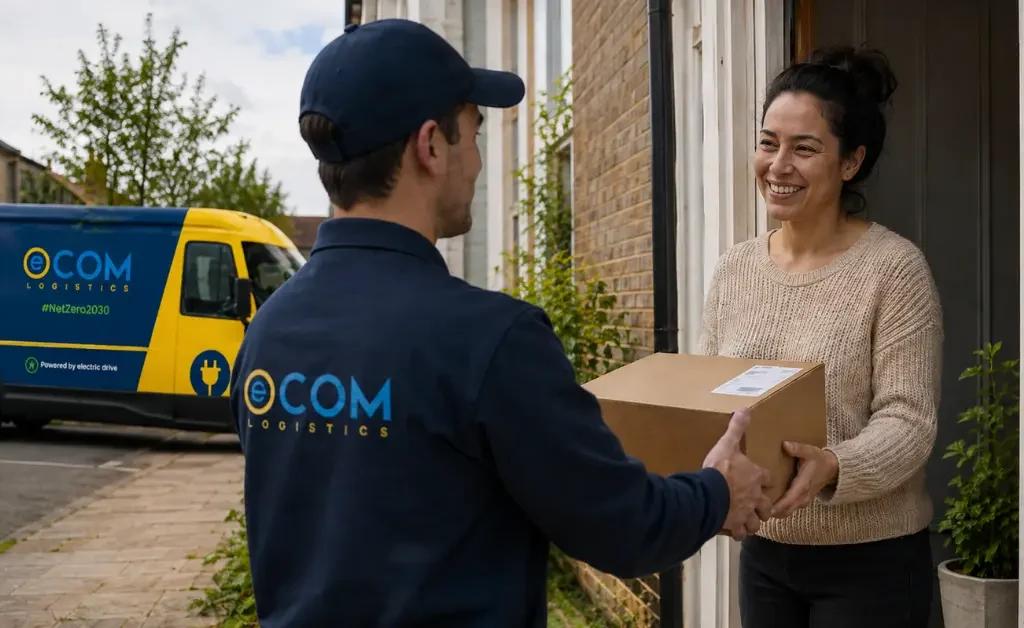
Ecom Logistics offers same-day and next-day last mile delivery across major Canadian cities, backed by a fleet of over 500 vehicles including a growing EV fleet for brands focused on sustainability. Same day delivery starts at as low as $5 with no hidden fees, no fuel surcharges, and no peak load charges. Every shipment includes real-time tracking, proof of delivery, and signature services as standard. Each account is managed by a dedicated account manager, and all drivers are trained in-house, held to the same standard your brand promises its customers.
Every question in this blog is one we answer confidently, with data. Talk to our team.
Frequently Asked Questions
The most important criteria are first attempt delivery success rates, real-time tracking capability, transparent pricing with no hidden surcharges, geographic coverage across your key markets, scalability as your volume grows, sustainability credentials, and dedicated account management. Price matters, but it should be evaluated in the context of total operational cost, not headline rate alone.
Ask for documented data on first attempt delivery success rates, on-time delivery performance, and exception handling response times. A credible provider will have this data and share it without hesitation. If a provider cannot produce performance data at your expected volume, treat that as a meaningful signal.
The seven questions in this blog cover the most important ground: first attempt success rate, tracking and visibility, exception handling, pricing transparency, coverage and scalability, sustainability profile, and account management structure. These questions go beyond the sales presentation and surface how the operation actually performs.
Because 98% of consumers say delivery experience impacts their brand loyalty, and 62% hold the retailer responsible when deliveries go wrong, regardless of which provider handled it. Your delivery partner’s performance is your brand’s performance in the customer’s eyes. A provider that misses delivery windows, fails to communicate exceptions, or hides fees in surcharges directly costs you repeat purchases.
Ask about coverage in every market you currently ship to and every market in your twelve-month growth plan. Ask about carrier network depth and whether they own their fleet or rely on subcontracted drivers. Ask specifically how their service level changes at higher volumes and during peak season. A provider that cannot give confident answers to these questions is unlikely to scale with you smoothly.
Well-run last mile delivery operations consistently achieve first attempt success rates above 95%, with top performers at 98% and above. A rate below 90% indicates systemic issues with address verification, customer communication, or route planning that will directly affect your customer experience and your cost per delivery.
Yes. Fuel surcharges, peak load charges, residential delivery fees, and address correction fees are common additions to base delivery rates. Always ask for the full rate card including every applicable surcharge before comparing providers on cost. The total cost at your expected volume and order profile is the number that matters, not the headline per-delivery rate.
Increasingly important. Consumer expectations around eco-friendly delivery are rising, and brands that can offer EV-supported or carbon-neutral delivery options are already using it as a differentiator. Ask about the provider’s EV fleet share, which routes are covered, and whether they can provide emissions reporting. A provider with no EV capability and no transition plan is a gap worth factoring into a long-term partnership decision.
- About the Author
- Latest Posts