
Every failed delivery costs more than most ecommerce brands account for. There is the re-attempt cost, the customer service time, the delay to the customer, and the compounding effect on your relationship with the carrier. What rarely gets calculated is the customer retention impact: the order that was supposed to build loyalty and instead created frustration.
Being able to reduce failed deliveries is one of the highest-leverage improvements an ecommerce brand can make to its last mile operation, and it does not require a complete infrastructure overhaul. It requires understanding where failures come from and making deliberate choices about the delivery partner and processes designed to prevent them. Understanding the biggest last mile delivery challenges is the right starting point before tackling first attempt success rate specifically.
This blog covers why failed deliveries happen, what they actually cost, and the practical steps that move the needle on your first attempt delivery success rate.
Why Reducing Failed Deliveries Should Be a Business Priority
A failed delivery is not just an operational inconvenience. It is a cost event that multiplies. Each unsuccessful delivery attempt costs retailers an average of $17.78, according to Opensend’s analysis of shipping cost data. That figure covers the re-attempt transport cost, driver time, and administrative handling, but it does not include the customer service interaction that often follows, the refund or compensation that sometimes results, or the likelihood that the customer does not order again.
Failed deliveries sit at the intersection of customer experience and operational cost in a way that makes them unusually damaging. The customer sees a brand that could not deliver on its promise. The brand absorbs a cost with no corresponding revenue. And the carrier relationship takes a hit every time a re-attempt is required.
For brands that have invested in understanding what Canadian customers expect from delivery in 2026, the message is consistent: visibility, reliability, and communication are non-negotiable. A failed first attempt undermines all three simultaneously.
The Most Common Causes of Last Mile Delivery Failure
Knowing what drives last mile delivery failure is the first step to reducing it. The causes fall into a predictable set of categories, and most of them are addressable before the van leaves the depot.
Inaccurate or Incomplete Address Data
This is the most preventable cause of failed deliveries and one of the most common. An address that is missing an apartment number, contains a formatting error, or was entered incorrectly at checkout will produce a failed attempt regardless of how well everything else is managed. The driver arrives, cannot locate the recipient, and the package comes back.
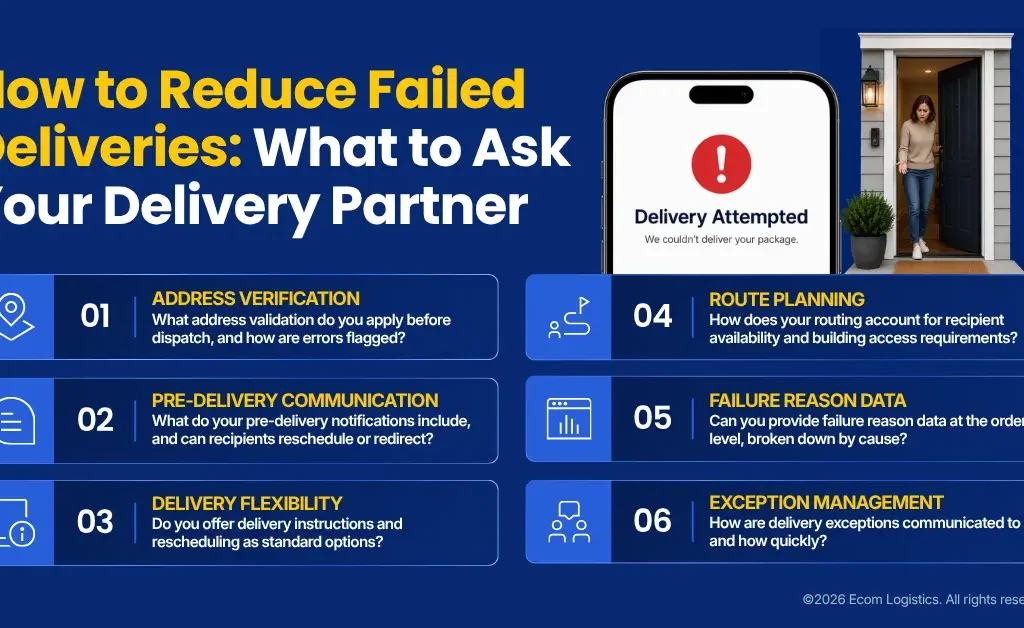
Address validation at the point of checkout, combined with carrier-level verification before dispatch, catches the majority of these errors before they become failed deliveries. This is a technology question to ask your delivery partner: what address verification is applied before each shipment is dispatched?
No Pre-Delivery Communication with the Recipient
A recipient who does not know a delivery is coming cannot make themselves available for it. This sounds obvious, but a significant share of failed deliveries happen simply because the customer was not informed in advance with enough specificity to act on it.
Pre-delivery notifications with a delivery window, not just a tracking link, allow recipients to plan around their order. When customers can reschedule, redirect, or provide delivery instructions, first attempt success rates improve materially. What Canadian customers now expect from delivery makes clear that proactive, specific communication before delivery is no longer a premium feature. It is the baseline.
Rigid Delivery Windows without Delivery Instructions Option
A delivery window that the customer cannot influence is a delivery window that will frequently be missed.
Flexible delivery options, including delivery instructions and rescheduling through a customer-facing portal, directly reduce failed attempt rates by giving recipients options rather than forcing a binary outcome. When to offer same-day, next-day, and scheduled delivery is directly connected to this: the delivery promise and the delivery window need to be calibrated to what customers can actually plan around.
Poor Route Planning and Timing
A driver arriving outside the expected delivery window, particularly outside business hours or during a window when the recipient is predictably unavailable, produces avoidable failures. Route planning that does not account for recipient availability patterns, building access requirements, or time-sensitive delivery windows will generate a failure rate that no amount of re-attempts will sustainably resolve.
This is where your delivery partner’s operational infrastructure matters. Dynamic route optimisation that sequences deliveries based on recipient data and access requirements, not just geographic efficiency, reduces failed attempts at the planning stage before any van leaves the depot.
What Your First Attempt Delivery Success Rate Is Telling You
Your first attempt delivery success rate is one of the clearest indicators of overall delivery operation health. A rate below 90% means more than one in ten deliveries is failing on the first attempt, each generating an average of $17.78 in additional cost and a customer experience that is already compromised before the second attempt is made.
According to SmartRoutes’ delivery success rate data, industry benchmarks for well-run last mile operations sit above 95%, with top performers consistently achieving 98% and above. The gap between a 90% and a 98% first attempt success rate is not marginal at volume. It is a meaningful cost and customer retention difference that compounds with every order.
“The first attempt success rate is the single metric that tells us the most about how well a delivery operation is actually functioning,” says Yash Chojar, Director – Sales and Delivery at Ecom Logistics. “When it drops, it is almost never one thing. It is usually a combination of address data quality, communication timing, and route planning all contributing simultaneously. The fix requires looking at all three, not just the one that is most visible.”
How to Improve Your First Attempt Delivery Success Rate
Improving your first attempt delivery success rate is not a single fix. It is a set of decisions, most of them made before an order is ever dispatched, that either set a delivery up to succeed or leave it vulnerable to failure. The sections below cover the interventions that move the needle most consistently, framed around what to look for and what to ask when evaluating your current or prospective delivery partner.
Choose a Delivery Partner with Address Verification Technology
Before evaluating anything else, ask your delivery partner specifically about address verification. What system do they use? At what point in the process is an address flagged as potentially invalid? What happens when an error is detected?
A delivery partner with robust address verification built into their dispatch process eliminates the most preventable category of failed delivery solutions before the order reaches a driver.
Require Pre-Delivery Notifications as a Standard
Pre-delivery notifications should not be optional or add-on. They should be standard in any delivery partner relationship. Ask specifically: what does the notification include, when is it sent, and does it give the recipient an option to reschedule or add delivery instructions, or change address.
A notification that says “your package is on its way” without a delivery window or any actionable option does not meaningfully reduce failed attempts. A notification that specifies a two-hour window and gives the recipient a link for delivery instructions or rescheduling does.
Build in Flexible Delivery Options
Delivery instructions and rescheduling capability are the options that do the most work in reducing failed delivery solutions at the recipient level. If your current delivery setup does not offer any of these as standard, a meaningful share of your failed attempts are structurally unavoidable until they are in place.
Track Your Failed Attempt Data by Category
Most ecommerce brands know their overall failed delivery rate. Far fewer track what is causing the failures. Address errors, recipient unavailability, access issues, and carrier timing failures all require different interventions. Without that breakdown, you are treating the symptom rather than the cause.
Ask your delivery partner for failure reason data at the order level. If they cannot provide it, you do not have the visibility to improve delivery success rate systematically.
Failed Delivery Rate: What Separates High and Low Performers
The difference between a delivery operation with a 90% first attempt success rate and one with a 98% rate is not luck. It is a set of deliberate operational decisions made consistently. The table below shows where those decisions sit.
| Factor | High Failure Rate Operation | High First Attempt Success Rate |
| Address verification | Manual or none | Automated at checkout and pre-dispatch |
| Pre-delivery notification | Basic tracking link only | Specific window with actionable options |
| Delivery flexibility | Fixed window, no alternatives | Delivery instructions, rescheduling |
| Route planning | Geographic efficiency only | Recipient availability and access data included |
| Failure reason tracking | Overall rate only | Categorised by failure type per order |
| Re-attempt process | Standard re-attempt, no intervention | Outbound contact before second attempt |
| Carrier communication | Reactive, post-failure | Proactive exception alerts in real time |
Sustainable Delivery and Failed Deliveries Are the Same Problem
It is worth noting that reducing failed deliveries is also one of the most direct ways to reduce the environmental impact of your delivery operation. Every failed attempt means a vehicle that has already made the journey needs to make it again. At scale, the emissions impact of a 10% failed delivery rate is significant.
This is one of the reasons building a sustainable last mile delivery strategy and reducing failed deliveries point to the same operational improvements: better communication, better route planning, and better flexibility at the recipient level. The two goals reinforce each other rather than competing.
Conclusion: The Brands Winning on Delivery Are the Ones Getting It Right Before the Van Left
A high first attempt delivery success rate is not just an operational metric. It is a customer experience metric, a cost efficiency metric, and increasingly a sustainability metric. Brands that get this right are not spending more on delivery. They are recovering costs that were previously being absorbed invisibly in re-attempts, customer service, and churn.
Ecom Logistics offers same-day and next-day last mile delivery across major Canadian cities with real-time tracking, automated pre-delivery notifications, flexible delivery options including delivery instructions and rescheduling, and address verification built into every dispatch. Our first attempt delivery success rates consistently outperform industry benchmarks, and every account includes a dedicated account manager who flags exceptions before your customers notice them.
If reducing failed deliveries is a priority for your operation right now, talk to our team.
Frequently Asked Questions
The most common causes are inaccurate or incomplete address data, recipients not being informed of a delivery window in advance, rigid delivery options with no flexibility for delivery instructions or rescheduling, and route planning that does not account for recipient availability. Most failed deliveries are preventable with the right delivery partner infrastructure.
Each failed delivery attempt costs retailers an average of $17.78 in direct costs, covering re-attempt transport, driver time, and administrative handling. This does not include customer service interactions, potential refunds, or the customer retention impact of a failed delivery experience.
Industry benchmarks for well-run last mile operations sit above 95%, with top performers consistently achieving 98% and above. A rate below 90% indicates systemic issues with address data, communication, or delivery flexibility that require targeted intervention.
Pre-delivery notifications with a specific delivery window and actionable options, such as the ability to reschedule, redirect, or provide delivery instructions, allow recipients to plan around their delivery. This directly reduces the share of failures caused by recipient unavailability, which is one of the most common failure categories.
The highest-impact interventions are: address verification at checkout and pre-dispatch, pre-delivery notifications with specific windows and recipient options, flexible delivery alternatives including delivery instructions and tracking failure reasons by category rather than overall rate only.
Address errors are one of the most preventable causes of failed deliveries. Automated address verification at the point of checkout and again before dispatch catches formatting errors, missing apartment numbers, and invalid addresses before they produce a failed attempt. A delivery partner with this capability eliminates the most avoidable category of last mile delivery failure.
When recipients can provide delivery instructions or reschedule before the delivery window, the share of failures caused by unavailability drops significantly. Flexibility removes the binary outcome of “recipient available or failed attempt” and replaces it with a set of alternatives that keep the first attempt successful even when the recipient cannot be present.
Yes. Every failed first attempt means a vehicle repeats a journey it has already made, doubling the fuel consumption and emissions for that order. Reducing failed deliveries is one of the most direct ways to lower the environmental impact of last mile delivery operations, which is why it sits at the centre of most sustainable last mile delivery strategies.
- About the Author
- Latest Posts